
Best Hedge Funds 2026: Top Quants, Activists, and High-Return Managers

The Best Hedge Funds for Exceptional Investment Returns
Quants, macro masters, activists — and one Omaha legend. A living list, updated regularly.
Latest changes:
- Continuously updating each hedge fund profile with fresh long-form research, performance reviews, portfolio analysis, and new coverage.
- Updating Citadel (October 7, 2026)
-
Added Michael Burry (who closed Scion Asset Management to outside investors but is still actively trading) to the list (Updated October 1, 2026)
- Evaluating addition of Ariel Investments, Man Group, other funds, and Fidelity Contrafund (FCNTX), a mutual fund whose performance has been remarkable over the years, as another benchmark.
- Added Stephen Mandel Jr./Lone Pine Capital, Larry Robbins/Glenview Capital Management, Baron/Baron Capital, Steven Cohen/Point72 Asset Management, Mario Gabelli/GAMCO Investors, Howard Marks/Oaktree Capital management, David Einhorn/Greenlight Capital, Li Lu/Himalaya Capital, Seth Klarman/The Baupost Group, David Abrams/Abrams Capital Management, Daniel Loeb/Third Point, ValueAct Capital, David Tepper/Appaloosa LP Holdings, Fisher Investments, John Paulson/Paulson & Co, and Baillie Gifford to the list in April-September 2026.
- Adding internal links to Insider Purchases, Value, Growth/IPOs, and International hubs.
This living list is reviewed weekly, monthly, and quarterly. Profiles may be refined as new filings, letters, or performance disclosures come in.
Quick heads-up: We’re refreshing and reorganizing this living list to make it even sharper, clearer, and more fun to navigate. You may see the furniture move around a bit this week — promise we won’t break anything.
Top-of-page sponsor placement Reserved for one sponsor per month — learn more.
Disclosure: This page may include affiliate links. This is research, not advice.
Start Here
A quick orientation before you dive into the fund list.
Introduction
Selecting the right hedge funds can be a game-changer for your portfolio. This guide compiles a living and growing list of leading firms, managers and investing legends that have consistently (or close enough) delivered exceptional performance.
We’ll cover performance history, leadership, portfolio themes and top holdings, what investors love (and should watch), plus practical takeaways for individuals.
Why trust these reviews?
- 30+ years around markets: I’ve seen deep drawdowns, bull runs, wins and whiffs — and learned from all of it.
- Studying the pros matters: managers like Warren Buffett, Ray Dalio, Ken Griffin, Jim Simons, Cliff Asness, Bill Ackman, Carl Icahn, etc., have durable edges worth understanding and emulating.
- I’m the founder of FUNanc1al (funanc1al.com), MLI (ml-inc.com), and other ventures; clients/prospects have included tech/fintech/biotech institutions and some of the funds listed here. Yale and Harvard grad. You can find my bio here and follow me on X here.
- Truly passionate about public and private investing and entrepreneurship. Finding the next 100-bagger can't hurt! Yes, welcome to the club :)
What we compare
- Strategy & risk framework
- Manager reputation & firm longevity
- Portfolio quality & key holdings
- Investment rationale & positioning
- Fees, minimums, and access constraints
Navigation
Jump to any fund, then open full reviews where it matters.
Table of Contents
Sponsored section SPONSOR THIS HEDGE FUND HUB — Reach investors who spend up to 10 minutes on this page.
Daily Hedge Fund Radar (New Links)
Short daily notes + links to new posts that expand this living list (filings, letters, new positions, big exits, and “what it means for regular humans”).
✨ Latest drops
- October 6, 2026 — The Hedge Funds Crushing It in 2026—and the Danger of Copying Them 📊🔥
- October 5, 2026 — Inside Citadel’s $170B+ 13F: How Ken Griffin Manages Thousands of Positions Without Betting the Farm
- September 24, 2026 — 🎸 Michael Burry After Scion: His AI Short, 2027 Puts & New Value Picks 🐻📊
- September 13, 2026 — 🌲 Lone Pine Capital: Inside Steve Mandel’s $25B Tiger Cub Masterclass (+43% Surge in 1H 2026) 🏹
- September 4, 2026 — 🏒 Glenview Capital & Larry Robbins: The $5.5B “Hockey Jersey” Hedge Fund Slashing Wall Street 🏥⚡
- August 28, 2026 — 🚀 The House of Elon & Patience: Inside Ron Baron’s Compounding Engine 🪐🎢
- August 18, 2026 — ⚾ Steve Cohen's Point72: Inside the $58.5B Alpha Factory, "Hogwarts" for Analysts, and the $3.4B Payday 💰📈
- August 3, 2026 — 🏛️ Mario Gabelli & GAMCO Investors: Inside the 14.1% Compounding Machine, PMV Investing, and the $11.2 Billion Value Vault
- July 27, 2026 — 🏰 Howard Marks & Oaktree Capital: The Art of Second-Level Thinking and Risk-Control Investing
- July 21, 2026 — 🃏 David Einhorn & Greenlight Capital: Inside the Poker-Playing Short-Slayer's $3.2B Value Engine
- July 14, 2026 — 🏔️ Li Lu & Himalaya Capital: The Art of Doing Nothing Exceptionally Well
- June 15, 2026 — 🏰 The Baupost Restoration: Seth Klarman's Cash Castle, The 4% Drag, and the Largest Restructuring in 42 Years
- May 18, 2026 — 🤫 ValueAct Capital Portfolio 2026: The Quiet Activist Fund Rewiring Corporate America
- May 2, 2026 — 🎩 Pershing Square USA (PSUS): IPO Drop, Insider Skill & the Ackman Question
- April 30, 2026 — 🐎 David Tepper’s Appaloosa Portfolio 2026: The 153% Return Playbook
- April 4, 2026 — Baillie Gifford (BGKEX): 40% Returns, 7-Year Bets — Is This the Ultimate EM Growth Fund? 🌏
- Jan 26, 2026 — Principles of Prosperity: How Bridgewater’s AI-Driven “Machine” Built a Fortress in 2025
- Jan 25, 2026 — Citadel’s 2025 Scorecard: No Fireworks, Just Relentless Discipline
Open recent archive
Want the daily radar in your inbox? Join the FUNanc1al newsletter.
Replicate the Feel: 6 Hedge Fund Playbooks (Retail Edition)
Best Hedge Funds: Profiles
Skim the cards, then open the full reviews for the ones that match your interest or style.
1. Citadel LLC
Structure: Hedge fund (Multi-strategy / Quant-heavy) • Updated: May 2026
At-a-glance
- Edge: World-class research, quantitative analytics, and elite risk controls power a diversified “pod shop” machine where autonomous portfolio teams trade across global asset classes using comprehensive (sometimes alternative) datasets, speed, and relentless stress-testing.
- Watch-outs: Access is limited, fees are premium, and performance can occasionally be lumpy. Citadel also employs sophisticated—and sometimes heavily leveraged—strategies such as the Treasury “basis trade,” meaning regulatory shifts or violent moves in government debt (or other) markets can pressure specific parts of the machine.
- Great for: Institutions, allocators, and retail “idea miners” fascinated by risk management. Citadel’s centralized oversight ensures no single trader can sink the ship. Capital is aggressively allocated—or pulled—based on performance and risk limits. A reminder most investors learn the hard way: survival matters.
Quick stats
- AUM: ~$67 billion (remarkable considering Ken Griffin launched Citadel with less than $1 million and still owns roughly 85% of the firm).
- Minimum: Typically institutional / restricted access
- Fees: Premium management + performance fees (varies by strategy; see detailed section below)
Fred’s Take: One of the few financial supercomputers capable of converting chaos into basis points—until the chaos converts back. Not for the faint of heart, but few firms match Citadel’s signal density when the engine is firing on all cylinders.
How to emulate (for individuals): Use diversified factor tilts, enforce strict risk rules, and remember that position sizing matters as much as stock picking (Citadel's portfolio lists > 7,200 holdings). Also note: Citadel frequently returns capital to investors to control fund size and preserve agility. Treat 13F filings as delayed, hedged context—not trading signals.
Notes & history (high level):
- Founded in 1990 by Ken Griffin, Citadel evolved into one of the world’s dominant multi-strategy hedge fund platforms spanning equities, credit, convertibles, commodities, and global macro.
-
The firm relies heavily on quantitative research, advanced technology, stress-testing, and institutional-grade risk infrastructure.
- Access remains highly selective, and investor terms are firmly in the “premium product” category.
Visit site · Read the full Citadel review
2. Bridgewater Associates
Structure: Hedge fund (Global Macro / Systematic) • Updated: Nov 2025
At-a-glance
- Edge: Deep macro research + systematic process; pioneered risk parity (All Weather).
- Watch-outs: Access limited; performance can be cycle-dependent; complexity isn’t for everyone.
- Great for: Institutions; retail “idea mining” on macro/risk-parity concepts.
Quick stats
- AUM: Verify current
- Minimum: Restricted / institutional
- Fees: Management + performance (varies by vehicle)
Fred’s Take: Macro chess, not checkers. When the process maps the regime, it hums; when the regime shifts abruptly, it stress-tests everyone’s convictions.
How to emulate (individuals): Risk-balanced allocation (stocks/bonds/commodities), humility about regimes, and rebalancing discipline.
Visit site · Read the full Bridgewater review
3. Renaissance Technologies
Structure: Hedge fund (Quant / Statistical Arbitrage) • Updated: Nov 2025
At-a-glance
- Edge: Dense data + advanced modeling; short-horizon signal extraction at scale.
- Watch-outs: Access essentially closed; the famed Medallion fund is internal only.
- Great for: Institutions via selected vehicles; retail “idea mining” on factor thinking and discipline.
Quick stats
- AUM: Verify current
- Minimum: Restricted / institutional
- Fees: Premium management + performance fees (by vehicle)
Fred’s Take: When your median holding period is basically “a long lunch,” discipline is the alpha. Signals fade; risk doesn’t—position sizing is everything.
How to emulate (individuals): Diversify factors, don’t chase micro-signals, and respect costs/turnover—most retail edges die in slippage.
Visit site · Read the full Renaissance review
4. Elliott Investment Management L.P.
Structure: Hedge fund (Activist / Multi-Strategy) • Updated: Nov 2025
At-a-glance
- Edge: Activist investing, distressed and non-distressed credit, complex arbitrage.
- Watch-outs: Typically closed to new investors; limited transparency; event-driven volatility.
- Great for: Investors studying activism, corporate turnarounds, and uncorrelated event trades.
Fred’s Take: One of the savviest activist funds alive—half negotiator, half tactician. Elliott creates value by outworking everyone else. It’s activism with spreadsheets, not slogans.
How to emulate (individuals): Focus on catalysts, special situations, and asymmetric trades where skill—not luck—drives outcome.
Visit site · Read the full Elliott review
5. Berkshire Hathaway Inc.
Structure: Conglomerate / Public Company • Updated: Nov 2025
At-a-glance
- Edge: Durable compounding machine; fortress balance sheet; unrivaled leadership record.
- Watch-outs: Slower growth from size; leadership succession risk.
- Great for: Long-term investors seeking exposure to quality businesses without fund fees.
Fred’s Take: Not technically a hedge fund—just the yardstick everyone else measures against. Buffett built a cash-flow cathedral; Munger designed the stained glass.
How to emulate (individuals): Buy quality, hold forever, read incessantly, and resist excitement.
Visit site · Read the full Berkshire review
6. Pershing Square Capital Management
Structure: Hedge fund (Concentrated Long/Short Equity) • Updated: Nov 2025
At-a-glance
- Edge: Concentrated, high-conviction bets; Buffett-style value with an activist twist.
- Watch-outs: Public visibility amplifies pressure; bold calls can backfire.
- Great for: Investors seeking transparency, deep dives, and lessons in conviction sizing.
Fred’s Take: Bill Ackman invests like Buffett—only louder, faster, and occasionally with fireworks. When he wins, he wins big; when he loses, it’s a masterclass in humility and risk management.
How to emulate (individuals): Own fewer stocks you truly understand, hedge intelligently, and remember: sometimes “doing nothing” is the hardest trade.
Visit site · Read the full Pershing review
7. AQR Capital Management
Structure: Quantitative / Multi-Factor / Global Macro • Updated: Nov 2025
At-a-glance
- Edge: Factor-based investing—value, momentum, carry, and defensive styles—executed with academic precision.
- Watch-outs: Models can lag in extreme regimes; patience required.
- Great for: Investors craving data-driven diversification and systematic discipline.
Fred’s Take: If finance had a physics department, AQR would run it. Cliff Asness and team turn economic intuition into repeatable math—boring in the best possible way.
How to emulate (individuals): Diversify across factors, size positions systematically, and never confuse a model with reality.
Visit site · Read the full AQR review
8. D.E. Shaw & Co.
Structure: Quant / Multi-Strategy / Hybrid Systematic • Updated: Nov 2025
At-a-glance
- Edge: Three decades of quant research and risk discipline spanning equities, credit, and macro futures.
- Watch-outs: Opaque models; requires trust in math over emotion.
- Great for: Investors drawn to systematic diversification and high-tech finance laboratories disguised as hedge funds.
Fred’s Take: Imagine a physics lab that prints alpha. D.E. Shaw has the quants, the servers, and the swagger to pull it off — and even Jeff Bezos once wrote code there.
How to emulate (individuals): Track signals systematically, respect risk limits, and treat emotion as a bug in your software.
Visit site · Read the full D.E. Shaw review
9. Baker Brothers Advisors LP
Structure: Biotech / Healthcare Long-Only Hedge Fund • Updated: Nov 2025
At-a-glance
- Edge: Biotech specialists with decades of clinical and academic insight and a buy-and-hold mentality rare in hedge fund land.
- Watch-outs: Ultra-concentrated sector exposure — volatility is a feature, not a bug.
- Great for: Healthcare investors who want to follow the smartest money in biotech without getting a Ph.D. in immunology.
Fred’s Take: The Baker Brothers are to biotech what the Wright brothers were to flight — visionaries who actually get things off the ground.
How to emulate (individuals): Study their top holdings, focus on cash-flow-viable biotechs, and remember — diversification is for the immune-compromised.
View 13F holdings · Read the full Baker Bros review
10. Balyasny Asset Management (BAM)
Structure: Multi-PM / Multi-Strategy (L/S Equities core) • Updated: Nov 2025
At-a-glance
- Edge: Deep bench of sector L/S teams, reborn with a heavier risk spine post-2018.
- Watch-outs: Platform complexity; results hinge on PM selection and tight risk execution.
- Great for: Allocators seeking diversified alpha engines; individuals “idea mining” sectors.
Fred’s Take: BAM is a comeback story: humbled in 2018, rebuilt with risk at the center, and now a disciplined platform where stock picking meets grown-up guardrails.
How to emulate (individuals): Run sector books with clear gross/net, size positions by edge persistence, and pre-write exit rules.
Visit site · Read the full BAM review
11. Tiger Global Management
Structure: Public L/S + Private Growth Equity • Updated: Nov 2025
At-a-glance
- Edge: Sharp eye for category leaders across internet/software/consumer/fintech — public and private.
- Watch-outs: High cyclicality and volatility; 2022 was a historic drawdown.
- Great for: Momentum-plus-quality idea mining; understanding tech leadership stacks.
Fred’s Take: A rocket you don’t board lightly. When Tiger gets the secular trends right, it flies; when liquidity regimes flip, brace for G-forces.
How to emulate (individuals): Own proven platform winners, cap position size, and always respect macro liquidity.
Visit site · Read the full Tiger Global review
12. Millennium Management
Structure: Multi-Manager / Multi-Strategy • Updated: Nov 2025
At-a-glance
- Edge: One of the most consistent return profiles in hedge-fund history — diversified, disciplined, and process-driven.
- Watch-outs: Limited transparency; difficult for outsiders to grasp inner mechanics.
- Great for: Investors studying portfolio diversification, risk-parity design, and systematic consistency.
Fred’s Take: Millennium is the tortoise in a field of racing hares — slow, methodical, and astonishingly steady. A reminder that risk management, not charisma, compounds returns.
How to emulate (individuals): Diversify ruthlessly, track exposures across all dimensions, and focus on process over prediction.
Visit site · Read the full Millennium review
13. Two Sigma Investments
Structure: Quant / AI / Multi-Asset • Updated: Nov 2025
At-a-glance
- Edge: AI-driven, data-heavy quant powerhouse — where science and markets intersect.
- Watch-outs: Internal founder disputes; complex systems not built for outsiders.
- Great for: Investors fascinated by machine learning, data-mining, and quant diversification.
Fred’s Take: If Renaissance is alchemy, Two Sigma is physics. A hedge fund where servers hum, models evolve, and even the walls probably run regressions.
How to emulate (individuals): Blend data and intuition, test ideas relentlessly, and accept that no model is final — only better until it breaks.
Visit site · Read the full Two Sigma review
14. Viking Global Investors
Structure: Long/Short Equity + Long-Only + Private Equity • Updated: Nov 2025
At-a-glance
- Edge: Research-intensive stock picking across public and private markets; disciplined by sector pods.
- Watch-outs: Periodic sizing/scale shifts; access can be constrained.
- Great for: Idea-mining across quality large caps and selective growth/private names.
Fred’s Take: A Tiger Cub with patience and polish. Viking won’t always be the hottest hand, but its research machine is a repeatable idea engine.
How to emulate (individuals): Build watchlists by industry, write pre-mortems for each position, and size positions by conviction × liquidity.
Visit site · Read the full Viking review
15. ARK Invest
Structure: Active ETFs (Public) + Venture (Retail-accessible) • Updated: Nov 2025
At-a-glance
- Edge: High-conviction focus on disruptive innovation; exceptional transparency (daily trades, open research).
- Watch-outs: Elevated volatility; rate-sensitive growth exposures; some positions may never reach profitability.
- Great for: Retail and pros tracking secular innovators (AI, genomics, autonomy, fintech, space).
Fred’s Take: ARK is growth—unfiltered. You’ll feel the drawdowns, but the research firehose and visibility are unmatched for learning and idea flow.
How to emulate (individuals): Ladder entries, cap position sizes, and pair high-beta innovators with cash-flow winners to tame portfolio variance.
Visit site · Read the full ARK review
16. Davidson Kempner Capital Management
Structure: Multi-Strategy • Event-Driven • Credit & Special Situations • Updated: Nov 2025
At-a-glance
- Edge: Four decades of disciplined, drawdown-aware execution across credit/equity/event-driven.
- Watch-outs: Lower octane than “shoot-the-moon” peers; access varies by vehicle.
- Great for: Steadier compounding, idea mining in complex credit and corporate actions.
Fred’s Take: Not the flashiest—but DK’s longevity and crisis handling are the point. The playbook is patience, process, and asymmetric setups, especially in credit.
How to emulate (individuals): Study capital structures around catalysts (mergers, spin-offs, restructurings). Insist on downside math before upside dreams.
Visit site · Read the full Davidson Kempner review
17. Coatue Management
Structure: Tech Growth (Public + Private) • Updated: Nov 2025
At-a-glance
- Edge: Early mapping of secular tech waves; founder-led bias; deep data platform for portfolio companies.
- Watch-outs: Tech cycle beta; private marks can lag reality in abrupt downturns.
- Great for: Surfing innovation trends (AI, fintech, climate tech) and sourcing public/late-stage ideas.
Fred’s Take: If you want to see where the puck might be going in tech, Coatue’s mosaic often gets there first — with public names you know and private ones you soon will.
How to emulate (individuals): Track secular themes, back founder-operators, and demand leading indicators (user growth, retention, unit economics) before upping size.
Visit site · Read the full Coatue review
18. Fisher Investments
Structure: independent registered investment adviser serving 200,000 individuals, families, institutions, and small businesses • Updated: Apr 2026
At-a-glance
- Edge: Investment Policy Committee (IPC)'s top-down strategy and active management leverage over 150 years of combined experience; forward-looking analysis of global macroeconomic, political, and sentiment factors.
- Watch-outs: Higher-than-average fees, a potential "one-size-fits-all" approach for smaller accounts, and aggressive marketing.
- Great for: Institutions/allocators; retail “idea mining.” Often holds significant positions in large-cap growth stocks, including tech companies like Microsoft and Apple.
Quick stats
- AUM: $387 billion (per Company website)
- Minimum: Fee-only advisor with a $1 million minimum
- Fees: Charges a percentage, typically around 1%–1.25%, of assets under management (AUM) rather than commissions, which is higher than some competitors or automated solutions.
Fred’s Take: Great source of ideas for retail investors. Superior signal density when the engine is humming. Fisher has authored over a dozen books, many focusing on behavioral finance and contrarian investing strategies; some, including The Only Three Questions That Still Count (2006) and The Ten Roads to Riches (2008), are well worth reading.
How to emulate (for individuals): Diversified factor tilts; strict risk rules.
- Long-Term Focus: Ken Fisher promotes a long-term, pro-equity approach. This may be aggressive for those near or in retirement, potentially leading to discomfort during market corrections.
- Pro-active Market Timing: While not typically "day trading," their strategies are built on economic forecasts. If their market timing is wrong, it could impact performance.
- "Safe Haven" Assets: Fisher Investments caution against loading up on gold, real estate, or other commodities, believing they often fail as hedges during downturns.
- Stop-Loss Orders: They advise against using mechanical stop-loss orders, believing they hinder long-term performance.
- Portfolio Insurance: They argue against buying "low-volatility" ETFs or options to hedge against volatility, arguing that they are rarely worth the cost.
Notes & history (high level):
- Major independent, fee-only investment adviser founded by Ken Fisher in 1979, managing $387 billion in assets for over 190,000 clients globally.
- The firm offers tailored wealth management for high-net-worth individuals and institutional investors.
- Utilizes a top-down, active management approach, analyzing macroeconomic factors before choosing sectors and securities.
Visit site · Read the full Fisher Investments review
19. Baillie Gifford
Structure: Independent private partnership (founded 1908) • Global investment manager • Updated: Apr 2026
At-a-glance
- Edge: True long-term, high-conviction growth investing. Bottom-up stock picking with a focus on “outliers” capable of 10x outcomes over a decade. Partnership structure (59 partners, ~20-year avg tenure) enables patience and conviction.
- Watch-outs: High volatility, concentrated bets, and periods of sharp underperformance. Growth-heavy portfolios can suffer when rates rise or sentiment shifts.
- Great for: Institutions and long-term investors; retail “idea mining.” Particularly strong in identifying disruptive tech, AI infrastructure, and emerging market champions.
Quick stats
- AUM: ~$273B (Dec 2025)
- Minimum: Varies by fund (broad retail access via funds; ETFs launching 2026)
- Fees: Typically ~0.50%–0.80% OCF; no performance fees; transparent structure.
Fred’s Take: Baillie Gifford is not investing in today’s market—they’re investing in 2035. When it works, it’s spectacular. When it doesn’t… it tests your soul.
How to emulate (for individuals):
Think like an “Actual Investor”:
- Hold fewer names, but with higher conviction
- Accept volatility as the price of asymmetric returns
- Focus on companies rewriting industries, not just beating quarters
👉 Translation: You don’t trade Baillie Gifford—you survive it.
Key Philosophy Highlights
Long-Term Focus:
Typical holding period ~7 years; targets 10-year outliers
Active Risk Taking:
Risk is embraced—not avoided—as the engine of outperformance
Innovation Bias:
Heavy exposure to AI, tech, healthcare, and structural disruption
Notes & history (high level):
- Founded in Edinburgh in 1908 by Colonel Augustus Baillie and T.J. Carlyle Gifford, the firm evolved from rubber industry speculation to one of the world’s premier growth investors.
- Today, it runs high-conviction portfolios across public and private markets, backing companies shaping the future—from AI infrastructure to space exploration.
Visit site · Read the full Baillie Gifford Investments review
20. Paulson & Co.
Structure: Family office • No longer a hedge fund • Updated: Apr 2026
At-a-glance
- Edge: Contrarian, high-conviction investing.
- Watch-outs: Lower stakes (family office), concentrated bets, contrarian can go wrong too.
- Great for: Outside the box investing; alternative assets and diversification strategies, “idea mining” for retail investors.
Quick stats
- AUM: ~$3.5B (Dec 2025)
- Minimum: No longer applicable (family office)
- Fees: No longer applicable (family office)
Fred’s Take: Paulson & Co. is the epitome of contrarian investing. When it works, it’s spectacular.
How to emulate (for individuals):
Think like an “Actual Investor”:
- Hold fewer names, but with higher conviction
- Embrace discomfort and be ready to bet against the crowd
- Focus on unique catalysts and special situations for value creation
👉 Translation: You need not trust the crowd—just trust Paulson.
Key Philosophy Highlights
Long-Term Focus:
Rarely pursues short-term bets
Active Risk Taking:
Risk is embraced—not avoided—as the engine of outperformance, often betting on alternative assets (gold, etc.)
Innovation Bias:
Not a pillar of Paulson's strategy.
Notes & history (high level):
- Family office only.
- Today, it runs a small, high-conviction portfolio of often contrarian investment plays.
Visit site · Read the full Paulson & Co. review
21. Appaloosa Management LP.
Structure: Family office • No longer a hedge fund • Updated: May 2026
At-a-glance
- Edge: Contrarian but also willing to embrace momentum, opportunistic, highly flexible and versatile, high-conviction investing.
- Watch-outs: Lower stakes (family office), concentrated bets (but usually under 10% each), contrarian can go wrong too.
- Great for: Tracking opportunities, organizing sector bets, diversification strategies, “idea mining” for retail investors.
Quick stats
- AUM: ~$15B (possibly less, Dec 2025)
- Minimum: No longer applicable (family office)
- Fees: No longer applicable (family office)
Fred’s Take: Appaloosa is the epitome of smart, flexible, contrarian investing. Has been a rather consistent winner over time, including at periods of great stress.
How to emulate (for individuals):
Think like an “Actual Professional Investor”:
- Hold fewer names, but still limits bets to 10% of total portfolio; don't-bet-the-farm meets higher conviction,
- Embrace discomfort and be ready to bet against the crowd
- Focus on unique catalysts and special situations for value creation
👉 Translation: You need not trust the crowd—just trust Tepper (similar to Paulson).
Key Philosophy Highlights
Contrarian Focus:
Willing to bet against the crowd.
"Don't Fight the Fed":
Central bank policy (quantitative easing/tightening) guides asset allocation.
Deep Research and Valuation:
Positions are built on thorough analysis of business case including company debt, legal structures, and potential for recovery.
Notes & history (high level):
- Family office only.
- Today, it still runs a high-conviction portfolio of often contrarian investment plays.
Visit site · Read the full Appaloosa LP review
22. ValueAct Capital
Structure: long-term, governance-oriented activist hedge fund with a tiered ownership, master-feeder fund structure (limited partnership) • Updated: May 2026
At-a-glance
- Edge: Activist, high-conviction investing.
- Watch-outs: Concentrated bets (but usually under 15% each), partners with management.
- Great for: Tracking opportunities, taking long-term bets, diversification strategies, “idea mining” for retail investors.
Quick stats
- AUM: ~$11B (as of Mar 2026)
- Minimum: ValueAct is a closed, institutional-focused activist hedge fund that does not accept retail investors or publish a standard minimum investment. To invest, you typically need to be an institutional investor or a high-net-worth accredited investor.
- Fees: Standard (performance + management) hedge fund schedule
Fred’s Take: ValueAct is the epitome of smooth activist investing, often highly profitable. Has been a rather consistent winner over time, including at periods of great stress.
How to emulate (for individuals):
Think like an “Actual Professional Investor”:
- Hold fewer names, but still limit bets to 10% (or close) of total portfolio; don't-bet-the-farm meets higher conviction,
- Seek high-stake turnarounds, embrace discomfort, and be ready to bet against the crowd
- Focus on strategic optimization (cost reduction, capital reallocations, etc.) for value creation
👉 Translation: You need not trust the crowd—just trust ValueAct (similar to Tepper and Paulson).
Key Philosophy Highlights
Activist Focus:
Hands-on investing.
Deep Research and Valuation:
Positions are built on thorough analysis of business case including company debt, legal structures, and potential for recovery.
Notes & history (high level):
- Activist investor.
- Runs a high-conviction portfolio of potential turnarounds.
Visit site · Read the full ValueAct Capital review
23. Third Point LLC (upgrading)
Structure: opportunistic, event-driven multi-strategy hedge fund known for its activist investor playbook and in-depth fundamental analysis • Updated: June 2026
At-a-glance
- Edge: Activist, high-conviction investing, with focus on catalyst-driven events such as spinoffs, restructuring, or market dislocations
- Watch-outs: Often concentrated bets (but only a couple of holdings usually constitute more than 10% of portfolio). Not all ideas are easily replicable: long/short equities, corporate debt, structured credit, collateralized loan obligations (CLOs), and early-stage tech/life sciences through Third Point Venture.
- Great for: Tracking opportunities, diversification strategies, “idea mining” for retail investors.
Quick stats
- AUM: ~$21.8B (as of Mar 2026)
-
Minimum:
Direct investment in Dan Loeb’s Third Point hedge funds typically requires a minimum of $10 million.However, you can access lower minimums through strategic platforms:.
- Private Wealth Platforms: Through institutional wealth management networks like Morgan Stanley, minimums start at $250,000.
- Feeder Funds: Utilizing feeder funds or aggregators may allow you to bundle investments to meet the threshold, though this can introduce an additional layer of management fees.
- Accredited Investor Status: Regardless of the platform, direct investments in private, non-registered Third Point funds require you to be a Qualified Client (generally $1 million under management or a net worth over $2.1 million) or an Accredited Investor
- Fees: Standard (performance + management) hedge fund schedule
Fred’s Take: Third Point is the epitome of not-so-smooth activist investing; does not always succeed, but can be highly profitable. Has been a rather consistent winner over time, including at periods of great stress.
How to emulate (for individuals):
To emulate the performance of Third Point, you can track their 13F public filings and build a long/short portfolio mirroring their top event-driven or "Magnificent Seven" positions. Because Third Point is a multi-strategy fund (investing in public and private equities, structured credit, and venture capital), direct replication requires a specific framework:
- Public Equity Replication (13F): You can emulate their top publicly-traded positions by allocating to large core holdings like Amazon, Meta, or Microsoft, and adjusting weights using their publicly disclosed net long exposures.
- Factor-Based Approximation: If you want to strip out idiosyncratic returns, construct a parsimonious factor model using three broad capital market benchmarks (e.g., global stocks, global bonds, and real assets).
- Tracking Event-Driven "Catalysts": Third Point's alpha isn't just stock picking; it relies on activism (pushing for management changes, spin-offs, or capital allocation reviews). To emulate this, you must analyze and invest in companies undergoing similar corporate restructurings or disputes.
- Benchmarking via TWR or IRR: To measure your emulated performance against their flagship fund, use Time-Weighted Returns (for public markets) and Internal Rate of Return (for private assets or multi-period tracking)
Key Philosophy Highlights
Activist Focus:
Hands-on investing.
Deep Research and Valuation:
Positions are built on thorough analysis of business case including company debt, legal structures, and potential for recovery.
Notes & history (high level):
- Activist investor.
- Runs a high-conviction portfolio of potential turnarounds.
Visit site · Read the full Third Point LLC review
24. Abrams Capital Management
Structure: Deep-value, highly concentrated investment partnership known for its Buffett- and Klarman-like philosophy, long holding periods, and extraordinary patience • Updated: June 2026
At-a-glance
- Edge: Fundamental deep-value investing with exceptional concentration, low turnover, and a broad mandate spanning public equities, debt securities, distressed assets, and private opportunities.
- Watch-outs: Extreme concentration can amplify both successes and mistakes. The portfolio often contains fewer than 15 positions, and David Abrams himself remains the key decision-maker.
-
Great for: Long-term investors, value enthusiasts, idea mining, and studying how patience and concentration can create outsized returns.
Quick stats
- AUM: ~$13.7B (SEC Form ADV)
- Minimum: Investment minimums are not publicly disclosed. Access is generally limited to institutions, family offices, and ultra-high-net-worth investors.
- Fees: Likely traditional "1.5 and 20" or "2 and 20" hedge fund structure, though terms remain private and negotiated individually.
Fred’s Take: Abrams Capital may be one of the purest expressions of modern value investing. David Abrams combines Warren Buffett's concentration, Seth Klarman's margin-of-safety philosophy, and an almost allergic aversion to leverage. The result has been an outstanding long-term record built not on complexity, but on patience, discipline, and occasionally breathtaking conviction.
How to emulate (for individuals):
13F Replication:
Track Abrams Capital's quarterly filings and focus on the firm's highest-conviction holdings rather than attempting to replicate every position.
Think Concentration, Not Diversification:
Abrams frequently owns fewer than 15 positions and has occasionally devoted nearly 40% of capital to a single company.
Maintain Dry Powder:
One of Abrams' greatest competitive advantages is his willingness to hold cash when opportunities are scarce.
Avoid Leverage:
Abrams generally avoids borrowed money and prefers margin-of-safety over financial engineering.
Think in Years, Not Quarters:
The firm often allows ideas to compound over multi-year periods and largely ignores Wall Street's short-term noise.
Key Philosophy Highlights
Margin of Safety First:
Every investment must offer a meaningful discount to intrinsic value.
No Leverage:
Abrams generally refuses to borrow money or employ complex hedging structures.
Concentrated Conviction:
Many hedge funds own hundreds of stocks. Abrams prefers to know a handful of businesses exceptionally well.
Patience as a Competitive Advantage:
Low turnover and long holding periods remain central pillars of the strategy.
Notes & history (high level):
Founded in 1999 by David Abrams, the Boston-based firm has quietly built one of the strongest reputations in value investing. The portfolio often resembles a curated collection rather than a diversified basket, with just a dozen or so public positions and a willingness to make truly enormous bets when conviction is high.
Perhaps nothing illustrates the philosophy better than Loar Holdings, which recently represented roughly 40% of Abrams' disclosed portfolio. That's not merely concentration.
That's conviction.
Visit site · Read the full Abrams Capital Management review
25. The Baupost Group
Structure: Legendary deep-value investment partnership built around Seth Klarman's margin-of-safety philosophy, opportunistic multi-asset investing, and extraordinary capital preservation • Updated: July 2026
At-a-glance
- Edge: One of the world's premier value-investing firms, combining deep fundamental research with the flexibility to invest across public equities, distressed debt, private investments, real estate, and special situations while always prioritizing downside protection.
- Watch-outs: Extended bull markets can leave Baupost underperforming faster-growing indices. Large cash balances, strict valuation discipline, and patience often look wrong—until markets finally break.
-
Great for: Value investors, risk-conscious allocators, distressed-investing enthusiasts, and anyone wanting to study one of Benjamin Graham's most successful modern disciples.
Quick stats
- AUM: ~$25B (Regulatory AUM)
- Minimum: Closed to the public. Primarily available to institutions, endowments, foundations, family offices, and existing investors.
- Fees: Historically around 1.25% management + 20% performance, modestly below the classic "2 and 20."
Fred’s Take: If Warren Buffett built Berkshire Hathaway and Benjamin Graham built the textbook, Seth Klarman built the instruction manual for surviving bear markets. Baupost may be the closest thing Wall Street has to a professional capital-preservation machine: obsessive about downside risk, willing to hold enormous cash balances, and happy to wait years for genuine bargains. It isn't designed to win every bull market—it is designed to still be standing after everyone else has been carried out.
How to emulate (for individuals):
Study the Margin of Safety
Never confuse a good company with a good investment. Price still matters.
Think Across Asset Classes
Klarman hunts wherever value appears—not just stocks. Distressed debt, credit, real estate, and special situations often provide better opportunities than fashionable equities.
Cash Is a Position
Holding cash is not market timing. Sometimes the best investment is simply waiting.
Protect the Downside First
Before asking how much you can make, ask how much you can lose.
Be Patient
Baupost has built its reputation by allowing market dislocations—not headlines—to determine when capital gets deployed.
Key Philosophy Highlights
Margin of Safety Above Everything
Capital Preservation First
Cash Is a Strategic Asset
Flexible Multi-Asset Investing
Patience Beats Activity
Notes & history (high level):
Founded in 1982, The Baupost Group has become one of the world's most respected value-investing partnerships by combining Graham-style investing with institutional-scale flexibility. Rather than forcing capital into expensive markets, Seth Klarman has spent decades waiting patiently for distressed opportunities across equities, credit, real estate, and special situations.
Perhaps Baupost's greatest competitive advantage isn't superior forecasting.
It's the willingness to do absolutely nothing until the odds become overwhelmingly favorable.
Visit site · Read the full Baupost Group review
26. Himalaya Capital
Structure: Highly concentrated long-term value investment partnership founded by Li Lu, blending Buffett and Munger-style investing with deep fundamental research, extraordinary patience, and an unwavering focus on economic moats • Updated: July 2026
At-a-glance
Edge: One of the world's most disciplined concentrated value investors. Himalaya seeks a small number of exceptional businesses with durable competitive advantages, trustworthy management, and decades of compounding potential. Charlie Munger's long-standing endorsement of Li Lu remains one of the strongest votes of confidence in modern value investing.
Watch-outs: Extreme concentration naturally increases volatility. Significant exposure to China and Asia introduces geopolitical and regulatory risks, while the fund's long-term patience can lag during speculative, momentum-driven bull markets.
Great for: Buffett and Munger followers, concentrated portfolio enthusiasts, long-term value investors, and anyone interested in studying the art of patient compounding.
Quick stats
AUM: ~$21.4B
Minimum: Closed to the public. Primarily available to institutions, accredited investors, qualified purchasers, and existing limited partners.
Fees: Performance-oriented structure reportedly featuring no annual management fee and incentive fees only after investors exceed a 6% annual hurdle.
Fred's Take: Himalaya demonstrates that extraordinary investing rarely requires extraordinary complexity. Li Lu focuses on understanding exceptional businesses, buying them with a margin of safety, and then allowing time—not constant activity—to do the heavy lifting. His philosophy reminds us that one of investing's greatest skills is knowing when to simply leave great businesses alone.
How to emulate (for individuals):
Stay Inside Your Circle of Competence
Invest only in businesses you genuinely understand. Passing on an opportunity is often wiser than pretending to understand it.
Seek Durable Economic Moats
Favor companies with competitive advantages capable of protecting profits for decades—not merely quarters.
Concentrate on Your Best Ideas
A handful of thoroughly researched businesses often beats owning dozens you barely know.
Demand a Margin of Safety
Even wonderful companies become poor investments when purchased at unreasonable prices.
Master the Art of Patience
Compounding works best when investors resist the temptation to constantly intervene.
Key Philosophy Highlights
- Economic Moats
- Circle of Competence
- Margin of Safety
- High-Conviction Concentration
- Long-Term Compounding
Notes & history (high level):
Founded in 1997, Himalaya Capital has quietly become one of the world's premier value-investing firms by applying the timeless principles of Benjamin Graham, Warren Buffett, and Charlie Munger to a highly concentrated portfolio of exceptional businesses. Under Li Lu's leadership, the firm has earned a reputation for exhaustive research, disciplined patience, and long-term ownership.
Perhaps Himalaya's greatest competitive advantage isn't superior forecasting.
It's having the patience to wait for exceptional businesses—and then the discipline to let compounding do the rest.
Visit site · Read the full Himalaya Capital review
27. Greenlight Capital
Structure: Long/short value-oriented hedge fund founded by David Einhorn, combining deep fundamental research, forensic accounting, activist investing, and disciplined risk management to uncover both undervalued longs and overvalued shorts • Updated: July 2026
At-a-glance
Edge: One of Wall Street's premier forensic value investors. Greenlight combines rigorous balance-sheet analysis with opportunistic long and short investing, seeking companies where fundamentals—not market sentiment—ultimately determine value.
Watch-outs: Traditional value strategies can struggle during prolonged momentum-driven bull markets. Short positions, activist campaigns, and concentrated convictions can also create meaningful volatility.
Great for: Contrarian investors, value enthusiasts, forensic accounting fans, and anyone interested in learning how to think independently rather than follow market narratives.
Quick stats
AUM: ~$3.2B
Minimum: Closed to new outside investors (since July 2026). Public investors can gain indirect exposure through Greenlight Capital Re (NASDAQ: GLRE) or monitor SEC 13F filings.
Fees: Traditional hedge fund structure: approximately 2% management fee plus 20% performance fee, subject to high-water marks.
Fred's Take: David Einhorn reminds investors that investing isn't simply about finding great businesses—it's about questioning assumptions. Long before Lehman Brothers collapsed, he identified cracks others ignored. Greenlight's greatest lesson isn't that every short seller is right. It's that skepticism, patience, and relentless research remain powerful competitive advantages in markets increasingly driven by narratives.
How to emulate (for individuals):
Think Like a Detective
Study financial statements carefully. Sometimes the biggest risks are hiding in plain sight.
Challenge Consensus
Popular opinion is not investment analysis. Great opportunities often emerge where few investors are willing to look.
Protect Capital First
Avoid permanent losses before worrying about maximizing gains. Surviving bad markets creates opportunities in the next cycle.
Demand Catalysts
Cheap stocks don't always become fairly valued. Look for specific events capable of unlocking value.
Stay Humble
Markets can remain irrational longer than expected. Conviction should never become stubbornness.
Key Philosophy Highlights
- Forensic Fundamental Research
- Long/Short Value Investing
- Capital Preservation
- Contrarian Thinking
- Catalyst-Driven Investing
Notes & history (high level):
Founded in 1996, Greenlight Capital has become one of the world's best-known long/short value hedge funds under David Einhorn. The firm earned global recognition through its successful bearish calls on Allied Capital and Lehman Brothers while building a reputation for deep fundamental research, disciplined risk management, and independent thinking.
Perhaps Greenlight's greatest edge isn't forecasting markets.
It's asking difficult questions long before everyone else realizes they needed to be asked.
Visit site · Read the full Greenlight Capital review
28. Oaktree Capital
Structure: Global alternative investment manager founded by Howard Marks and Bruce Karsh, specializing in distressed debt, private credit, special situations, and value-oriented investing with an unwavering emphasis on risk control and market cycles • Updated: August 2026
At-a-glance
Edge: One of the world's premier distressed-debt investors. Oaktree combines deep credit expertise, second-level thinking, and disciplined risk management to generate attractive long-term risk-adjusted returns while emphasizing capital preservation over chasing maximum upside.
Watch-outs: Oaktree often underperforms during speculative bull markets when distressed opportunities are scarce and investors aggressively pursue higher-risk assets. Its conservative approach can appear overly cautious near market peaks.
Great for: Long-term investors, value enthusiasts, credit investors, and anyone wanting to better understand market cycles, risk management, capital preservation, and Howard Marks' timeless investment philosophy.
Quick stats
AUM: ~$224B
Minimum: Institutional and accredited investors primarily access Oaktree's private funds. Retail investors can gain exposure through selected public funds, interval funds, business development companies (such as OCSL), or by following Oaktree's SEC filings and Howard Marks' investor memos.
Fees: Generally 1.0–1.5% management fees plus incentive allocations (typically 15–20%) depending on strategy and investment vehicle.
Fred's Take: Howard Marks reminds investors that exceptional investing isn't about predicting the future—it's about managing uncertainty better than everyone else. Oaktree's greatest lesson isn't distressed debt. It's learning that avoiding catastrophic losses often matters more than chasing spectacular gains. Long-term compounding begins with surviving the difficult years.
How to emulate (for individuals):
Think in Market Cycles
Markets constantly swing between optimism and pessimism. Understanding where we are in the cycle often matters as much as security selection.
Control Risk First
The biggest investment victories often come from avoiding permanent losses rather than maximizing every possible gain.
Practice Second-Level Thinking
Look beyond consensus. Ask not only whether something is good, but whether expectations already fully reflect that reality.
Be Patient
The best opportunities frequently emerge when others are forced sellers. Cash and patience become strategic assets during market stress.
Stay Opportunistic
Distressed markets often create extraordinary long-term opportunities for disciplined investors willing to remain rational while others panic.
Key Philosophy Highlights
- Second-Level Thinking
- Risk Control First
- Capital Preservation
- Distressed Debt Expertise
- Market Cycle Awareness
Notes & history (high level):
Founded in 1995, Oaktree Capital has grown into one of the world's largest alternative asset managers with approximately $224 billion under management. Under Howard Marks and Bruce Karsh, the firm built its reputation through disciplined investing across distressed debt, private credit, real estate, and special situations while making risk management—not return maximization—the cornerstone of its investment philosophy.
Perhaps Oaktree's greatest competitive advantage isn't forecasting markets.
It's recognizing that superior long-term returns usually begin with superior risk control.
Visit site · Read the full Oaktree Capital review
29. GAMCO Investors
Structure: Publicly traded asset manager founded by legendary value investor Mario J. Gabelli, specializing in bottom-up fundamental investing through its proprietary Private Market Value (PMV) with a Catalyst™ framework • Updated: August 2026
At-a-glance
Edge: GAMCO searches for companies trading below their estimated private-market value while identifying catalysts capable of unlocking that hidden worth. Its disciplined research process combines deep fundamental analysis, long-term patience, and a value-investing mindset rooted in Graham & Dodd principles.
Watch-outs: Active value investing periodically falls out of favor during momentum-driven bull markets. GAMCO also faces industry-wide pressure from passive investing, mutual-fund outflows, and key-man risk associated with founder Mario Gabelli.
Great for: Value investors, long-term stock pickers, business owners, and anyone interested in learning how to estimate intrinsic value, identify corporate catalysts, and think like a private-business buyer rather than a stock trader.
Quick stats
AUM: ~$36.6B
Minimum: Individual investors can access GAMCO through Gabelli mutual funds, actively managed ETFs, closed-end funds, and separately managed accounts. Investors can also study Mario Gabelli's SEC filings and shareholder commentary to better understand the firm's PMV investment philosophy.
Fees: Generally 0.70–1.00% annual management fees for most equity funds, with additional distribution or shareholder-service fees depending on fund share class. Certain alternative strategies may include performance-based fees.
Fred's Take: Mario Gabelli teaches investors to stop asking what a stock is worth today and start asking what an entire business would be worth to a knowledgeable buyer. Markets often fluctuate wildly. Business value usually moves much more slowly. Learning to recognize that difference may be one of value investing's greatest competitive advantages.
How to emulate (for individuals):
Think Like an Owner
Evaluate businesses as if you were purchasing the entire company rather than simply trading shares on an exchange.
Estimate Private Market Value
Focus on what an informed strategic buyer might realistically pay for a business, not simply where the stock happens to trade today.
Look for Catalysts
Undervalued companies often need a catalyst—such as a restructuring, spin-off, acquisition, or management change—to unlock their intrinsic value.
Practice Deep Research
Successful value investing requires understanding industries, balance sheets, cash flows, and management teams better than the average market participant.
Stay Patient
Markets don't always recognize value immediately. Time and disciplined conviction often become powerful competitive advantages.
Key Philosophy Highlights
- Private Market Value (PMV)
- Catalyst-Driven Investing
- Bottom-Up Fundamental Research
- Long-Term Value Investing
- Business Owner Mindset
Notes & history (high level):
Founded in 1977, GAMCO Investors has grown into one of America's best-known value-investment firms, managing approximately $36.6 billion in assets. Mario Gabelli built the firm's reputation around the belief that public markets frequently misprice businesses relative to their true private-market value, creating opportunities for patient investors willing to wait for catalysts to unlock that hidden worth.
Perhaps GAMCO's greatest lesson isn't simply buying cheap stocks.
It's learning to value businesses the way an informed acquirer would—and patiently waiting for the market to eventually agree.
Visit site · Read the full GAMCO Investors review
30. Point72 Asset Management
Structure: Global multi-strategy hedge fund founded by legendary investor Steven Cohen, combining fundamental stock picking, quantitative investing, global macro, venture capital, and private credit • Updated: August 2026
At-a-glance
Edge: Point72 blends hundreds of specialized investment teams with sophisticated real-time risk management, alternative data, quantitative research, and one of Wall Street's premier talent-development programs. Its diversified multi-manager model seeks consistent, risk-adjusted returns across multiple market environments.
Watch-outs: High management and performance fees, an intensely competitive pod structure, capacity constraints associated with managing more than $50 billion, and a legacy reputation shaped by SAC Capital's insider-trading scandal despite significant compliance reforms since then.
Great for: Investors interested in multi-manager hedge funds, risk management, portfolio construction, quantitative investing, institutional research processes, and understanding how elite investment platforms combine fundamental analysis with technology and disciplined risk controls.
Quick stats
AUM: ~$58.5B
Minimum: Primarily available to institutional investors, including pension funds, endowments, sovereign wealth funds, foundations, and select qualified investors through institutional vehicles.
Fees: Generally 1.50–2.85% annual management fees plus performance-based incentive fees (often 10–30% of profits), with certain funds also charging pass-through operating expenses.
Fred's Take: Point72 reminds us that investing isn't just about finding great stocks—it's about building an entire system capable of producing repeatable decisions. Elite talent, rigorous research, cutting-edge technology, and disciplined risk management become competitive advantages that compound over time.
How to emulate (for individuals):
Diversify Your Thinking
Don't rely on a single investment style. Study businesses, valuation, macroeconomics, and quantitative data to build a broader decision-making framework.
Respect Risk
Successful investing isn't simply maximizing returns—it's avoiding catastrophic losses through thoughtful position sizing and portfolio construction.
Build a Research Process
Develop repeatable routines for analyzing companies, industries, financial statements, and management teams rather than relying on intuition alone.
Never Stop Learning
Point72 invests heavily in developing analysts. Individual investors should likewise treat investing as a lifelong educational process.
Think Like a Professional
Great investing is often the result of discipline, preparation, and process—not prediction.
Key Philosophy Highlights
- Multi-Manager Investing
- Elite Risk Management
- Fundamental + Quantitative Research
- Alternative Data
- Continuous Talent Development
Notes & history (high level):
Founded by Steven Cohen, Point72 evolved from SAC Capital into one of the world's largest alternative investment firms, now managing approximately $58.5 billion across multiple investment strategies. The firm's institutional platform combines fundamental research, quantitative investing, venture capital, and macro investing under an advanced risk-management framework designed to generate consistent alpha across changing market environments.
Perhaps Point72's greatest lesson isn't simply finding better investments.
It's recognizing that extraordinary investment performance is often built on extraordinary processes, disciplined risk management, and continuous learning.
Visit site · Read the full Point72 review
31. Baron Capital (Ron Baron)
Structure: Long-term growth-focused asset manager founded by Ron Baron in 1982, investing primarily through actively managed mutual funds and ETFs using fundamental, bottom-up research • Updated: September 2026
At-a-glance
Edge: Baron Capital combines deep fundamental research with unusually long investment horizons, seeking exceptional businesses benefiting from secular growth, durable competitive advantages, large addressable markets, and visionary management. Rather than attempting to predict short-term market movements, Baron often holds high-conviction winners for many years and lets business growth and compounding do the heavy lifting.
Watch-outs: Concentrated positions can create substantial volatility, active-management expense ratios are higher than passive index alternatives, growth-oriented portfolios can experience extended periods of benchmark underperformance, and the firm's identity remains closely associated with founder Ron Baron. Several strategies also carry meaningful exposure to a relatively small number of high-conviction companies.
Great for: Investors interested in long-term growth investing, concentrated portfolios, founder-led businesses, secular growth trends, fundamental stock research, private-company exposure, and studying how patience can become an investment advantage.
Quick stats
AUM: ~$66.64B as of June 30, 2026
Minimum: Varies by fund, share class, ETF, brokerage platform, and account type. Baron mutual funds and active ETFs are accessible to individual investors through Baron Capital, financial advisors, and participating brokerage and retirement platforms.
Fees: Baron mutual fund expense ratios generally range from approximately 1.0% to 1.9%, depending on the fund and share class. Active ETFs and individual products have their own expense structures.
Fred's Take: Ron Baron provides one of investing's simplest—and hardest—lessons: finding an extraordinary business is only half the job. You also have to own it long enough for the extraordinary part to matter. Baron Capital's greatest edge may therefore be time itself: deep research creates conviction, conviction creates patience, and patience gives compounding room to work.
How to emulate (for individuals):
Think in Years, Not Quarters
Judge businesses by their long-term competitive and earnings potential rather than obsessing over every quarterly stock-price movement.
Look for Secular Growth
Favor businesses benefiting from durable structural trends and large addressable markets rather than relying solely on temporary economic or market cycles.
Study Management
Treat leadership quality, character, vision, capital allocation, and execution as fundamental components of the investment thesis.
Let Winners Compound
Don't automatically sell an exceptional company simply because the stock has appreciated. A great business can continue creating value for far longer than investors expect.
Redefine Risk
Short-term volatility isn't necessarily the same as investment risk. Focus instead on the probability of permanent capital loss caused by deteriorating fundamentals, excessive leverage, disruption, valuation, or a flawed thesis.
Key Philosophy Highlights
- Long-Term Growth Investing
- Fundamental Bottom-Up Research
- Secular Growth & Large Addressable Markets
- Exceptional Management Teams
- High-Conviction Ownership
- Patience & Long-Term Compounding
Notes & history (high level):
Founded by Ron Baron in 1982, Baron Capital has grown into a major long-term growth investment firm managing approximately $66.64 billion as of June 30, 2026. Its investment philosophy centers on identifying exceptional businesses with sustainable competitive advantages, strong management teams, large growth opportunities, and the potential to compound value over many years.
Baron is particularly associated with long-duration, high-conviction investments in disruptive businesses, including major investments in Tesla and SpaceX. Rather than defining risk primarily as stock-price volatility, the firm focuses on the possibility of permanent capital loss and treats time as an important analytical advantage.
Perhaps Baron Capital's greatest lesson isn't simply finding tomorrow's winners.
It's having enough conviction—and patience—to still own them when tomorrow finally arrives.
Visit site · Read the full Baron Capital review
32. Glenview Capital Management (Larry Robbins)
Structure: New York-based private hedge fund founded by Larry Robbins in 2000, combining fundamental bottom-up research, long/short equity investing, concentrated opportunistic strategies, and particularly deep expertise in healthcare • Updated: September 2026
At-a-glance
Edge: Glenview combines Growth at a Reasonable Price (GARP) investing with deep fundamental research, concentrated positions, sector expertise, and active engagement with portfolio companies. Rather than merely finding undervalued businesses and waiting, Larry Robbins has frequently worked with management teams and boards on capital allocation, governance, strategy, and operational improvement—giving Glenview an unusually owner-oriented approach to public-market investing.
Watch-outs: Concentration cuts both ways. Large individual positions and substantial healthcare exposure can produce significant volatility and drawdowns when investment theses or sector conditions move against the firm. Glenview's historical performance has included pronounced hot and cold streaks, while its activist and opportunistic approach can make results more dependent on successful execution of a relatively small number of high-conviction ideas.
Great for: Investors interested in GARP investing, concentrated portfolios, healthcare stocks, activist investing, corporate turnarounds, capital allocation, fundamental stock research, and studying how investors can create value through engagement rather than simply waiting for the market to recognize it.
Quick stats
Q2 2026 13F value: ~$5.4B of reportable securities as of June 30, 2026. This represents disclosed 13F securities rather than total firm AUM.
Minimum: Glenview operates private investment funds generally restricted to accredited, institutional, and other qualified investors. Access and minimum investment requirements depend on the specific fund and investor arrangement.
Fees: Vary substantially by vehicle and arrangement. The profile indicates management fees ranging from approximately 0.25% to 2.0% annually and performance allocations generally ranging from 10% to 30%, depending on the fund and fee structure.
Fred's Take: Glenview offers a fascinating variation on fundamental investing: don't just find value—help unlock it. Larry Robbins combines valuation discipline, concentrated conviction, deep sector knowledge, and constructive engagement with management. The potential reward is substantial when research and corporate execution converge; the price of that conviction is volatility when they don't. Glenview's lesson may be that public-market investors don't always have to behave like spectators.
How to emulate (for individuals):
Look for Growth at a Reasonable Price
Don't choose between growth and valuation if you can find both. Seek businesses with durable earnings potential, defensible market positions, and valuations that leave room for upside.
Know Your Sector
Develop genuine expertise in a limited number of industries. Understanding regulation, reimbursement, competitive dynamics, management incentives, and industry structure can create an analytical edge.
Concentrate Carefully
High conviction can produce exceptional returns, but concentration magnifies mistakes as effectively as successes. Make position size proportional not merely to upside, but to confidence and downside risk.
Think Like an Owner
Study capital allocation, governance, incentives, balance sheets, and strategic decisions—not merely earnings estimates and stock charts. Ask what management could actually do to increase long-term shareholder value.
Look for Change
Turnarounds, portfolio restructurings, management changes, operational improvements, and market dislocations can create opportunities when the future of a business looks materially different from its recent past.
Key Philosophy Highlights
- Growth at a Reasonable Price (GARP)
- Fundamental Bottom-Up Research
- Concentrated High-Conviction Investing
- Healthcare & Sector Expertise
- Active Corporate Engagement
- Capital Allocation & Operational Improvement
Notes & history (high level):
Founded by Larry Robbins in 2000, Glenview Capital Management developed its identity around fundamental long/short investing, concentrated opportunistic positions, and particularly deep expertise in healthcare. Robbins previously spent six years at Leon Cooperman's Omega Advisors after beginning his career at Gleacher & Company.
Glenview's Q2 2026 13F showed approximately $5.4 billion of reportable securities, with major positions including Global Payments, CVS Health, Tenet Healthcare, Thermo Fisher Scientific, Amazon, Agilent Technologies, Danaher, and Meta Platforms. The quarter also illustrated Glenview's willingness to move aggressively when conviction changes, including major increases in Thermo Fisher and Danaher and a new position in Agilent.
Perhaps Glenview's most useful lesson is that finding an undervalued company doesn't necessarily have to be the end of the investment process.
Sometimes the investor can help make the thesis happen.
Read the full Glenview Capital review
33. Lone Pine Capital (Steve Mandel)
Structure: Greenwich, Connecticut-based global equity investment firm founded by Steve Mandel in 1997, combining fundamental bottom-up research, concentrated long/short equity, long-only strategies, and long-duration compounding • Updated: September 2026
At-a-glance
Edge: Lone Pine combines the fundamental research discipline of its Tiger Management heritage with an unusually long-term focus on high-quality businesses, competitive advantages, unit economics, and management quality. Steve Mandel placed particular emphasis on the character, ethics, and track record of corporate leadership. The firm also practices what it has called a more collaborative or “suggestivist” form of engagement—working privately with management teams and boards rather than relying on confrontational activism.
Watch-outs: Concentrated exposure to growth and technology can create substantial volatility when market regimes change. Lone Pine experienced severe drawdowns during the 2021–2022 growth-stock correction, illustrating how high-conviction compounders can become painful holdings when valuations compress. Founder succession is another variable: Mandel stepped back from day-to-day portfolio management in 2019, leaving investment execution to the firm's next generation of leadership.
Great for: Investors interested in Tiger Cub investing, long-term compounders, growth investing, fundamental stock research, management-quality analysis, concentrated portfolios, long/short equity, competitive advantages, and studying how elite investors evaluate businesses over multi-year horizons.
Quick stats
Q2 2026 13F value: ~$12.9B of reportable securities across approximately 49 positions as of June 30, 2026. The top 10 represented roughly 53% of the disclosed portfolio. This represents disclosed 13F securities rather than total firm AUM.
Minimum: Lone Pine's private funds are generally restricted to institutional, accredited, and other qualified investors. Minimum investment requirements and liquidity terms depend on the specific vehicle and investor arrangement.
Fees: Vary by strategy and vehicle. The profile indicates approximately 1% annual management fees for certain Cypress hedge funds, while some long-only Cascade vehicles have historically charged approximately 1%–2%. Performance allocations and other expenses depend on the individual fund structure.
Fred's Take: Lone Pine offers one of the clearest examples of how the Tiger investment tradition evolved from simply finding cheap stocks into finding exceptional businesses capable of compounding for years. The lesson isn't merely “buy growth.” It's to understand the economics of the business, scrutinize the people running it, demand enough upside for the risk, and then give the thesis time to work. The danger is equally instructive: even wonderful businesses can become terrible stocks when purchased at valuations that leave no room for disappointment.
How to emulate (for individuals):
Study the Business, Not Just the Stock
Focus on unit economics, competitive advantages, market structure, reinvestment opportunities, and the durability of earnings rather than short-term price movements.
Underwrite Management
Treat management quality as part of the investment thesis. Study executives' track records, incentives, capital allocation, candor, ethics, and treatment of shareholders.
Think in Years
Give exceptional businesses enough time to compound. A longer investment horizon can create an edge precisely because so much of the market remains focused on quarters, catalysts, and near-term price movements.
Concentrate With Discipline
Put meaningful capital behind your strongest ideas, but remember that concentration magnifies analytical mistakes as effectively as it magnifies successful ones.
Never Ignore Valuation
A great company isn't automatically a great investment. Estimate both upside and downside before buying, particularly when enthusiasm for growth stocks has already pushed expectations higher.
Key Philosophy Highlights
- Fundamental Bottom-Up Research
- Long-Term Business Compounding
- Management Quality & Character
- Concentrated High-Conviction Investing
- Disciplined Valuation & Risk Underwriting
- Collaborative “Suggestivist” Engagement
Notes & history (high level):
Founded by Steve Mandel in 1997 after his years as a managing director and consumer analyst under Julian Robertson at Tiger Management, Lone Pine became one of the best-known “Tiger Cub” investment firms. Its name comes from the famous lone pine tree at Mandel's alma mater, Dartmouth College. Mandel stepped back from day-to-day portfolio management in 2019, and the firm subsequently evolved toward a next-generation investment leadership structure.
Lone Pine's Q2 2026 13F reported approximately $12.9 billion across 49 positions, with major disclosed holdings including ASML, Nebius Group, Seagate Technology, Home Depot, Linde, Carvana, Medline, Nu Holdings, Hut 8, and Teradyne. The top 10 accounted for roughly 53% of reported portfolio value, underscoring the firm's willingness to concentrate capital behind conviction.
2026 also provided a striking demonstration of how quickly fortunes can reverse in concentrated equity investing: the profile records a roughly 43% gain through the first half of 2026 following the firm's much more painful experience during the 2021–2022 growth-stock correction.
Perhaps Lone Pine's most useful lesson is simple: the quality of the people running a business can matter almost as much as the quality of the business itself.
Great companies compound capital. Great managers decide what happens to it.
Read the full Lone Pine Capital review
34. Michael Burry (Scion Asset Management)
Structure: Former hedge fund and investment-management firm founded by Michael Burry, built around deep-value contrarian investing, forensic fundamental research, concentrated positions, and asymmetric bets against perceived market bubbles. Scion Asset Management ceased managing outside capital and deregistered with the SEC in late 2025; Burry now invests privately and publishes research through Cassandra Unchained • Updated: September 2026
At-a-glance
Edge: Burry's edge has historically come from going where consensus doesn't want to go—and doing considerably more homework once he gets there. His approach combines deep-value investing, free-cash-flow and asset-value analysis, forensic research, extreme skepticism toward popular narratives, and asymmetric instruments such as put options and credit default swaps. Rather than asking what the market currently believes, Burry searches for situations where prevailing expectations may be dramatically wrong.
Watch-outs: Contrarian investing can be brutally early. Burry's concentrated positions and bearish bets can suffer substantial losses while markets continue moving against his valuation thesis, sometimes for years. His high portfolio turnover also makes copying disclosed positions particularly hazardous, while options introduce timing and expiration risk that ordinary equity investors don't face. Burry himself acknowledged in 2025 that his valuation framework had become increasingly out of sync with prevailing markets before closing Scion to outside capital.
Great for: Investors interested in deep value, contrarian investing, forensic accounting, free cash flow, asset-based valuation, asymmetric risk/reward, market bubbles, short selling, options, behavioral finance, concentrated portfolios, and studying how exceptional investors challenge consensus thinking.
Quick stats
Final disclosed Scion portfolio: Approximately $1.38B of reported underlying/notional exposure in its final public portfolio snapshot, heavily influenced by put-option positions. The portfolio included bearish exposure to Palantir and Nvidia alongside long positions including Lululemon, Pfizer, Molina Healthcare, Halliburton, SLM, and Bruker preferred shares. Because option-related 13F values can represent the underlying securities rather than capital actually committed, the figure should not be interpreted as Scion's economic net asset value.
Current structure: Scion Asset Management ceased providing investment-management services to outside investors and deregistered with the SEC in late 2025. Burry now invests privately (see long-form section below for the latest pointers), publishes his research through Cassandra Unchained, and in September 2026 joined Minerva Investment Management as a senior adviser to a planned short-biased fund.
Minimum: No longer applicable. Scion Asset Management is closed to outside investors.
Fees: No longer applicable following the closure of Scion to external capital.
Fred's Take: Michael Burry may be one of the best reminders in modern investing that independent thinking is both enormously valuable and enormously uncomfortable. His greatest successes came from questioning assumptions almost everyone else accepted—but his more recent experience also demonstrates the danger of being fundamentally right about valuation while disastrously early about timing. The lesson isn't to become a permanent bear. Burry isn't one. It's to become valuation-sensitive: investigate expensive optimism, investigate cheap pessimism, trust cash flows more than narratives, and never confuse consensus with truth.
How to emulate (for individuals):
Go Where Others Aren't Looking
Search among unpopular, misunderstood, distressed, or neglected securities rather than automatically following whatever currently dominates financial headlines.
Follow the Cash
Study free cash flow, balance sheets, debt, asset values, and accounting quality rather than relying exclusively on headline earnings or popular valuation ratios. Reported profits can flatter a business; cash is considerably harder to impersonate.
Do the Forensic Work
Read filings, footnotes, prospectuses, debt agreements, and primary-source disclosures. Burry's housing-market success came partly from examining underlying mortgage securities in extraordinary detail when much of the market relied on ratings and assumptions.
Look for Asymmetry
Seek situations where the potential gain materially exceeds the capital at risk. But remember that options, shorts, and other asymmetric instruments introduce timing risk and can expire before a fundamentally correct thesis plays out.
Don't Be Contrarian Just to Be Contrarian
The objective isn't to disagree with the crowd. It's to identify where the crowd may be wrong. Sometimes expensive optimism deserves skepticism; sometimes collapsing prices create opportunity.
Respect Timing
A thesis can eventually prove correct and still destroy capital if expressed with the wrong instrument, position size, or time horizon. Being early isn't free.
Key Philosophy Highlights
- Deep Value & Margin of Safety
- Contrarian Investing
- Free Cash Flow & Asset-Based Analysis
- Forensic Fundamental Research
- Asymmetric Risk/Reward
- Bubble Identification & Structural Mispricing
Notes & history (high level):
Michael Burry founded Scion Capital in 2000 and became internationally famous for identifying vulnerabilities in the U.S. subprime-mortgage market before the 2008 financial crisis. His use of credit default swaps generated enormous gains when the housing thesis finally played out, and the story was subsequently chronicled in Michael Lewis's The Big Short and its film adaptation. Burry later returned to professional money management through Scion Asset Management, combining deep-value equities with occasional highly concentrated macro and bearish trades.
Scion's final disclosed portfolio illustrated the extremes of Burry's approach: bearish put-option exposure to Palantir and Nvidia dominated the reported portfolio, while long positions included Lululemon, Pfizer, Molina Healthcare, Halliburton, SLM, and Bruker preferred shares. After deregistering Scion in late 2025, Burry was no longer required to disclose his portfolio through regular 13F filings.
His subsequent activity reinforces an important distinction: Burry isn't simply a permabear. In September 2026, while expressing bearish views on parts of the AI and semiconductor complex, he mentioned new long positions in MercadoLibre, Birkenstock, Sprouts Farmers Market, QXO, and Build-A-Bear Workshop after substantial price corrections. The common denominator isn't bullishness or bearishness. It's valuation.
Perhaps Burry's most useful lesson is therefore not to predict crashes.
It's to think independently without forgetting that the market can remain expensive, irrational, or simply different from your expectations for much longer than your trade can survive.
Contrarianism finds the question. Research has to earn the answer.
Read the full Michael Burry review
FUNDS (LONG-FORM) START HERE
1. Citadel — Full Review
Note: This is the expanded deep-dive. The at-a-glance card above summarizes strengths, cautions, fees, and emulation tips.
Profile
- Founded in 1990 by Kenneth C. Griffin.
- Large multi-asset platform spanning equities, credit/convertibles, commodities, and global macro.
- Invests on behalf of institutions such as universities and healthcare organizations, aiming for durable long-term returns.
- Citadel Securities (affiliated market-making firm) is a major electronic market maker serving a wide range of clients.
- Global Quantitative Strategies leverages proprietary research, statistical modeling, and technology across asset classes.
- Strategic investments have included outside capital in affiliated businesses and consideration of public-market options over time.
- Assets Under Management: Over $77 billion (approximately, as of October 2026)
- Headquarters: Miami, Florida (relocated from Chicago in 2022)
- Global Workforce: 3,100+ employees across North America, Europe, and Asia (approximately, as of October 2026)
- Profitability: Recognized as the most profitable hedge fund manager of all time based on net gains since inception.
Key Strategic Focus
Citadel operates as a multi-strategy hedge fund using centralized risk management, specialized asset classes, and high-performance quantitative analytics.
💡 Core Investment Strategies
- ⚡ Commodities — Energy (oil, power, refined products), agriculture, and related markets. Granular fundamental and weather data modeling.
- 💳 Credit & Convertibles — Corporate/convertible bonds, preferreds, credit & equity derivatives, bank loans, CLOs.
- 📈 Equities — Often market-neutral, rooted in fundamental research and disciplined risk controls (long/short, event-driven, volatility). Does include long-tenured fundamental equity strategies.
- 🗓 Global Fixed Income & Macro — Rates, sovereigns, inflation, currencies, EM, commodities, and credit; views shaped by macro policy and relative-value opportunities.
- Global Quantitative: Momentum and mean-reversion algorithmic models.
✅ Key Operational Advantages
- 🛡 Centralized Risk Management: Portfolio Construction Group reporting directly to leadership.
- 💻 Technology Infrastructure: High-performance computing and massive data ingestion.
- 🤝 Multi-Manager Model: Capital allocation across autonomous pods with strict drawdown limits.
Risk Management
The investment firm manages risk through a strict, independent framework.
- Independent Group: The Portfolio Construction and Risk Group operates separately from the investment team and reports directly to the CEO.
- Leadership: Chief Risk Officer oversees risk tolerance and capital allocation across all funds.
- High-Tech Monitoring: The risk center uses large interactive screens to track thousands of traded instruments in real time.
- Daily Stress Tests: The firm emphasizes stress testing, risk capital allocation, and liquidity management across thousands of instruments. Citadel runs over 500 stress tests every day to simulate market crashes and economic crises.
- Historical stress events have included the 2007–2008 crisis (meaningful losses and temporary withdrawal limits), followed by a sharp rebound in 2009.
Top Executive: Kenneth C. Griffin
📊 Professional Profile
- Role: Founder, CEO, and Co-Chief Investment Officer of Citadel; Founder and Non-Executive Chairman of Citadel Securities.
- Net Worth: Approximately $57 billion.
- Assets Managed: Over $75 billion.
- Origins: Began trading from his Harvard dorm room in 1987 before founding Citadel in Chicago in 1990.
- Headquarters: Moved both Citadel and Citadel Securities from Chicago to Miami in 2022.
💡 Core Operations
- Citadel (Hedge Fund): Utilizes a multi-strategy pod structure spanning equities, fixed income, macro, credit, and commodities.
- Citadel Securities (Market Maker): A massive global liquidity provider responsible for a large share of all U.S. stock and equities trading volume.
- Performance: Widely ranked by industry trackers like LCH Investments as the most profitable hedge fund manager in history.
📌 Philanthropy & Influence
- Giving: Donated over $2.7 billion via Griffin Catalyst to education, health sciences, and civic initiatives.
- Politics: Prominent conservative donor and free-market advocate.
Funds
- Wellington (flagship)
- Global Equities
- Tactical Trading
- Global Fixed Income
Portfolio Snapshot (illustrative)
📋 13F Filing Context
Snapshot, not the full portfolio. Form 13F filings can be reported up to 45 days after quarter-end and do not show a manager’s complete investment exposure. Short positions are generally excluded, while non-U.S. securities and other assets may not be reportable. Options and other disclosed positions can also represent only one side of a broader trade or hedge.
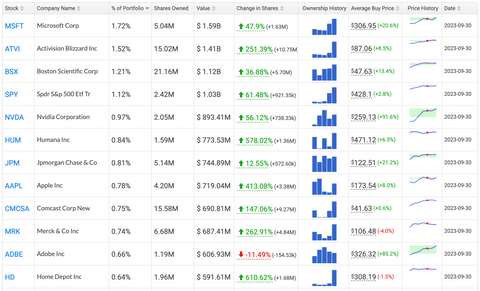
- Highly diversified; individual positions typically represent a small share of total exposure.
- Thousands of line items across sectors and instruments.
- Blue-chip and large-cap technology exposures can feature prominently in public disclosures at various times.
Minimum Investment
Minimums are often high and access can be restricted or invitation-only; terms vary by vehicle.
Fee Structure
Premium management and performance-based fees are common for top multi-strategy platforms; specifics vary by fund and share class.
What I Like / Dislike
- Like: Multi-engine platform, strong research culture, robust risk discipline; historically strong years demonstrate significant alpha potential.
- Dislike: Premium fees, potential performance lumpiness, and limited access; past gating during crisis periods is a consideration for some allocators.
Recent Notes
- Corporate developments have included a relocation of headquarters to Miami and continued platform expansion.
Recent Citadel Coverage
● LIVEUpdating: October 2026
- Jan 2026 — Citadel’s 2025 Scorecard: No Fireworks, Just Relentless Discipline
- Feb 2026 — NVIDIA (NVDA) Stock Analysis 2026: Is the AI King Still Investable? 🚀
- Oct 2026 — Inside Citadel’s $170B+ 13F: How Ken Griffin Manages Thousands of Positions Without Betting the Farm
📌 This section updates automatically as new Citadel insights go live.
Learn more: Visit Citadel
2. Bridgewater — Full Review
Note: Expanded deep-dive; the card above is your quick snapshot.
Profile
- Founded by Ray Dalio; global-macro research firm with systematic implementation.
- Flagship strategies include Pure Alpha (active macro) and All Weather (risk-parity, strategic beta).
- Institutional client base; culture emphasizes radical transparency and process repeatability.
Strategy Architecture
- Pure Alpha: Diversified macro bets across rates, FX, equities, credit, and commodities, driven by researched cause-and-effect linkages.
- All Weather: Risk-balanced exposures designed to weather inflation/growth regimes with periodic rebalancing.
Risk Management
- Emphasis on scenario analysis, stress testing, and explicit risk budgeting across asset classes.
Access, Minimums, Fees
- Generally institutional access; minimums can be high, terms vary by product.
- Fees reflect active macro and portfolio-engineering sophistication.
What I Like / Dislike
- Like: Process clarity, regime thinking, and a robust risk framework that’s teachable.
- Dislike: Limited access; active macro can face periods of whipsaw or crowding.
Recent Notes
- Leadership has professionalized beyond the founder; process remains institutionalized.
Recent Bridgewater Coverage
● LIVEUpdated: January 2026
- Jan 2026 — Principles of Prosperity: How Bridgewater’s AI-Driven “Machine” Built a Fortress in 2025
- Feb 2026 — What Few People Know About Bridgewater → Coming soon
- Feb 2026 — What Nobody Knows About Bridgewater → Coming soon
📌 This section updates automatically as new Bridgewater insights go live.
Learn more: Visit Bridgewater
3. Renaissance — Full Review
Note: Expanded deep-dive; the card above is your quick snapshot.
Profile
- Founded by mathematician Jim Simons; pioneering quant firm known for statistical arbitrage.
- Medallion is internal/employee-only; external vehicles (e.g., institutional equity funds) have different mandates and characteristics.
- Research culture, data engineering, and model life-cycle management are core differentiators.
Strategy Architecture
- Short- to medium-horizon signals across equities, futures, and other liquid markets; large-scale portfolio construction and constant model evaluation.
- Emphasis on breadth and ensemble effects rather than single big bets.
Risk Management
- Tight exposure control, rapid de-risking of decaying signals, and rigorous execution to limit slippage/impact.
Access, Minimums, Fees
- Access limited; institutional minimums; fee structures reflect active alpha capture and capacity scarcity.
What I Like / Dislike
- Like: Relentless research loop, disciplined capital allocation, world-class execution.
- Dislike: Practical inaccessibility for most individuals; external funds ≠ Medallion.
Recent Notes
- Ongoing succession and professionalized leadership; research pipeline remains the core asset.
● Recent Renaissance Coverage — Live Updated: January 2026
- Jan 2026 — Renaissance Technologies in 2025: Quant Quake, Post-Simons Growing Pains & The Limits of the Machine
- Feb 2026 — What Few People Know About Renaissance → Coming soon
- Feb 2026 — What Nobody Knows About Renaissance → Coming soon
📌 This section updates automatically as new Renaissance insights go live.
Learn more: Visit Renaissance
4. Elliott — Full Review
Note: Expanded deep-dive. The quick card above gives the elevator pitch; this one gives the full flight plan.
Profile
- Founded in 1977 by Paul E. Singer with $1.3 million from family and friends.
- Among the oldest hedge funds under continuous management; relocating headquarters to West Palm Beach, Florida.
- As of mid-2025, manages roughly $59 billion with about 550 employees—half devoted to research and portfolio analysis.
- Known for a disciplined culture, due process, and relentless pursuit of value in complex or distressed situations.
Strategy Architecture
- Originated in convertible arbitrage and evolved into a multi-strategy platform spanning equities, credit, private equity, real estate, and commodities.
- Distressed & special-situations investing: seeks opportunity in defaulted or near-defaulted debt, bankruptcy processes, and corporate restructurings.
- Non-distressed credit: complex structured products, layered securitizations, and mispriced instruments demanding deep analytical horsepower.
- Arbitrage suite: event-driven, related-securities, convertible, volatility, and fixed-income arbitrage—all used for opportunistic risk management.
- Activism: builds stakes to influence management, governance, or capital allocation (recently seen with Phillips 66 and AT&T).
- Volatility & macro hedging: uses credit, gold, rates, and FX derivatives to dampen systemic shocks.
Risk Management & Culture
- Risk awareness is structural, not reactive—each trade has a thesis, exit path, and risk-reward asymmetry before capital is deployed.
- Hard-wired focus on liquidity, counterparty control, and operational rigor.
- Cultural hallmarks: tenacity, creativity, negotiation skill, and meticulous due diligence.
Founder — Paul E. Singer
- Founder, President, and Co-CEO; also Co-CIO.
- Known for shaping modern activism and sovereign-debt litigation (“vulture investing”).
- Through the Paul E. Singer Foundation and Start-Up Nation Central, supports education, tech innovation, and LGBTQ rights.
- Graduate of University of Rochester and Harvard Law School; net worth estimated around $5 billion.
- Owner of AC Milan football club—activism meets calcio.
Funds & Access
- Flagship funds include Elliott Associates L.P. and Elliott International L.P.; private-equity vehicles complement hedge operations.
- Access is often restricted; minimums may start near $5 million; terms vary.
Portfolio Snapshot
- Approx. 50 holdings with high concentration—top two (e.g., TFPM & MPC) can exceed 40 % of exposure.
- Energy verticals often prominent; positions tend toward catalyst-driven value realization rather than passive compounding.
- Limited mega-cap tech; portfolio often idiosyncratic.
Fee Structure
Standard industry range: ~1.5 % management + 20 % performance; specifics vary by share class. Always confirm with offering docs.
What I Like / Dislike
- Like: Old-school activist discipline, uncorrelated event exposure, deep credit expertise, powerful negotiation DNA.
- Dislike: Limited access for new investors; occasional reputation for aggressiveness in sovereign cases.
Recent Notes
- 2024–25: Increased stakes in energy and industrial cyclicals; continued activism campaigns for operational reforms.
Recent Elliott Coverage
● LIVEUpdated: January 2026
- Jan 2026 — Elliott’s 2025 Paradox: Why the Parachute Cost Them the Party
- Feb 2026 — What Few People Know About Elliott → Coming soon
- Feb 2026 — What Nobody Knows About Elliott → Coming soon
📌 This section updates automatically as new Elliott insights go live.
Learn more: Visit Elliott Management
5. Berkshire Hathaway — Full Review
Note: Not a hedge fund, but a masterclass in capital allocation and risk restraint.
Profile
- Headquartered in Omaha, Nebraska; founded as a textile company (1839), transformed into a holding company by 1970.
- Core engine: insurance float reinvested into equities and wholly owned businesses.
- ~383 k employees; 2024 revenues near $300 billion; total assets approaching $950 billion.
- Chairman & CEO Warren Buffett (since 1970); late Vice Chairman Charlie Munger (1978-2023) was Buffett’s philosophical partner.
- Book value compounded ~20 % annually for half a century—double the S&P 500.
Investment Philosophy
- “It’s far better to buy a wonderful company at a fair price than a fair company at a wonderful price.”
- Focus on moats, management quality, and durability of advantage.
- Prefers concentrated, long-term holdings—“Our favorite holding period is forever.”
- Low leverage; ample liquidity for opportunistic deployment.
Risk Management (in their own words)
- “Risk comes from not knowing what you are doing.”
- “Widespread fear is your friend; it serves up bargains.”
- “It takes character to sit with cash and do nothing.” — Munger
- “Diversification is protection against ignorance.” — Buffett
Key Strategic Focus
- Insurance: GEICO, General Re — cash-flow generators.
- Infrastructure: BNSF Railroad, Berkshire Energy.
- Consumer & Financial holdings: Apple, Coca-Cola, American Express, Bank of America, Chevron, Occidental, Moody’s, Kraft Heinz.
- Private subsidiaries span everything from furniture to aerospace parts.
Founder — Warren E. Buffett
- Born 1930 in Omaha; inspired by Ben Graham’s “The Intelligent Investor.”
- Studied under Graham at Columbia Business School; founded Buffett Partnership Ltd. before acquiring Berkshire.
- Philanthropy: pledged 99 % of wealth to charity; co-launched the Giving Pledge with Bill Gates.
- Estimated net worth $120 billion (2024); among the world’s most respected investors.
Portfolio Snapshot
- Top holdings (public equities): Apple (~50 % of equity portfolio), BAC, AXP, KO, CVX, OXY, KHC, MCO, DVA, HPQ.
- Roughly 90 % of value concentrated in the top 10 positions—proof of conviction.
- Holdings horizon: multi-decade; portfolio churn ≈ 0 % most years.
Access & Fee Structure
- Any investor can own Berkshire shares (NYSE: BRK.A / BRK.B).
- Class A shares ≈ $580 k each; Class B ≈ $380 (as of 2025).
- No management or performance fees—just trading commissions.
What I Like / Dislike
- Like: Exceptional compounding record, ethical culture, fortress balance sheet, timeless investor education value.
- Dislike: Succession uncertainty; growth naturally moderates with scale.
Recent Notes
- Greg Abel designated CEO successor (2021); smooth leadership transition ongoing.
- Charlie Munger passed away Nov 2023 at 99—a final chapter in investing wisdom.
Recent Berkshire Hathaway Coverage
● LIVEUpdated: May 2026
- Jan 2026— Berkshire Hathaway’s Scorecard for 2025: Defensive Portfolio, Slightly Underwhelming Performance — But a Historic Transition
- May 2026— 🍅 Kraft Heinz (KHC): CEO Buys $5 Million — Value Trap or Ultimate 6.9% Yield Play?
- xxx 2026 — What Nobody Knows About Berkshire Hathaway → Coming soon
📌 This section updates automatically as new Berkshire insights go live.
Learn more: Visit Berkshire Hathaway
Quick Compare: Top Hedge Funds at a Glance
Before diving into the deep dives, here’s a one-screen cheat sheet summarizing strategy, edge, and accessibility for each fund. Think of it as the “Hedge Fund Buffet Sampler.” 🍽️
| Fund | Core Strategy | Edge / Distinction | Founder / CEO | Approx. AUM | Access |
|---|---|---|---|---|---|
| Citadel LLC | Multi-Strategy / Quant | High-octane research engine; tight risk controls | Ken Griffin | ~$60B+ | Institutional / Limited |
| Bridgewater | Global Macro / Risk Parity | Systematic macro; “All Weather” design | Ray Dalio (Founder) | ~$120B+ | Institutional |
| Renaissance Tech | Quant / Stat Arb | Short-horizon models; Medallion legend | Jim Simons (Founder) | ~$50B+ | Closed (internal) |
| Elliott Investment Management | Activist / Event-Driven / Credit | Activism + distressed depth; sovereign workouts | Paul Singer | ~$59B | Institutional / Select |
| Berkshire Hathaway | Value / Conglomerate | Insurance float + quality equities, decades of compounding | Warren Buffett (Chair/CEO) | ~$950B assets | Public (BRK.A / BRK.B) |
| Pershing Square | Concentrated Long / Activist / Opportunistic | Buffett-style focus; famous hedges and shorts | Bill Ackman | ~$18B+ | Institutional; PSH (OTC) for public access |
| AQR Capital | Factor / Quant / Multi-Asset | Academic rigor; value/momentum/carry/defensive styles | Cliff Asness et al. | ~$100B | Institutional + some mutual/UCITS |
| D.E. Shaw & Co. | Quant / Multi-Strat (Sys + Disc + Hybrid) | Pioneer quant shop; deep risk culture | David E. Shaw (Founder) | ~$60B | Institutional / Limited |
| Baker Bros. | Biotech / Healthcare (Concentrated) | Sector mastery; long-term, conviction stakes | Felix & Julian Baker | ~$23B | Institutional; limited retail focus |
| Balyasny Asset Mgmt (BAM) | Multi-PM / L/S Equity lead + Macro/Credit/Comm. | Re-tooled risk post-2018; diversified playbook | Dmitry Balyasny | ~$120B (firmwide) | Institutional / Select |
| Tiger Global | Tech Growth (Public + Private) | High-beta tech leadership; idea source | Chase Coleman | ~$58B (2022) | Institutional / Limited |
| Millennium | Multi-PM / Multi-Strat | Remarkably steady track record; huge diversification | Israel Englander | ~$60B+ | Institutional / Limited |
| Two Sigma | Quant / ML-driven Multi-Asset | AI/ML at scale; Venn risk platform | Overdeck & Siegel | ~$60B | Institutional / Limited |
| Viking Global Investors | Fundamental L/S + Private | Tiger Cub pedigree; public + private blend | Andreas Halvorsen | ~$40–50B | Institutional / Select |
| ARK Invest | Growth / Disruptive Innovation (Active ETFs) | High transparency; daily trades/notes | Cathie Wood | Varies (ETFs; peak ~$50B) | Public ETFs (ARKK, ARKG, etc.) |
| Davidson Kempner | Event-Driven / Multi-Strat | Longevity + steady returns; capital preservation | Anthony Yoseloff (CIO) | ~$37B | Institutional / Select |
| Coatue | Tech Growth (Public + Private) | Founder-led tech focus; robust private book | Philippe Laffont | ~$40B+ | Institutional / Select |
Source: Fund materials, filings, and industry estimates. Figures are rounded and approximate; verify current data before investing.
6. Pershing Square — Full Review
Note: A hybrid of value investing, activism, and creative hedging. Not for the timid—but always worth watching.
Profile
- Founded in 2004 by William (Bill) Ackman after his Gotham Partners venture; initial capital ~$50 million from personal funds and Leucadia National.
- Headquartered in New York City with under 100 employees; AUM ≈ $18–20 billion.
- Ackman hires unconventionally—past recruits have included a former fly-fishing guide and a chance taxi acquaintance. Culture prizes curiosity over pedigree.
Investment Approach
- Inspired by Warren Buffett, Ackman seeks durable franchises with pricing power and capable management.
- Maintains a highly concentrated portfolio—usually 8–12 core positions—to maximize research depth and accountability.
- Combines long-term compounding with opportunistic short or hedged trades when macro risk spikes.
- Prefers publicly traded, high-visibility companies where Pershing’s influence can unlock value through activism or governance change.
Activism Highlights
- Launched headline campaigns at McDonald’s, Wendy’s, and Herbalife.
- Valeant Pharmaceuticals (2016) — painful $4 billion loss that reshaped Ackman’s process toward discipline and humility.
- COVID-19 hedge (2020) — invested $27 million in credit protection, generating $2.6 billion within a month when markets crashed.
- Short U.S. Treasuries (2023) — a tactical macro bet that netted $200 million before being closed due to geopolitical risks.
Risk Management
- Combines macro hedges with bottom-up conviction. Ackman treats portfolio insurance as an active discipline, not an afterthought.
- After Valeant, Pershing refocused on research depth, smaller staff, and performance accountability—resulting in a 58 % gain in 2019.
- Views volatility as inevitable but survivable; designs position sizes accordingly.
Founder — Bill Ackman
- Founder & CEO; Harvard BA & MBA; Forbes net worth ≈ $3.5 billion (2025).
- Known for articulate investor letters and media presence—turns shareholder communication into an educational forum.
- Signatory of The Giving Pledge, pledging ≥ 50 % of wealth to philanthropy.
Funds & Access
- Flagships: Pershing Square L.P. and Pershing Square International L.P.
- Pershing Square Holdings Ltd (PSHZF) — publicly listed in London; accessible OTC to retail investors.
- Typical minimum ≈ $5 million for private funds.
Portfolio Snapshot (2025)
- Only ~7 positions; top 3 (CMG, QSR, HLT) ≈ 45 % of total weight.
- Sectors: restaurants, hotels, real estate, railroads, and select tech.
- Average hold: 1–3 years; turnover low by hedge-fund standards.
Fee Structure
Standard 1.5 % management + 20 % performance (after loss carryforwards). PSHZF’s public structure offers similar economics, minus lockups.
What I Like / Dislike
- Like: Transparent communications, focused portfolio, creative hedging, long-term conviction, ethics and philanthropy.
- Dislike: Personality-driven volatility—both in media and returns; occasional off-equity bets can surprise traditional investors.
Recent Notes
- Reaffirmed inflation-sensitive macro awareness; continues active dialogues on U.S. housing and interest-rate policy.
Recent Pershing Square Coverage
● LIVEUpdated: April 2026
- Jan 2026 — Pershing Square Rounds Up a Strong 2025: High Conviction, Concentrated Bets — and Real Outperformance
- Apr 2026 — Ackman IPO: Genius Play or Structural Trap? 🎩📉
- xxx 2026 — What Nobody Knows About Pershing Square → Coming soon
📌 This section updates automatically as new Pershing Square insights go live.
Learn more: Visit Pershing Square
7. AQR Capital — Full Review
Note: Where Renaissance meets academia. AQR proves that quant doesn’t have to be mystical to be powerful.
Profile
- Founded in 1998 by Cliff Asness, Robert Krail, and John Liew — University of Chicago PhD graduates.
- Headquarters: Greenwich, Connecticut • AUM ≈ $100 billion (2025) • ~1,000 employees.
- AQR stands for Applied Quantitative Research—because that’s literally what they do.
Investment Philosophy
- Applies rigorous academic research to real-world markets: value, momentum, quality/defensive, and carry factors.
- Portfolios blend fundamental economics with statistical modeling to capture persistent sources of return.
- Diversifies across styles, regions, and asset classes (equities, credit, commodities, rates, currencies).
- Rejects market timing and stock picking in favor of systematic, repeatable edge.
Strategy Spectrum
- Equity Style Funds: Single-factor (value, momentum, quality) and multi-factor blends.
- Alternatives: Absolute-return, market-neutral, arbitrage, and global-macro vehicles.
- 130/30 Portfolios: Enhanced long/short framework leveraging mild shorting to boost alpha.
- UCITS & Mutual Funds: Bring institutional-grade quant to individual investors worldwide.
Risk Management & Culture
- Risk is measured before return is earned—statistical discipline is the firm’s first language.
- Emphasizes low correlation to traditional equity beta; diversification is the core product.
- After a tough 2018 (-34 %), AQR tightened models and re-optimized execution — discipline over ego.
- Consistently ranks as one of the best employers in money management (P&I 2023 list).
Founder — Cliff Asness
- Managing & Founding Principal; former Director of Quant Research at Goldman Sachs AM.
- Co-created Goldman’s Global Alpha Fund, one of the first quant macro vehicles.
- Outspoken advocate for evidence-based investing and humor-laced blog commentary on markets and academia.
Funds & Access
- Offers ~40 strategies across equity & alternatives; vehicles include LPs, mutual funds, and UCITS.
- Institutional clients: pension plans, endowments, insurers, foundations, and sovereign funds.
- Retail access via AQR mutual funds and global UCITS platforms.
- Minimum investment ≈ $5 million for private funds; lower for mutual funds.
Portfolio Snapshot
- Thousands of positions; no single holding > 3 % weight.
- Exposure spans mega-cap tech, financials, industrials, and commodities with carefully balanced factor weights.
- Turnover varies from weeks to years depending on signal horizon.
Fee Structure
Typical range ≈ 1–2 % management + 15–30 % performance fee (depending on vehicle and mandate). UCITS ≈ 1.4 % + 15 %. Managed accounts similar but tiered by size.
What I Like / Dislike
- Like: Quant discipline, academic credibility, diversified style toolkit, rich research portal, transparent methodology.
- Dislike: Occasional underperformance in factor reversals; requires long-term patience and faith in statistics.
Recent Notes
- 2023–25: Strengthened data pipeline and AI-driven execution; expanding retail education initiatives globally.
Recent AQR Capital Management Coverage
● LIVEUpdated: February 2026
- Feb 2026 — AQR Capital’s 2025 Scorecard: From Applied Quantitative Research to Actually Quality Returns
- Feb 2026 — What Few People Know About AQR Capital Management → Coming soon
- Feb 2026 — What Nobody Knows About AQR Capital Management → Coming soon
📌 This section updates automatically as new AQR Capital Management insights go live.
Learn more: Visit AQR Capital Management
8. D.E. Shaw — Full Review
Note: Founded by computer-science visionary David E. Shaw, this is the hedge fund where quantitative finance grew up and never looked back.
Profile
- Founded in 1988 by David E. Shaw — Stanford Ph.D., former Columbia professor, and one-time Morgan Stanley prop-trader.
- Headquarters: New York City · AUM ≈ $60 billion (2025) · ~2,500 employees worldwide.
- Famous alumni include Jeff Bezos (Amazon founder) and a fleet of scientists with 24 International Math Olympiad medals and hundreds of papers between them.
Investment Approach
- Runs three pillars: systematic models, discretionary teams, and hybrid strategies combining both.
- Systematic equity and futures strategies apply risk-aware stock selection and macro bets across rates, FX, and commodities.
- Discretionary arms cover credit, energy, reinsurance, private equity, and renewables — where human judgment still adds value.
- Every trade lives inside a mathematical framework that tests decades of data before deploying a dollar.
Risk Management
- Risk is central culture, not a department. The firm’s Risk Committee includes the Chief Risk Officer, Executive Committee members, and rotating managing directors.
- All portfolio managers are considered risk managers; capital allocation adjusts continuously to correlation and volatility shifts.
- Shaw’s team refined these principles through crashes from ’98 to ’08 and beyond — a rare quant firm that improved with every storm.
Founder — David E. Shaw
- Scientist-entrepreneur worth ≈ $8 billion (Forbes 2025). Served on U.S. Presidential Science Advisory Councils under Clinton and Obama.
- Now splits time between philanthropy and computational biochemistry research while remaining the firm’s guiding intellect.
Funds & Vehicles
- Alternative Investments: Absolute-return funds seeking low correlation to traditional markets.
- Long-Oriented Strategies: Active Equity (2000) for institutional custom index exposures.
- Orienteer (2013): Global multi-asset program blending systematic signals with select alpha trades.
Portfolio Snapshot
- Highly diversified; no position > 4 % weight.
- Top names include big tech and blue-chip staples; most positions ≈ 1 % or less.
- Holding periods span weeks to years — a blend of high-frequency and strategic core.
Minimum Investment & Fees
- Accredited investors only (≈ $1 million net worth or $200 k income standard).
- Minimum entry ≈ $1 million per fund variant.
- Fees range widely: management ~1 – 3.5 %; performance 15 – 35 %, tiered by fund and liquidity terms.
What I Like / Dislike
- Like: Elite quant talent, deep risk infrastructure, and diversified return streams spanning decades.
- Dislike: Complexity and opacity make it hard for outsiders to mirror or verify strategy shifts.
Recent Notes
- In 2024 the firm relocates its HQ to Two Manhattan West in Hudson Yards — eight floors of servers, screens, and smarts.
Recent D.E. Shaw Coverage
● LIVEUpdated: February 2026
- Feb 2026 — D.E. Shaw’s 2025 Scorecard: Put on Quite a Show With AI and Quants
- Feb 2026 — What Few People Know About D.E. Shaw → Coming soon
- Feb 2026 — What Nobody Knows About D.E. Shaw → Coming soon
📌 This section updates automatically as new D.E. Shaw insights go live.
Learn more: Visit D.E. Shaw & Co.
In-article sponsor Your brand here: tools, data, or research for serious investors.
9. Baker Brothers Advisors — Full Review
Note: A rare example of a hedge fund built on scientific literacy and patient capital — a laboratory for long-term biotech conviction.
Profile
- Founded in 2000 by Felix and Julian Baker; seeded by the Tisch Family.
- Headquarters: New York City · AUM ≈ $23 billion (2025).
- Pure-play life-sciences focus with decades-long relationships across pharma boards and research networks.
Investment Philosophy
- Vertical-specific expertise in biotech and healthcare — eschews diversification for depth and diligence.
- Average holding period > 3 years; often a decade or longer for core winners.
- Seeks commercial-stage biotechs or late-development firms with clear path to profitability and buyout appeal.
- Portfolio construction reflects Buffett’s quote: “Diversification is protection against ignorance.”
Portfolio Structure
- Hyper-concentrated: ≈ 50 % of assets in two names (Beigene Ltd BGNE, Incyte INCY).
- Total positions ≈ 117 but the long tail (< 1 % each) manages risk while fostering idea discovery.
- Minimal exposure to big pharma (PFE, JNJ) or managed care (UNH) — it’s pure biotech DNA.
Risk Management
- Focus on commercial-stage or near-profit biotechs limits binary risk relative to early-stage peers.
- Long-term orientation absorbs sector drawdowns and reduces taxable turnover.
- High conviction acts as a filter against noise — the Bakers understand the difference between a temporary selloff and a failed trial.
Founders — Felix & Julian Baker
- Felix: B.S. & Ph.D. in Immunology from Stanford; served on boards of Seattle Genetics (now Pfizer), Alexion (now AstraZeneca), and others.
- Julian: A.B. magna cum laude from Harvard; director at Incyte, Acadia Pharma, Prelude Therapeutics, and more.
- Each worth ≈ $2.8 billion (Forbes 2025); known for hands-on engagement with science teams and C-suites alike.
Funds & Access
- Private pooled vehicles for institutional investors and family offices only.
- No main website and no retail distribution; information comes via SEC filings (13F/ADV).
- Minimum investment and fees undisclosed but typical hedge-fund ranges apply (1–2 % + performance fee).
Performance & Legacy
- Track record of anticipating M&A targets — early stakes in Seattle Genetics and Alexion became legendary exits.
- Long-term compounding from Incyte position (est. 2001) illustrates patience as strategy.
- Despite sector volatility, Baker Bros ranks among top biotech funds by 10-yr CAGR returns.
What I Like / Dislike
- Like: Scientific expertise rare in finance, phenomenal due diligence, and a portfolio that doubles as a watchlist for serious biotech investors.
- Dislike: Sector concentration means periodic pain; retail investors can only observe, not participate directly.
Recent Notes
- 2024: Exited Seattle Genetics stake after Pfizer merger — a multi-decade home run closing the loop on their original thesis.
Recent Baker Bros. Coverage
● LIVEUpdated: February 2026
- Feb 2026 Madrigal, BeiGene, and Biotech Alpha: Inside the “Gene-ius” Kingmakers of Baker Bros. 2025
- Feb 2026 AbCellera (ABCL) Stock Analysis: 7 Triggers for a Biotech Short Squeeze or Long-Term Multibagger?
- Feb 2026 What Nobody Knows About Baker Bros. → Coming soon
📌 This section updates automatically as new Baker Bros. insights go live.
Learn more: Baker Bros on Whale Wisdom
10. Balyasny Asset Management — Full Review
Profile
- Founded in 2001 by Dmitry Balyasny, Scott Schroeder, and Taylor O’Malley; HQ Chicago with 16+ global offices.
- ~1,500 team members across 150+ investment teams; AUM ≈ $120B (firm materials).
- Platform model: multiple sector PM pods operating within shared risk, tech, data, and execution infrastructure.
Strategies
- Core: Equities Long/Short via fundamental, bottom-up stock selection.
- Plus: Macro, Equity Arbitrage / Event, Credit, Commodities, and Growth Equity (BAM Elevate for private tech/tech-enabled).
- Goal: consistent absolute returns across regimes via diversified, complementary sleeves.
Risk Management
- 2018 was an inflection point (AUM drawdown, layoffs). The firm hired CRO Alex Lurye (ex-Citadel risk leader) and embedded risk deeper into PM workflows.
- Portfolio construction uses factor exposures, stress tests, liquidity ladders, and capital buffers to contain tails.
- Liquidity controls: avoid concentration breaches even in liquid assets; pre-modeled liquidation timelines under stress.
Leadership
- Dmitry Balyasny — Managing Partner & CIO; early career at Schonfeld. Influenced by individual-responsibility philosophies; active in philanthropy.
- Taylor O’Malley — President; chairs Global Macro Strategy Committee; oversees Risk, Tech, Data Intelligence, and Ops.
- Scott Schroeder — Business Development and legal/regulatory head.
Funds & Vehicles (selected)
- Atlas-family funds across macro, enhanced, master, and private holdings; minimums vary by vehicle (some $0–$25M per class as disclosed in filings).
- Client base spans institutions, SWFs, endowments, FOFs, family offices, and HNW.
Portfolio Snapshot
- Highly diversified; few single names > 2.5% weight.
- Large use of ETFs (e.g., Russell 2000) for exposure shaping and hedging.
- Construction echoes other platforms (AQR, D.E. Shaw) in diversification discipline, though BAM remains more fundamental L/S at heart.
Minimums & Fees
- Accredited/qualified investors; minimums often around $5M but vary by fund/class.
- Typical hedge-fund economics: management fee on AUM plus performance incentive; see offering docs for specifics.
Performance Notes & Culture
- Strong pre-2018 record (double-digit annualized) and resilience across the dot-com bust and GFC; 2018 reset catalyzed a risk-first rebuild.
- Current BAM emphasizes coaching, analytics, and playbooks that make PMs sturdier across regimes.
What I Like / Dislike
- Like: Measured post-2018 transformation; deep sector benches; risk is now a muscle, not a memo.
- Dislike: Platform complexity can dilute edge if PM selection/pruning lags; individuals can’t easily replicate the infra.
Recent Notes
- Continued global build-out (including Asia/Middle East) and expansion of data/tech pipelines to support pods.
Learn more: BAM website
11. Tiger Global — Full Review
Profile
- Founded 2001 by Chase Coleman III, a Julian Robertson “Tiger Cub.” HQ: New York.
- AUM figures have fluctuated with market cycles; the platform spans public L/S and private growth equity.
- Formerly “Tiger Technology”; distinct from Tiger Management (closed) and Tiger Asia.
Two Engines
- Public Equity: Long/short flagship (Tiger Global Investments) and a long-only sleeve (Long Opportunities), concentrated in leaders with secular tailwinds.
- Private Equity: Growth stakes in category-defining companies riding internet/software/consumer/fintech S-curves.
Strategy DNA
- Hunts for moaty, founder-led businesses with operating leverage and giant TAMs.
- Barbell of public and private lets Tiger ride trends across lifecycle phases — but also compounds regime risk.
Risk Management (and Lessons)
- 2020: Stellar gains (≈ $10B for investors).
- 2022: One of the industry’s largest drawdowns as multiples de-rated; long-only fared worse.
- Reset: Trimmed speculative exposure, rebalanced to durable mega-caps (MSFT, META, GOOGL, etc.), added more shorts, and re-underwrote China stakes.
- Key lesson: liquidity regime changes can overpower even great company selection; sizing and hedging are existential.
Founder — Chase Coleman
- Began under Robertson in 1997; received ~$25M to launch Tiger Global when Tiger Management wound down.
- Net worth ≈ multi-billion (Forbes), emblematic of the “Tiger Cub” tradition of aggressive but research-driven growth investing.
Funds & Vehicles
- 20 pooled vehicles; seven hedge funds within the platform.
- Flagship: Tiger Global Investments, LP (~$35B historically). Other sleeves: Long Opportunities and multiple private funds.
- Minimums typically ≈ $1M and up for hedge sleeves; private funds vary widely.
Portfolio Snapshot
- Concentrated top book: META and MSFT have represented a large combined weight; top five can exceed 50%.
- Sector focus: internet/software/consumer/fintech leaders with network effects and strong unit economics.
- Private pipeline supplies future public ideas; public winners fund patience in privates.
Fees
- Typical hedge economics: ~1.25–1.5% management for public funds; ~2% for private funds; performance fees ~20% (public) and 20–25% (private).
What I Like / Dislike
- Like: Pattern-recognition in tech moats; cross-over lens across private/public; a watchlist of tomorrow’s leaders.
- Dislike: Volatility and regime sensitivity; 2022 showed process needs to flex faster when liquidity tides turn.
Recent Notes
- 2023 rebound (+28.5%) after portfolio overhaul; continued fundraising for early-stage growth despite tighter VC tape.
Learn more: Tiger Global
12. Millennium Management — Full Review
Note: Founded in 1989, Millennium built a fortress of risk systems and diversification long before “multi-strategy” was cool.
Profile
- Founded by Israel Englander in 1989 with $35M; now manages ≈ $60B+ in AUM.
- Headquartered in New York City with ~5,500 employees worldwide.
- One of the largest and most profitable hedge-fund organizations globally.
Strategy Framework
- Operates a multi-manager, multi-strategy model spanning:
- Fundamental Equity — long/short stock selection by sector teams.
- Equity Arbitrage — merger, event-driven, and volatility trades.
- Fixed Income & Macro — rates, credit, mortgages, commodities.
- Quantitative — systematic strategies across asset classes.
- Hundreds of independent PM pods operate with ring-fenced capital and strict risk budgets.
- Goal: steady, market-neutral alpha aggregation through diversified micro-edges.
Risk Management
- Millennium’s hallmark is risk control: every PM operates under real-time surveillance for leverage, factor drift, and drawdown.
- Diversified across thousands of securities — only index trackers like SPY, QQQ, and IWM exceed 1% position weight.
- Rarely experiences major drawdowns; compounding ≈14% annually since inception (per reports).
Founder — Israel Englander
- NYU-trained finance graduate; early career on the American Stock Exchange as trader and specialist.
- Still CEO and 100% owner; widely respected for discipline and privacy.
- Net worth ≈ multi-billion range; known for long-term staff loyalty and culture of discretion.
Performance Record
- Among the top 5 all-time cumulative profit generators in hedge-fund history (per LCH rankings).
- Over $22B+ in net gains for investors since inception.
- Annualized ≈14% over 35+ years — exceptional for such scale and diversification.
Portfolio Snapshot
- ~7,000 securities; extremely diversified.
- Top 3–4 positions are ETFs (SPY, QQQ, IWM) used for beta and liquidity control.
- Broad exposure to mega-cap tech, healthcare, consumer staples, and industrial leaders.
Fees & Access
- Private funds only; minimums undisclosed and vary widely.
- Standard hedge-fund fee mix: management fee + performance incentive; exact figures not public.
What I Like / Dislike
- Like: Peerless consistency, diversified structure, stable leadership.
- Dislike: Spartan public disclosures — learning from Millennium means inference, not reading.
Recent Notes
- 2023: Millennium seeded Diego Megia’s spinout Taula Capital ($3B macro fund launching 2024).
Recent Millennium Management Coverage
● LIVEUpdated: February 2026
- Feb 2026 — The $900 Million Gut-Punch: How Israel Englander Saved Millennium’s Year
- Feb 2026 — What Few People Know About Millennium Management → Coming soon
- Feb 2026 — What Nobody Knows About Millennium Management → Coming soon
📌 This section updates automatically as new Millennium Management insights go live.
Learn more: Millennium Management
13. Two Sigma — Full Review
Note: A technological tour de force, blending computer science, finance, and machine learning into one of the world’s most advanced investing engines.
Profile
- Founded in 2001 by John Overdeck, David Siegel, and Mark Pickard.
- HQ: New York City · AUM ≈ $60B · ~2,000 employees.
- Name “Two Sigma” nods to volatility (σ) and the sum (Σ) of many signals — math meets metaphor.
Investment Framework
- Principles rooted in technology, data science, and AI more than traditional finance.
- Leverages ML engines (like proprietary system Halite) and vast alternative datasets to predict risk and return.
- Over two-thirds of staff are in R&D; infrastructure includes 775k+ virtual CPUs and 5,000 TB of memory — yes, terabytes.
- Goal: consistent, low-correlation alpha through statistical insight and portfolio diversification.
Risk Management
- Quantitative to its core: risk measured at every level — asset, factor, region, and model uncertainty.
- Created Venn (2017), an analytics platform that helps institutional investors model portfolio risks and correlations.
- Diversification is religion; over 3,000 positions with minimal single-stock exposure (<1% weights).
Founders & Origins
- Overdeck and Siegel met at D.E. Shaw (yes, same alumni tree as Bezos and Asness).
- Overdeck — International Math Olympiad medalist, Stanford grad, early Amazon engineer.
- Siegel — MIT Ph.D. in computer science; former CIO at Tudor Investment Corp.
- Seed funding from Paul Tudor Jones jump-started operations in 2001.
- Mark Pickard served as President until retirement (2006).
Funds & Products
- Flagships include Two Sigma Spectrum Portfolio (~$15B), Equity Portfolio (~$12B), Strategies Fund (~$10B), and others.
- Two Sigma Impact (private equity arm) raised $677M in 2023 for mission-driven investments.
- Access mostly institutional; retail and even accredited access remains limited.
Portfolio Snapshot
- ~3,400 holdings; no position >1% weight; top positions are ETFs like QQQ and SPY.
- Exposure: mega-cap tech (NVDA, TSLA, NFLX, V, NKE, GOOGL) plus small factor-driven positions.
- Blends systematic long/short equity with multi-asset overlays across rates, FX, and commodities.
Fees & Access
- Institutional focus; typical management 2–4%, performance 20–30% depending on strategy.
- Individual access minimal outside public feeder vehicles (if open).
What I Like / Dislike
- Like: World-class infrastructure, strong performance, AI-first ethos, educational outreach (Venn).
- Dislike: Founders’ rift (Overdeck vs. Siegel) could disrupt culture; limited transparency.
Recent Notes
- 2023: Two Sigma Impact fund launch closed oversubscribed; continued R&D on multi-agent AI trading frameworks.
Recent Two Sigma Investments Coverage
● LIVEUpdated: February 2026
- Feb 2026 — Two Sigma Investments Scorecard for 2025: The Numbers (Finally) Add Up!
- Feb 2026 — What Few People Know About Two Sigma Investments → Coming soon
- Feb 2026 — What Nobody Knows About Two Sigma Investments → Coming soon
📌 This section updates automatically as new Two Sigma Investments insights go live.
Learn more: Two Sigma
14. Viking Global Investors — Full Review
Profile
- Founded in 1999 by Ole Andreas Halvorsen, Brian Olson, and David Ott (all Tiger Management alumni).
- HQ: Greenwich, CT; AUM reportedly under $50B across public and private strategies.
- Families of funds: Viking Global Equities (long/short, 1999), Viking Long Funds (long-only, 2009), and Viking Global Opportunities (liquid/illiquid, 2015).
Strategy Framework
- Public Equity: High-conviction long and short investments, organized by sector verticals (tech, healthcare, consumer, industrials, etc.). The engine is fundamental research: business model quality, durability of cash flows, management quality, and competitive moats.
- Private Equity: From disruptive early-stage names to mature firms on credible paths to profitability; preference for founder/management teams able to scale sustainably.
- Process: Intensive primary work (expert calls, channel checks), structured valuation, and portfolio construction guardrails (exposure limits, stop-loss/risk budgets).
Risk Management
- Reasonably diversified across ~100 public positions; top names typically include mega-cap quality (Visa, Amazon, Microsoft, Danaher, UnitedHealth, Meta).
- Position sizing reflects liquidity and thesis maturity; historically few positions >5% (Visa sometimes an exception).
- History includes periods of scale adjustments (e.g., 2017 capital return); reports suggest the flagship long/short fund reopened to new capital in 2023.
Founder — Ole A. Halvorsen
- Norwegian origin; Williams College (Economics) and Stanford GSB (MBA).
- Ex-Tiger Management senior MD; sits at the intersection of tight risk discipline and long-form fundamental work.
Performance & Portfolio Snapshot
- Track record is relatively consistent versus peers, though not the absolute fastest compounding among Tiger Cubs in every window.
- Portfolio skew: diversified quality compounders plus selective growth; measured sleeves in earlier-stage names (DNA, ADPT historically small).
- Concentration: ~30% in top 7 holdings; broad tail of smaller positions for optionality.
Access, Minimums & Fees
- Clients include endowments, pensions, sovereigns, funds, and HNWIs.
- Minimums commonly cited around $5M for several funds; availability varies.
- Fee mix: monthly management fee of ~0.125% (i.e., 1.5% annualized) plus ~20% performance fee (net of losses), subject to fund terms.
What I Like / Dislike
- Like: Durable research culture; balanced across public/private; good lessons in position sizing and thesis hygiene.
- Dislike: Episodic scale adjustments; access can tighten; at times a step behind the very top performers.
Recent Notes
- Market chatter indicates the flagship L/S may have reopened to capital in 2023 after a decade-plus; watching for formal confirmation.
Recent Viking Global Investors Coverage
● LIVEUpdated: February 2026
- Feb 2026 — Viking’s 2025 Scorecard: When the “Tiger Cub” Trades Its Stripes for a Suit
- Feb 2026 — What Few People Know About Viking Global Investors → Coming soon
- Feb 2026 — What Nobody Knows About Viking Global Investors → Coming soon
📌 This section updates automatically as new Viking Global Investors insights go live.
Learn more: Viking Global Investors
15. ARK Invest — Full Review
Profile
- Founded by Cathie Wood (2014 for ARK; note: early bio milestones date to the 1990s/2000s at AllianceBernstein/GSAM).
- HQ: St. Petersburg, FL; <100 professionals.
- AUM swung from ~$50B (Feb 2021 peak) to the mid-teens by 2022 after sharp underperformance; trend subsequently stabilized with market recovery.
Strategy Framework
- Active ETFs: The flagship ARKK (Innovation) plus ARKQ (Autonomy/Robotics), ARKG (Genomics), ARKW (Next-Gen Internet), ARKF (Fintech), ARKX (Space), among others.
- Venture Access: Retail-friendly ARK Venture lowers the bar to a historically exclusive asset class (min as low as $500).
- Theme: Disruptive innovation—AI, genomics/CRISPR, robotics, energy storage, blockchain, space infrastructure.
- Target: Seek names that can double over ~5 years (implied ~15% CAGR+) based on ARK’s open models and research memos.
Risk Management & Volatility
- High beta by construction; no cash sleeves in ETFs, so “cash-like innovation” (mega-cap tech) sometimes acts as ballast.
- Rates sensitive: higher discount rates compress long-duration growth equity valuations.
- Concentration: ARKK often holds 35–55 names; top 10 can be ~60–65% of weight (e.g., COIN, ROKU, TSLA historically).
- Transparency is a feature: daily trades, holdings emails, live research streams—great for education and gauging thesis shifts.
Founder — Cathie Wood
- USC (Finance & Econ, summa); mentored by economist Arthur Laffer.
- Former CIO of global thematic strategies at AllianceBernstein; launched ARK after proposing active ETFs focused on innovation.
- Performance has been cyclical: standout 2020, deep 2021–22 drawdowns, subsequent rebounds; positioning evolves with thesis work and macro.
Vehicles, Minimums & Fees
- ARKK: Expense ratio ~0.75%. Most ARK ETFs sit in the 0.75–0.85% zone.
- ARK Venture: management ~2.75%, total net expense ratio ~2.90%, min investment ~$500 (distinct retail angle).
- Access: ETFs trade on exchanges (e.g., NYSE Arca); no accreditation required for the ETFs.
Portfolio Snapshot (ARKK as anchor)
- Top exposures frequently include category leaders and platforms (e.g., TSLA, COIN, ROKU, PATH, ZM—mix changes with research and flows).
- Cross-fund overlap is common; holdings may appear in 3–4 ARK ETFs if they sit at the intersection of multiple themes.
What I Like / Dislike
- Like: Radical transparency; differentiated frameworks on S-curve adoption; daily signals for readers building growth baskets.
- Dislike: Volatility is the toll; some earlier-stage names may never cross the profitability chasm; crowding and liquidity can magnify swings.
Recent Notes
- ARK continues to expand tooling (open models, podcasts, research decks) and to refine cross-theme exposure (AI × Genomics × Robotics) as platform plays emerge.
Learn more: ARK Invest
16. Davidson Kempner — Full Review
Profile
- Founded 1983 by Marvin Davidson (ret. 2004) and Thomas Kempner (ret. 2020); led today by Anthony A. Yoseloff (Executive Managing Member & CIO).
- HQ: New York City; ~500 employees; ~$37B AUM across evergreen and drawdown vehicles.
Strategy Framework
- Event-Driven / Multi-Strategy: Bottom-up, catalyst-oriented investing spanning credit and equity.
- Credit: Corporate & structured credit, convertible arb, long/short credit, private lending.
- Equity: Merger arb, special situations, long/short equity, selective private equity.
- Real Assets: Opportunistic sleeves in real estate, infrastructure, renewables, aircraft, shipping.
- Structured Capital: Custom solutions across capital structures for idiosyncratic outcomes.
Risk Management
- Capital preservation as a first principle; one of the fund’s worst years (2008) reportedly <10% drawdown.
- Diversified book (300+ positions typical). Heavy singular exposures can appear around hard catalysts (e.g., ATVI pre-MSFT deal close), but position risk is sized relative to merger odds/timing.
- Partner capital is significant alongside clients—useful alignment in complex situations.
Leadership
- Anthony Yoseloff oversees strategy and risk; sits on multiple institutional boards (e.g., Princeton’s PRINCO board, NYPL investment committee), reinforcing a long-horizon governance mindset.
Vehicles, Access & Fees
- ~45 pooled vehicles (30+ hedge funds). Representative funds include:
- Davidson Kempner International, Ltd. (~$10B; min ~$3M)
- Davidson Kempner Institutional Partners, LP (~$9.7B; min ~$5M)
- Davidson Kempner Partners (~$4.3B; min ~$5M)
- Distressed Opportunities International (~$2B; min ~$2M)
- Minimums generally $2–5M (accredited/qualified status required; availability varies).
- Indicative fees: management 0.5%–1.75% depending on vehicle (e.g., 1.5% on committed for long-term funds); performance fees generally ~20% (15% for some special-opp sleeves). Check offering docs.
Portfolio Snapshot
- Core: catalyst-linked holdings across credit/equity; mix of mainstream (META, WMT, etc.) and “off-the-run” names.
- Past outsized positions tied to corporate actions (e.g., ATVI pre-acquisition) reflect risk-adjusted spread math, not speculative concentration.
What I Like / Dislike
- Like: 40-year durability; thoughtful risk control; rich hunting ground for event-driven/credit ideas; meaningful partner coinvestment.
- Dislike: Compounding rate can trail high-beta stars in rip-roaring bull markets; access and transparency are institutional by design.
Recent Notes
- Jul 2023: Closed Opportunities Fund VI at ~$3.0B—continued appetite for complex, catalyst-driven credit/equity.
Recent Davidson Kempner Capital Management Coverage
● LIVEUpdated: February 2026
- Feb 2026 — Davidson Kempner’s 2025: The “Shadow Bank” Pivot & The Deep-Value Sea Change
- Feb 2026 — ARKO Corp: The Convenience Store “Squeeze” — Value Trap or Fuel-Injected Turnaround?
- Feb 2026 — What Nobody Knows About Davidson Kempner Capital Management → Coming soon
📌 This section updates automatically as new Davidson Kempner Capital Management insights go live.
Learn more: Davidson Kempner
17. Coatue Management — Full Review
Profile
- Founded in 1999 by Philippe Laffont (MIT CS; ex-Tiger Management analyst). Brother Thomas Laffont co-leads private investing.
- HQ: New York City; staff <200; AUM ≈ $40B+ spanning public, long-only, hybrid, and private funds.
- “East Meets West” annual conference convenes global tech founders and CEOs; strong network effects for deal flow and insight.
Strategy Framework
- Public Tech Equity (since 1999): Disciplined, long-term growth investing in category leaders across AI/cloud, semis, consumer internet, fintech, and healthcare tech.
- Private / Growth: From early to late stage; structured equity toolkit allows non-dilutive solutions for founders and flexible capital through cycles.
- Data Platform: In-house data science overlays 200+ proprietary datasets to benchmark KPIs, inform hiring/fundraising, and sharpen GTM strategy.
Risk Management
- Moderately concentrated public book (top 5 ≈ 40% weight) with 300+ total positions for breadth.
- Bias to blue-chip tech leaders (NVDA, META, AMZN, AMD, MSFT, TSLA, etc.) balanced with a pipeline of emerging disruptors.
- Private marks and tech cyclicality can amplify volatility; Coatue uses structure (convertible/structured equity) to cushion drawdowns for portfolio companies.
Founder — Philippe Laffont
- MIT CS (1991); McKinsey alum; Tiger Management telecom analyst (1996).
- Combines Tiger-style fundamental rigor with a platform approach to founder support and data.
Funds & Access
- ~40 pooled vehicles; ~10 are hedge funds across offshore/onshore structures and long-only sleeves.
- Examples: Coatue Offshore Master Fund LP (~$22B), Offshore Fund, Ltd. (~$7.5B), Qualified Partners LP (~$6B), Long Only Offshore Master (~$5B), plus hybrid and private funds (e.g., Early Stage, Private Funds II).
- Minimums often around $5M (varies by vehicle); investor base is largely institutional and qualified.
Portfolio Snapshot
- Public equity: tech-heavy with semis, hyperscale platforms, and software leaders; top weights frequently include NVDA, META, AMZN, AMD, MSFT.
- Private pipeline: fintech, climate tech, AI infrastructure/apps, and TMT adjacencies; structured equity used to avoid punitive down rounds.
Fees
- Fixed fee typically 0–2.5% of AUM (or committed capital/cost basis per docs), plus performance fees of ~10–33% depending on strategy/vehicle.
- Standard institutional provisions (fee breaks for affiliates/classes) and pass-throughs where applicable; always check offering docs.
What I Like / Dislike About Coatue
- Like: Secular-trend mapping; founder support + data platform; public/private idea flywheel; consistently fertile idea source for readers.
- Dislike: Tech beta and private-mark lag can sting in fast drawdowns; access limited for most individuals.
Recent Notes
- Raised ≈$3B for a structured-equity fund to help private companies bridge valuations without down rounds; continued focus on AI and climate-tech stacks.
Recent Coatue Management Coverage
● LIVEUpdated: February 2026
- Feb 2026 — Coatue’s AI Master Plan: Chips, Power, and the New Token Economy
- Feb 2026 — What Nobody Knows About Coatue Management 1 → Coming soon
- Feb 2026 — What Nobody Knows About Coatue Management 2 → Coming soon
📌 This section updates automatically as new Coatue Management insights go live.
Learn more: Coatue Management
18. Fisher Investments — Full Review
Profile
- Founded in 1979 by Ken Fisher, who remains active as executive chairman and co-chief investment officer.
- Manages $387 billion in assets for 200,000 individuals, families, businesses and institutions globally (as of 3/31/2026).
- 45+ years of experience serving clients, 6,700 employees in 16 offices globally.
- In June 2024, Fisher Investments announced that Advent International and ADIA had acquired a minority interest in the firm for $2.5-$3 billion. The deal would result in the firm being valued at $13 billion. Ken Fisher will maintain about 70% ownership.
-
The firm has moved its headquarters to Plano, Texas.
Strategy Framework
- Portfolio construction starts with a macro (economic, political, sentiment) perspective to exploit a greater opportunity set for generating outperformance.
- Top-down investment process helps inform country, sector/industry and thematic preferences—considered by Fisher the main drivers of portfolio returns. From there, they conduct individual security analysis to select securities that best capture higher-level preferences, which they believe are likely to outperform peers.
- Develops portfolio themes to emphasize parts of the market they believe will perform best, such as different countries and stock market sectors, then analyze individual securities and select those believed to be most likely to capture alpha.
Risk Management
- Top-Down Approach: The Investment Policy Committee (IPC) analyzes global macroeconomic, political, and sentiment drivers to identify broad, high-potential investment categories before selecting specific securities, managing risk at both the asset allocation and security level.
- Global Diversification: By investing across international markets, they aim to reduce the risk associated with concentrating only on domestic (e.g., US) stocks.
- Volatility Management: Fisher advocates that downside volatility is necessary for long-term upside, advising against emotional reactions to short-term fluctuations, viewing volatility as "friend" rather than risk
- Retirement/Income Risks: They assess specific risks for retirees, such as inflation risk (too conservative) and sequence of returns risk, aiming to balance long-term growth with income needs.
- Specific Asset Risks: They actively monitor risks associated with income-producing vehicles, such as dividend cuts in stocks and credit risk in bonds
- Active Flexibility: Unlike managers who hold a static mix of stocks and bonds, Fisher adjusts portfolio allocations based on forward-looking market views, aiming to reduce risk when market conditions shift.
- Active management, market timing (based on research), and global perspective are paramount to their philosophy.
Founder — Ken Fisher
- Was CEO for 37 years and now serves as Executive Chairman and Co-Chief Investment Officer.
- Fisher’s prestigious Forbes “Portfolio Strategy” column ran monthly for 32 1/2 years until 12/31/2016, making him the longest continuously running columnist in the magazine’s history.
- He writes monthly, native language columns in major media organs around the world, including the New York Post in the United States; The Daily Telegraph in the United Kingdom; Singapore’s The Business Times; and many more. In total, his 28 bespoke columns span more countries and more languages in more total reach than any other, non-syndicated columnist of any type ever.
- Appears regularly on financial and news media segments globally—including Fox News, Sky News (UK and Australia), CNN International and the BBC.
- Fisher has written 11 books, including 4 New York Times bestsellers. His 1970s’ theoretical work pioneered an investment analysis tool called the Price-to-Sales Ratio, now part of financial core curriculum.
- Recipient of the Bernstein Fabozzi/Jacobs Levy Award for outstanding research in the Journal of Portfolio Management.
Funds & Access
- Fisher Investments manages a variety of global, global ex-US, US and Emerging Market equity strategies for institutional investors. A comprehensive list is available here.
Portfolio Snapshot (Top Holdings)
- Report date: Dec 31, 2025.
- Firm: Fisher Asset Management, LLC, 6500 International Parkway, Plano, Texas 75093.
- Position statistics: 1,117 total positions; 109 new; 589 increased; 508 decreased; 1,097 with activity; 106 sold out.
- Total market value about $300.4 billion.
- A more complete list is available here.
A few quick observations:
-
The book is still dominated by mega-cap (big tech) growth, especially NVIDIA, Apple, Alphabet, Microsoft, and Amazon.
-
The biggest new-looking macro tilt is the large Treasury ETF position, which stands out almost as much as the tech exposure.
-
The holdings mix looks like a giant, diversified quality-growth portfolio with a deliberate fixed-income sleeve rather than a concentrated hedge fund book.
Fees
- Fisher Investments typically charges a tiered, asset-based annual fee, starting at 1.25% for the first $1 million under management, 1.125% for the next $4 million, and 1.00% for amounts over $5 million. They generally require a $1 million minimum, though lower amounts may be accepted with a 1.50% fee. (data may evolve over time)
- Structure: No commissions or hidden, layered fees; fees are solely based on assets under management (AUM)
- Costs: Fees are generally higher than passive index funds but competitive with similar active, high-net-worth advisors.
-
Other Costs:
Clients may pay external, third-party fees, such as exchange-traded fund (ETF) expenses or transaction fees from the custodian.
- Negotiation: The 1.25% rate is standard, but some, particularly larger portfolios, may have room for negotiation.
What I Like / Dislike About Fisher Investments
- Like: strong returns compared to benchmarks, particularly in US-based portfolios; high-quality, comprehensive market research and communications; solid crisis management (bear market advisory); always a terrific source of ideas for retail investors.
- Dislike: high management fees compared to robo-advisors or index trackers (but still competitive with peers); customization may have limitations (cookie-cutter portfolios).
Recent Notes
-
In June 2024, the firm announced its 401(k) Solutions business for small to mid-sized retirement plans would be spun off into an independent company called Fisher Retirement Solutions
Recent Fisher Investments Coverage
● LIVEUpdated: April 2026
- Apr 2026 — 🚀 Ken Fisher’s 2025 Performance Review: The $300B AI & Tech "Flex"
- xxx 2026 — What Nobody Knows About Fisher Investments 1 → Coming soon
- xxx 2026 — What Nobody Knows About Fisher Investments 2 → Coming soon
📌 This section updates automatically as new Fisher Investments insights go live.
Learn more: Fisher Investments
19. Baillie Gifford — Full Review
Profile
- Edinburgh-based investment manager with a staff of 1,626 representing 70 nationalities working in 11 offices in the US, Canada, Europe, and Asia Pacific.
- Founded in 1908, known for its long-term, growth-oriented investment philosophy.
- Focuses on identifying innovative companies and technology-driven growth ventures,
- Holding over $273 billion in assets (as of Dec 2025). The firm specializes in global equities, bonds, and private companies.
- Operates as an independent private partnership; 59 partners wholly own the firm and show their commitment with 20 years average service; which allows for stable, consistent decision-making.
- Typical investment period: 7 years; Baillie Gifford aims to back companies for at least five to ten years.
Strategy Framework
- Leverages bottom-up, fundamental research to pick stocks, rather than following market indices (unlike Fisher Investments, for example, see section above).
- Invests with a long-term mindset, looking for companies that can grow over decades.
- Growth Investing: Seeks companies with potential for superior, sustainable growth compared to peers
- Key Themes: Actively invests in technology, AI, healthcare, and industries undergoing significant structural change.
- Baillie Gifford is known for high-conviction portfolios that may look significantly different from their benchmarks, often focusing on disruptive innovators
-
Equities & Fixed Income: Offers a range of products including global, Asia, China, US, and UK equities, alongside fixed income and multi-asset strategies. Private Companies: Known for investing in disruptive, private companies alongside listed ones.
Risk Management
- Long-Term Philosophy: Baillie Gifford believes short-term volatility is irrelevant to long-term objectives, viewing high-growth companies' volatility as necessary to achieve high returns
- They focus on identifying transformative companies, managing risk through dedicated committees (IRCs) that meet at least quarterly, and utilizing a bottom-up research approach
- Investment Risk Committees (IRCs): Dedicated IRCs for Equity, Multi-Asset, and Fixed Income review portfolios at least four times a year to manage risk.
- Active Risk Taking: Rather than avoiding risk, the firm seeks to take informed risks on innovative companies, seeing it as crucial for outperformance.
- Investment Team Focus: Risk is integrated into the investment process, using data, research, and deep analysis to guide portfolio construction.
- Specialized Approaches: Strategies like Positive Change utilize specialized directors to manage risks and impact in emerging markets, while Investment Grade Bond teams focus on identifying structural market inefficiencies.
- Baillie Gifford uses specialized oversight, such as the Equity Investment Risk Committee and Multi-Asset and Fixed Income Investment Risk Committee to ensure portfolio alignment with their growth philosophy.
Founders
- Baillie Gifford was founded in 1908 in Edinburgh, Scotland, as a legal partnership by Colonel Augustus Baillie and Thomas John (T J) Carlyle Gifford. They identified opportunities in the growing rubber industry to launch investment trusts. The firm transitioned over time from a legal firm to a dedicated investment management partnership
- Colonel Augustus Baillie: A lawyer who served in the Boer War and established the business at age 47.
- T J Carlyle Gifford: A lawyer who became a well-known figure in the investment trust industry, later helping to form the Association of Investment Trust Companies in 1929.
- The firm remains an independent private partnership, maintaining its headquarters in Edinburgh
Funds & Access
- A great range of funds available to suit investors' preference. All give access to their expertise in seeking out long-term growth. A comprehensive list is available here (for retail investors).
Portfolio Snapshot (Top Holdings)
- The portfolio rendered below (extract only: top holdings) is provided by Nasdaq. For specific funds, always consult Baillie Gifford's funds literature available here.
- Report date: Dec 31, 2025.
- Firm: Baillie Gifford & Co, LLC, Carlton Square, Edinburgh, EH1 3AN, (44131) 275-2000.
- Position statistics: varies by fund.
- Total market value: varies by fund.
- A more complete list of funds (and their respective holdings) is available here.
Report last updated Dec 31, 2025
Position Statistics
| Total Positions | 282 |
| New Positions | 20 |
| Increased Positions | 89 |
| Decreased Positions | 176 |
| Positions with Activity | 265 |
| Sold Out Positions | 17 |
| TOTAL MARKET VALUE OF POSITIONS($MILLIONS) | 112,703 |
282 TOTAL Positions
| NVIDIA CORPORATION | COM | 8,847,239 | -540,823 | (5.761) | 43,867,705 |
| AMAZON COM INC | COM | 7,363,224 | -569,283 | (7.177) | 29,387,070 |
| MERCADOLIBRE INC | COM | 6,461,189 | 304,579 | 4.947 | 3,481,563 |
| SPOTIFY TECHNOLOGY S A | SHS | 4,470,554 | -195,457 | (4.189) | 8,331,104 |
| SHOPIFY INC | CL A SUB VTG SHS | 4,092,697 | -555,755 | (11.956) | 31,206,232 |
| NU HLDGS LTD | ORD SHS CL A | 3,946,322 | 88,932 | 2.305 | 257,256,952 |
| NETFLIX INC. | COM | 3,594,635 | 43,747 | 1.232 | 36,940,035 |
| SEA LTD | SPONSORD ADS | 3,539,840 | -121,606 | (3.321) | 38,758,791 |
| CLOUDFLARE INC | CL A COM | 3,381,445 | -1,009,933 | (22.998) | 16,823,947 |
| PDD HOLDINGS INC | SPONSORED ADS | 3,251,877 | -80,340 | (2.411) | 31,032,323 |
| COUPANG INC | CL A | 3,148,931 | -91,816 | (2.833) | 146,122,094 |
| META PLATFORMS INC | CL A | 3,029,092 | -613,495 | (16.842) | 4,399,233 |
| APPLOVIN CORP | COM CL A | 2,942,582 | -37,990 | (1.275) | 6,166,349 |
| MICROSOFT CORP | COM | 2,344,302 | -133,602 | (5.392) | 5,544,839 |
| ROCKET LAB CORP | COM | 1,513,803 | 485,525 | 47.217 | 17,851,446 |
| DOORDASH INC | CL A | 1,465,615 | -54,929 | (3.612) | 7,970,062 |
| SAMSARA INC | COM CL A | 1,459,365 | 190,106 | 14.978 | 47,660,513 |
| FERRARI N V | COM | 1,450,392 | -19,320 | (1.315) | 3,890,014 |
| ROBLOX CORP | CL A | 1,299,936 | -105,781 | (7.525) | 21,543,528 |
| ALPHABET INC | CAP STK CL C | 1,273,068 | 286,450 | 29.033 | 3,750,936 |
A few quick observations:
- The book is still dominated by high-growth, transformative US technology and consumer stocks, with significant exposure to AI, digital commerce, and, in some funds, a substantial allocation to private companies.
-
Key Themes and Sector Focus: 1) AI Infrastructure: Focus on companies enabling AI, such as TSMC, Nvidia, and Cloudflare; 2) Digital Commerce & Payments: Dominant holdings include Amazon, MercadoLibre, Shopify, and Nu Holdings; 3) Private Companies: Significant investment in private, high-growth firms such as SpaceX, Stripe, Databricks, and Anthropic.
-
"Actual Investors": Their approach focuses on identifying a small number of "outlier" companies that drive the majority of returns, often staying invested for over a decade
-
According to the March 2026 data, the US Growth Trust portfolio is focused heavily on: Information Technology: ~35.9%; Industrials: ~19.9%; Consumer Discretionary: ~14.0%; Health Care: ~13.1%
- While heavily oriented toward technology, the firm also holds "AI-immune" compounders to manage volatility, such as Babcock International (UK defense) and DSV (transport)
Fees
- Baillie Gifford fees are generally competitive, featuring low to moderate ongoing charges (OCF) typically ranging from 0.50% to 0.80% for many equity funds. Specific costs vary by fund, share class, and whether it is an OEIC or an investment trust
- Investors incur no performance fees, initial charges, or exit charges. Management fees are often tiered for trust vehicles. Additional costs associated with buying and selling underlying investments can occur, which again vary depending on the fund. For precise fee information, it is best to consult Baillie Gifford's literature library.
What I Like / Dislike About Baillie Gifford
- Like: strong historical performance in growth markets compared to benchmarks; high-quality, comprehensive market research and communications; growth/tech visionary's portfolios make for a great source of investment ideas for retail investors; competitive fees; a partnership structure allowing patience .
- Dislike: high volatility, significant underperformance on some years (may vary by fund), and sector concentration are notable risks.
Recent Notes
-
October 2025 — Baillie Gifford announced the appointment of Jamie McGregor as Director of ETF Capital Markets. In this newly created role, McGregor will lead Baillie Gifford’s entry into the U.S. ETF market, overseeing the launch of the firm’s initial suite of actively managed ETFs planned for 2026. The introduction of ETFs marks a milestone in the firm’s evolution, providing investors with new access to its distinctive growth strategies – 25 years after it launched mutual funds in North America. On October 10, 2025, the firm submitted a preliminary Form N-1A filing to the U.S. Securities and Exchange Commission for five actively managed ETFs.
- Updating
Recent Baillie Gifford Coverage
● LIVEUpdated: April 2026
- Apr 2026 — Baillie Gifford (BGKEX): 40% Returns, 7-Year Bets — Is This the Ultimate EM Growth Fund? 🌏
- xxx 2026 — What Nobody Knows About Baillie Gifford 1 → Coming soon
- xxx 2026 — What Nobody Knows About Baillie Gifford 2 → Coming soon
📌 This section updates automatically as new Baillie Gifford insights go live.
Learn more: Baillie Gifford
20. Paulson & Co. — Full Review
Profile
- Paulson & Co. is a Florida-based family office—formerly a major hedge fund—managed by John Paulson, famous for his 2007 "bet against the subprime mortgage market".
- Holding close to ~$5 billion in assets (as of Dec 2025). The firm specializes in special situations, contrarian ideas, and unique catalysts.
- As of early 2026, the disclosed portfolio is small, focusing on ~10 major positions, reflecting a shift toward high-conviction, long-term catalysts, such as biotech developments and gold assets.
- Now serves as a family office, but is listed here as an admittedly precious source of investment ideas for retail and institutional investors alike.
Strategy Framework
- The portfolio focuses on a highly concentrated, event-driven (merger arbitrage, etc.) strategy, with a 2025/2026 emphasis on pharmaceutical and gold mining stocks.
- Paulson is known for his high-conviction portfolio that may look significantly different from typical growth or value portfolios, often focusing on special situations and unique catalysts.
- Actively pursues contrarian ideas: Paulson made his fortune by identifying overvalued segments in the mortgage market and betting against them.
- Gold & Inflation Hedges: He has historically supported gold, viewing it as a logical alternative to cash during times of high inflation.
- Real Estate: He has maintained substantial investments in real estate, viewing it as a long-term wealth builder.
- Cryptocurrencies: Paulson has explicitly stated he does not believe in cryptocurrencies, calling them a "bubble" and a "limited supply of nothing".
- Unfamiliar Sectors: He advises against investing in areas that one does not understand.
- Passive Investing (Historically): While he has transitioned his firm to a family office, his career was built on active management rather than passive strategies
Risk Management
-
John Paulson’s risk management strategy combined rigorous, fundamental research with a contrarian, event-driven approach, famous for generating nearly $20 billion in profit by shorting subprime mortgages in 2007-2008. His core strategies include strict position sizing, hedging for limited downside, and high-conviction bets on market inefficiencies and corporate events.
-
Position Sizing Discipline: Typically, Paulson capped individual positions at 2.5% of the portfolio, but he is willing to increase this to 10–12% for high-conviction trades.
-
Asymmetric Risk/Reward: Paulson structure trades to have limited downside but high upside potential, famously using credit default swaps to bet against housing with capped losses.
- Rigorous Fundamental Analysis: Before entering a position, his team conducts in-depth research on macroeconomic trends and industry dynamics to identify overvalued assets.
- Event-Driven Focus: Paulson specializes in arbitrage, including mergers, bankruptcies, and corporate restructuring, ensuring he is not solely reliant on overall market direction.
- Contrarian mindset: He is willing to act against consensus, often seeing market fear, mispriced, or even distressed securities as an opportunity.
Founder — John Paulson
- Founder of Paulson & Co. (1994), John Paulson (born 1955) is famous for "The Big Short," betting against the U.S. subprime mortgage market to net ~$4 billion in 2007.
- "The Big Short" (2007-2008) — Paulson recognized the housing bubble by analyzing risks in subprime lending, utilizing credit default swaps (CDS) to bet against overvalued mortgage-backed securities, resulting in one of the largest profits in financial history
- Net Worth: Estimated around $4 billion (as of March 2026)
-
E ducation: NYU (Undergraduate) and Harvard Business School (MBA, Baker Scholar).
- Career Path: Held roles at Boston Consulting Group, Odyssey Partners, and Bear Stearns before founding Paulson & Co
- Investment Strategy: Known as a contrarian, focusing on value, distressed assets, and event-driven opportunities.
- Philanthropy: Donated $400 million to Harvard University, $100 million to NYU, and $100 million to the Central Park Conservancy.
- High Tax Jurisdictions: He has expressed dissatisfaction with high tax rates, specifically citing the nearly 13% city and state tax rate in New York.
- In 2020, Paulson announced the conversion of his hedge fund into a family office to manage his personal wealth, moving away from managing external client capital.
Funds & Access
- Not applicable -- John Paulson shifted his firm to a family office in 2020, focusing on merger, event-driven, and credit strategies.
Portfolio Snapshot (Top Holdings)
- The portfolio rendered below is provided by Nasdaq.
- Report date: Dec 31, 2025.
- Firm: 15 EXCHANGE PLACE, JERSEY CITY, New Jersey, 07302, (212) 956-2221.
- Position statistics: ~10 holdings.
- Total market value: $ 3,459 million.
Report last updated Dec 31, 2025
Position Statistics
| Total Positions | 11 |
| New Positions | 0 |
| Increased Positions | 3 |
| Decreased Positions | 3 |
| Positions with Activity | 6 |
| Sold Out Positions | 2 |
| TOTAL MARKET VALUE OF POSITIONS($MILLIONS) | 3,459 |
11 TOTAL Positions
| PERPETUA RESOURCES CORP | COM | 942,600 | UNCH | 32,347,299 | |
| MADRIGAL PHARMACEUTICALS INC | COM | 874,917 | -102,479 | (10.485) | 1,707,522 |
| ACADIAN ASSET MANAGEMENT INC | COM | 524,840 | UNCH | 7,743,282 | |
| BAUSCH HEALTH COS INC | COM | 412,431 | 14,075 | 3.533 | 73,255,869 |
| NOVAGOLD RESOURCES INC | COM NEW | 235,064 | UNCH | 27,238,061 | |
| INTERNATIONAL TOWER HILL MINES | COM | 184,730 | UNCH | 70,239,388 | |
| AGNICO EAGLE MINES LTD | COM | 156,892 | UNCH | 783,561 | |
| SOLSTICE ADVANCED MATLS INC | COM SHS | 113,477 | 109,412 | 2691.574 | 1,395,787 |
| THRYV HLDGS INC | COM NEW | 14,432 | 223 | 1.567 | 4,347,070 |
| HONEYWELL INTL INC | COM | 0 | -42,634 | Sold Out | 0 |
| TRILOGY METALS INC NEW | COM | 0 | -58,597 | Sold Out | 0 |
A few quick observations:
-
The book is still dominated by an extraordinarily low number of big bets. Paulson runs a sniper strategy.
- Total positions: ~10 core holdings
- Sector focus: Healthcare 🧬, Materials ⛏️, Financials 🏦
- Approach: High-conviction, event-driven, long-duration bets
While markets obsessed over AI multiples…
👉 Paulson went where catalysts meet patience.
-
Key biotech bets like Madrigal Pharmaceuticals (MDGL) seek to leverage massive unmet medical demand (NASH/MASH liver treatments).
-
Mining Bets Perpetua Resources (PPTA) and International Tower Hill Mines (THM) crystallize a dual thesis: a strategic gold play as a monetary hedge and a bet on geopolitics via antimony, a defense-critical mineral.
Fees
- Not applicable, as Paulson & Co is no longer a hedge fund, but serves as a family office.
- His portfolio is still listed in key sites (Nasdaq, etc.). A list of great investment ideas is thus provided free of charge.
What I Like / Dislike About Paulson & co.
- Like: The master of contrarian investing, wonderful source of ideas, perfect for structuring hedges and constructing diversified portfolios.
- Dislike: After closing his hedge fund to outside investors, Paulson currently manages his own money through a family office, concentrating on personal investment interests, including real estate and targeted equity holdings. Still a great source of ideas, but the stakes are lower.
Recent Notes
-
After closing his hedge fund to outside investors, Paulson currently manages his own money through a family office, concentrating on personal investment interests, including real estate and targeted equity holdings.
Recent Paulson & Co. Coverage
● LIVEUpdating: April 2026
- Apr 2026 — 🏔️ John Paulson 2025: From "Short of the Century" to the "Long of the Decade"
- Mar 2026 — John Paulson’s $5,000 Gold Bet: Genius or Gamble? 🚀
- Jan 2026 — Paulson Buys International Tower Hill Mines: Gold, Antimony & a $115M Fortress Bet
📌 This section updates automatically as new Paulson & Co. insights go live.
Learn more: John Paulson
21. Appaloosa LP — Full Review
Profile
- David Tepper founded his hedge fund, Appaloosa Management, in early 1993 after leaving Goldman Sachs, focusing on distressed debt and equities.
- The firm, originally based in Short Hills, New Jersey and later moving to Miami Beach, Florida, converted to a family office in 2020 to manage Tepper's personal wealth.
- Assets Under Management (AUM): As of early 2026, the firm manages roughly $15 billion to $17 billion (possibly less), much of which is reported to be Tepper's personal capital, as the firm has returned external investor funds over the last decade.
- Appaloosa invests in the global public equity and fixed income markets with a focus on equities and debt of distressed companies, bonds, exchange warrants, options, futures, and junk bonds.
- Strategy: Event-driven, opportunistic, and global macro, with an emphasis on distressed debt, high-yield bonds, and equity securities (including more recently tech).
- Performance: Appaloosa has achieved an average annual gross return of around 28% since 1993, significantly outperforming the S&P 500.
Strategy Framework
- Appaloosa is famous for its "deep value" approach, often buying assets when they are unpopular or in distress.
- Distressed Debt Focus: The firm made its name investing in the debt and equities of companies in bankruptcy or financial crisis.
- Event-Driven & Opportunistic: Tepper is known for shifting between asset classes, including bonds, equities, derivatives (options/futures), and Sovereign debt based on macroeconomic trends and opportunistic bets.
- Concentrated Positions: Appaloosa often makes high-conviction, large bets, often turning over the portfolio to target market inefficiencies.
- Macro Analysis: The firm deeply analyzes GDP growth, Federal Reserve policy, and interest rates to adjust portfolio allocations.
Risk Management
-
Appaloosa utilizes a high-risk, concentrated strategy focusing on debt of troubled companies and, more recently, large-cap tech holdings. Tepper manages risk through extreme flexibility, deep research, and a "Don't Fight the Fed" philosophy, allowing for rapid portfolio shifts during market volatility.
-
Distressed Debt Specialist: Appaloosa made its name buying the bonds and debt of bankrupt or troubled companies (e.g., Enron, Worldcom, Marconi).
-
Concentrated Portfolios: Rather than diversifying broadly, the firm takes massive positions in its highest-conviction ideas, with the top 10 holdings often accounting for over 50% of the portfolio.
-
Contrarian "Macro" Approach: Tepper often bets against prevailing market sentiment, notably purchasing beaten-down bank stocks during the 2009 financial crisis, resulting in immense profits.
-
Strategic Flexibility and Adaptability: The fund freely shifts between fixed income, distressed debt, and public equities depending on where the best risk-reward opportunities lie. Tepper is quick to trim or eliminate large positions when valuation or market conditions change.
-
Recent Portfolio Shifts: As of early 2026, the portfolio has embraced technology leaders (NVIDIA, Meta, Amazon) and increased exposure to Chinese internet stocks via ETFs, balancing specific company risk with broader market bets.
-
"Don't Fight the Fed": A central tenet of Tepper's strategy is analyzing central bank policy (quantitative easing/tightening) to guide asset allocation, believing liquidity drives markets.
-
Aggressive High-Risk/High-Reward: The firm uses borrowed money to leverage positions to maximize gains, accepting that this approach can lead to years with significant declines (20%+).
-
Deep Research and Valuation: Despite the high-risk nature, positions are built on thorough analysis of company debt, legal structures, and potential for recovery.
-
Position Sizing and Hedging: While concentrated, the firm utilizes baskets (like KWEB for China exposure) to express a thesis while hedging against idiosyncratic or single-company failures.
Founder — David Tepper
-
David Tepper is widely considered one of the most successful hedge fund managers of his generation, known for his contrarian approach and expertise in distressed debt. As of May 2026, he is a prominent billionaire investor, sports team owner, and philanthropist.
-
Founder of Appaloosa Management: Tepper launched Appaloosa Management in 1993 with $57 million in capital, having previously been a head trader at Goldman Sachs.
-
Contrarian Investment Strategy: He is famously a contrarian who invests in deeply undervalued or distressed assets when others are panic-selling, often finding value in bankruptcies and corporate turnarounds.
-
"Don't Fight the Fed" Fame: Tepper earned a reputation as a market-timing master after his 2010 CNBC appearance, where he famously predicted that Federal Reserve quantitative easing would drive stocks up.
-
Net Worth & Ranking: As of early 2026, David Tepper's estimated net worth is over $23.7 billion, frequently ranking him among the top 100 richest people in the world.
- NFL & MLS Owner: In 2018, Tepper bought the NFL’s Carolina Panthers for $2.3 billion and later established the MLS franchise Charlotte FC.
- Transition to Family Office:Starting around 2019, Tepper began converting Appaloosa Management into a family office, returning outside client capital to focus on managing his own fortune.
- Significant Philanthropy: He is a major philanthropist supporting education and poverty reduction, having donated over $67 million to Carnegie Mellon University, which renamed its business school the Tepper School of Business.
- Background & Education: Born in Pittsburgh in 1957, he is the son of a public school teacher and earned both his bachelor's and MBA from the University of Pittsburgh and Carnegie Mellon University, respectively.
- Staggering Performance: Over three decades, Appaloosa Management has achieved average gross annualized returns often reported as over 25%, significantly outperforming the market.
-
2008 Financial Crisis Success: Tepper made billions during the 2008 crisis by purchasing heavily beaten-down bank stocks (like Bank of America and Citigroup) when others feared they would fail.
Funds & Access
- Not applicable -- David Tepper shifted his firm to a family office in 2020.
Portfolio Snapshot (Top Holdings)
- The portfolio rendered below is provided by Nasdaq.
- Report date: Dec 31, 2025.
- Firm: 51 JOHN F. KENNEDY PKWY, SHORT HILLS, New Jersey, 07078, (973) 701-7000
- Position statistics: ~47 holdings.
- Total market value: $ 8,045 million.
Report last updated Dec 31, 2025
Position Statistics
| Total Positions | 47 |
| New Positions | 2 |
| Increased Positions | 14 |
| Decreased Positions | 33 |
| Positions with Activity | 47 |
| Sold Out Positions | 9 |
| TOTAL MARKET VALUE OF POSITIONS($MILLIONS) | 8,045 |
20 TOP Holdings (out of a TOTAL of 47) Positions
| MICRON TECHNOLOGY INC | COM | 999,885 | 666,590 | 200 | 1,500,000 |
| ALIBABA GROUP HLDG LTD | SPONSORED ADS | 726,709 | -185,579 | (20.342) | 5,137,931 |
| ALPHABET INC | CAP STK CL C | 706,088 | 157,831 | 28.788 | 1,786,931 |
| AMAZON COM INC | COM | 599,311 | -88,164 | (12.824) | 2,179,391 |
| TAIWAN SEMICONDUCTOR MANUFACT | SPONSORED ADS | 474,035 | 29,365 | 6.604 | 1,130,000 |
| META PLATFORMS INC | CL A | 367,728 | 140,962 | 62.162 | 600,000 |
| NVIDIA CORPORATION | COM | 353,311 | -41,566 | (10.526) | 1,700,000 |
| ISHARES INC | MSCI STH KOR ETF | 341,213 | 341,213 | New | 1,875,000 |
| CORNING INC | COM | 285,101 | -9,950 | (3.372) | 1,570,200 |
| NRG ENERGY INC | COM NEW | 247,050 | -34,647 | (12.299) | 1,640,000 |
| QUALCOMM INC | COM | 220,493 | -19,257 | (8.032) | 1,145,000 |
| WHIRLPOOL CORP | COM | 213,994 | -87,021 | (28.909) | 3,910,000 |
| MICROSOFT CORP | COM | 206,980 | 15,524 | 8.108 | 500,000 |
| AMERICAN AIRLINES GROUP INC | COM | 183,101 | 63,406 | 52.973 | 14,150,000 |
| PDD HOLDINGS INC | SPONSORED ADS | 181,600 | -2,558 | (1.389) | 1,775,000 |
| VISTRA CORP | COM | 149,584 | -47,487 | (24.096) | 945,000 |
| UBER TECHNOLOGIES INC | COM | 146,465 | -44,096 | (23.14) | 1,850,000 |
| KRANESHARES TRUST | CSI CHI INTERNET | 141,360 | -78,864 | (35.811) | 4,750,000 |
| ADVANCED MICRO DEVICES INC | COM | 136,952 | -263,369 | (65.789) | 325,000 |
| JD.COM INC | SPON ADS CL A | 127,580 | -63,466 | (33.22) | 4,157,046 |
A few quick observations:
- The book is dominated by big tech (Meta, Alphabet, Nvidia, Amazon, etc.), other tech (Micron, Qualcomm), and Asian/Chinese plays (Alibaba, PDD, JD, Taiwan Semi, etc.).
- No holding constitutes more than 10% of total portfolio, but the top 5 holdings do represent nearly 50% of all shares.
- Tepper has recently embraced a more conventional (momentum-following) than contrarian framework (Big Tech is hardly contrarian).
Fees
- Not applicable, as Appaloosa is no longer a hedge fund, but serves as a family office.
- His portfolio is still listed in key sites (Nasdaq, etc.). A great list of investment ideas is thus provided free of charge.
What I Like / Dislike About Appaloosa LP.
- Like: One of the most successful hedge fund managers of his generation, known for his contrarian approach and expertise in distressed debt. A wonderful source of ideas, perfect for helping construct diversified portfolios.
- Dislike: After closing his hedge fund to outside investors, Tepper currently manages his own money through a family office. Still a great source of ideas, but the stakes are lower.
Recent Notes
- As made clear above, Tepper currently manages his own money through a family office, concentrating on personal investment interests, including real estate and targeted equity holdings.
- The Tepper Foundation was founded in 1996 by David Tepper based on his vision that everyone should have equal opportunity to thrive. Much of the foundation’s principles can be traced back to Tepper’s own upbringing. His Jewish heritage instilled the importance of tzedakah, the moral obligation to give back to others that grounds his lifelong commitment to philanthropy.
Recent Appaloosa Coverage
● LIVEUpdating: May 2026
- Apr 2026 — 🐎 David Tepper’s Appaloosa Portfolio 2026: The 153% Return Playbook
- xxx 2026 — Coming soon
- xxx 2026 — Coming soon
📌 This section updates automatically as new Appaloosa insights go live.
Learn more: Tepper Foundation (Appaloosa LP, which is unrelated to Appaloosa Wealth Management in Cleveland, OH, is not open to outside investors and no longer has a dedicated website) (David Tepper founded the Tepper Foundation in 1996 based on his vision that everyone should have equal opportunity to thrive; it crystalizes his lifelong commitment to philanthropy.)
22. ValueAct Capital — Full Review
Profile
-
San Francisco-based activist hedge fund, founded in 2000, managing over $11 billion in assets.
-
Pioneering a "friendly" approach to activism, it takes long-term equity positions in large-cap companies, actively partnering with management and boards to drive strategic, operational, and structural improvements.
-
Led by Mason Morfit (CEO/Chief Investment Officer) and Rob Hale (Co-CEO)
-
Investment Horizon: Long-term focus, typically holding positions for 3 to 10+ years.
- Practices concentrated, data-driven investing, frequently securing seats on public company boards
Strategy Framework
-
ValueAct Capital operates on a "quiet activism" framework. Rather than engaging in hostile takeovers, the firm functions as an insider partner. It typically acquires 5% to 15% stakes in undervalued companies, secures board representation if necessary, and drives long-term, fundamental growth alongside management.1. High-Conviction "Value" InvestingValueAct takes a highly concentrated approach, managing a focused portfolio of around 15 to 20 core positions. The firm seeks fundamentally strong businesses that are temporarily mispriced due to industry transitions, restructurings, or shifting market sentiments. Holding periods are long—often 3 to 5 years, and sometimes up to a decade—allowing for deep, structural business transformations.2. The "Friendly" (Constructivist) ApproachUnlike traditional activist hedge funds that rely on proxy fights and public shaming to force change, ValueAct focuses on behind-the-scenes persuasion. Their goal is to get CEOs and executive teams to implement strategic ideas that the firm identifies. They operate as collaborative thinkers rather than adversaries, often relying on just one or two designated board seats to execute their strategic blueprint.3. Core Pillars of Value CreationOnce ValueAct builds a financial marriage with a company, they apply a structured playbook to unlock hidden enterprise value:
- Board Representation: Principals frequently join corporate boards, helping to improve oversight, long-term capital allocation discipline, and CEO succession planning.
- Operational Optimization: The firm works closely with internal teams to streamline cost structures, divest non-core assets, and focus on core competencies.
- Capital Allocation Discipline: They evaluate share repurchases, dividend policies, and ensure cash flows are reinvested into high-return segments.
- Strategic Shifts: ValueAct often helps legacy businesses execute major digital or "agentic" transitions, pivoting models toward recurring software/subscription revenues.
4. Expansion into International MarketsWhile historically focused on U.S. equities, the strategy has expanded globally, with a massive footprint in the Japanese markets. ValueAct leverages its corporate governance and shareholder engagement expertise to help unlock the value of Japanese conglomerates, a traditionally closed corporate environment
Risk Management
ValueAct Capital does not employ algorithmic Value-at-Risk (VaR) or standard defensive hedging to control its downside. Instead, the firm practices "quiet activism"—taking large, concentrated, long-term equity positions and actively engaging with management and boards. Their primary risk management strategy is fundamental, high-conviction research coupled with active operational and strategic turnaround.
-
ValueAct's approach to managing and mitigating investment risk revolves around three core tenets:
- Ecosystem and Stakeholder Mapping: ValueAct assesses risks by identifying relevant stakeholders (customers, suppliers, employees, regulators, and shareholders) and analyzing their respective incentives and viewpoints.
- Fundamental Risk Mitigation: Rather than trading around positions to hedge volatility, the firm mitigates the risk of a declining stock price by holding companies for 3 to 10+ years, helping them invest in the business to increase long-term returns and sustainability.
- Collaborative Consultation: They mitigate execution and strategic risk by taking active board seats and providing data-driven insights to help companies optimize operations, rationalize costs, and pivot business models.
-
ValueAct's internal policies for mitigating long-term portfolio risk are outlined in their ValueAct Capital philosophy:
- Relationships & Trust: They place emphasis on collaborating with the institutional investor community and current and former portfolio companies.
- Responsibility & Long-Term Thinking: They require high standards of integrity, a deep understanding of industry structure, and consideration of social, ethical, and environmental issues.
- Transparency & Respect: A team culture that promotes openness and shared learning to preserve enterprise value.
Founder — Jeffrey W. Ubben
-
ValueAct Capital was founded by Jeffrey W. Ubben in 2000. He established the San Francisco-based activist hedge fund to take a collaborative, long-term approach to value creation, partnering with management teams and boards of directors to implement strategic improvements.
-
Prior to launching ValueAct, Ubben was a Managing Partner at Blum Capital Partners and a portfolio manager at Fidelity Investments.
-
ValueAct Era: He served as the firm's Chief Executive Officer (CEO) and Chief Investment Officer (CIO), successfully steering it to manage billions in assets while gaining seats on dozens of public company boards (such as Microsoft, Adobe, and Rolls-Royce).
-
Next Chapter: In 2020, Ubben stepped down from his executive duties at ValueAct to launch Inclusive Capital Partners, an investment firm focused on environmental and social solutions. He retains the title of Chairman Emeritus at ValueAct
- Following a carefully planned succession process, Mason Morfit currently serves as Co-CEO and Chief Investment Officer of ValueAct Capital. He also serves as a member of the advisory council for Princeton University’s School of Public and International Affairs. Mr. Morfit previously served on the boards of Microsoft Corporation; C.R. Bard, Inc.; Immucor, Inc.; and Valeant Pharmaceuticals International.
Funds & Access
- ValueAct Capital primarily operates two main families of private funds: the Flagship Fund (focused on active, long-term value investing) and the Japan Fund (targeting Japanese companies). Access is highly restricted to accredited and institutional investors through limited partnerships, as the firm does not solicit capital from the general public.
-
Because ValueAct manages assets on behalf of a select, limited number of institutional investors (such as endowments, foundations, and high-net-worth families), there is no public retail access or open mutual fund equivalent.
- Regulation: The firm is registered with the SEC and provides regulatory filings (e.g., Form ADV and 13F) on the SEC EDGAR System.
- General Guidelines: The firm's policy explicitly states that material on their official site does not constitute any offer for sale or general solicitation of interests in their funds.
Portfolio Snapshot (Top Holdings)
- The portfolio rendered below is provided by Nasdaq.
- Report date: Mar 31, 2026.
- Firm: ONE LETTERMAN DRIVE, SAN FRANCISCO, California, 94129, (415) 362-3700
- Position statistics: ~19 holdings.
- Total market value: $ 6,030 million.
Report last updated Mar 31, 2026
Position Statistics
| Total Positions | 19 |
| New Positions | 3 |
| Increased Positions | 5 |
| Decreased Positions | 12 |
| Positions with Activity | 17 |
| Sold Out Positions | 1 |
| TOTAL MARKET VALUE OF POSITIONS($MILLIONS) | 6,030 |
Institutional Holdings information is filed by major institutions on form 13-F with the Securities and Exchange Commission.
19 TOTAL Positions
| AMAZON COM INC | COM | 768,227 | -135,743 | (15.016) | 2,884,600 |
| VISA INC | COM CL A | 761,768 | 196,670 | 34.803 | 2,316,250 |
| BLACKROCK INC | COM | 585,965 | -159,770 | (21.424) | 546,100 |
| META PLATFORMS INC | CL A | 558,799 | -80,737 | (12.624) | 915,674 |
| SALESFORCE INC | COM | 539,221 | UNCH | 2,994,509 | |
| ROCKET COS INC | COM CL A | 389,081 | -153,978 | (28.354) | 28,214,724 |
| LIBERTY LIVE HOLDINGS INC | COM SHS SER C | 349,889 | -4,203 | (1.187) | 3,561,208 |
| MONGODB INC | CL A | 338,458 | -120,342 | (26.23) | 1,037,800 |
| KKR & CO INC | COM | 308,423 | 308,423 | New | 3,279,700 |
| TOAST INC | CL A | 298,658 | 113,025 | 60.886 | 12,895,438 |
| ROBLOX CORP | CL A | 281,670 | -6,126 | (2.129) | 5,848,621 |
| SIMPSON MFG INC | COM | 258,652 | -13,709 | (5.033) | 1,398,042 |
| SPOTIFY TECHNOLOGY S A | SHS | 186,370 | 186,370 | New | 358,500 |
| LIBERTY LIVE HOLDINGS INC | COM SER A | 170,475 | -2,134 | (1.236) | 1,777,075 |
| LIVE NATION ENTERTAINMENT INC | COM | 103,413 | -32,845 | (24.105) | 624,666 |
| WIX COM LTD | SHS | 58,475 | 58,475 | New | 1,099,370 |
| DISNEY WALT CO | COM | 41,224 | -275,803 | (86.997) | 400,231 |
| CBRE GROUP INC | CL A | 30,748 | UNCH | 234,591 | |
| INSIGHT ENTERPRISES INC | COM | 0 | -118,898 | Sold Out | 0 |
- The book is dominated by Big Tech (AMZN, META, CRM) + Blue Chip holdings (V, BLK). ValueAct holds a massive ~$1 billion+ stake in Meta, with CEO Mason Morfit actively supporting CEO Mark Zuckerberg’s artificial intelligence (AI) initiatives and long-term profit-driving strategies. Meanwhile, having helped orchestrate shifts in the board and cost-saving measures in recent years, one of ValueAct’s most prominent long-term foundational bets remains Salesforce.
- No holding constitutes more than 12.7% of total portfolio, but the top 5 positions do represent just a little over 50% of all shares.
- Smaller positions (Rocket Cos, KKR, Toast, Roblox, Live Nation Entertainment, Wix, etc.) are well worth investigating; some of these issues have dramatically underperformed, are sometimes priced for disaster, and qualify as materially undervalued.
Fees
-
ValueAct Capital charges standard hedge fund fees, featuring annual management fees typically ranging from 0.25% to 2%, plus a performance fee of around 20% of the fund's profits.
-
Actual fee arrangements and percentages can vary by the specific co-investment vehicle or fund.
-
A breakdown of how these fees generally structure out includes:
- Management Fees: Assessed annually (typically charged quarterly) and usually fall between 0.25% and 2%, though certain co-investment vehicles bypass this altogether.
- Performance Fees: Usually calculated as 20% of the profits, assessed at the end or beginning of the fiscal year.
What I Like / Dislike About ValueAct Capital.
-
Like:
- Collaborative Activism: ValueAct avoids aggressive or hostile takeovers. Instead, they work privately with management and often gain board seats to implement lasting, fundamental changes.
- Long-Term Focus: Unlike short-term traders, they focus on multi-year rerating paths, typically holding major positions for 3 to 5 years (and sometimes over a decade) to unlock shareholder value.
- Proven Track Record: ValueAct has historically delivered strong returns through its engagement with major brands like Microsoft, Adobe, and Meta, often seeing stock prices rally after securing influence.
-
Dislike:
- High Fees & Minimums: As an exclusive hedge fund, typical barriers to entry require accredited investor or qualified purchaser status. Management and performance fees can heavily eat into net returns, but this is true for most hedge funds listed here.
- Concentration Risk: The portfolio is highly concentrated in a few, high-conviction stocks. If a single campaign (such as their past involvement with Valeant) stumbles, it can severely drag down the entire fund's performance.
- Long Capital Lockup: Because of their multi-year investment horizon, investors face strict redemption terms, making it difficult to access your capital quickly if needed.
Recent Notes
- ValueAct Capital submitted its Q1 2026 13F filing, revealing a major new position in KKR & Co Inc. (which now accounts for over 5% of the portfolio) as well as new stakes in Spotify and Wix.com. The firm has maintained strong momentum, securing a 21% net return for its flagship fund in the prior year.
- Outside of public equities, ValueAct participated in the management buyout of Japan's Topcon Corporation.
- After consulting on strategic transformation and helping guide the board through an intense proxy period, ValueAct has recently dialed back its position in Disney shares.
Recent ValueAct Capital Coverage
● LIVEUpdating: May 2026
- May 2026 — 🤫 ValueAct Capital Portfolio 2026: The Quiet Activist Fund Rewiring Corporate America
- xxx 2026 — Coming soon
- xxx 2026 — Coming soon
📌 This section updates automatically as new ValueAct Capital insights go live.
Learn more: ValueAct Capital
23. Third Point LLC — Full Review
Profile
-
Third Point LLC is an SEC-registered, event-driven, and value-oriented hedge fund founded by Daniel S. Loeb in 1995.
- Manages over $20 billion in assets
-
Operating out of New York City (headquartered at 55 Hudson Yards), the firm focuses on pushing for corporate change within companies undergoing major transitions, actively investing across global public equities, corporate/structured credit, private credit, and venture capital.
- Third Point typically targets situations such as spinoffs, restructurings, bankruptcies, and mergers, actively pushing for shareholder value creation.
- Beyond New York, the firm has physical locations including Sunnyvale and Los Angeles (California), Stamford (Connecticut), London (UK), Hong Kong, and Bangalore (India)
Strategy Framework
Third Point operates on an opportunistic, event-driven framework that relies on bottom-up fundamental analysis to identify specific catalysts that will unlock shareholder value. The firm executes this strategy through the following core pillars:
- Activism & Catalyst-Driven Equity: Taking concentrated long positions in underperforming companies and aggressively pushing boards and management for operational improvements, M&A execution, or capital structure changes.
- Risk & Merger Arbitrage: Investing in announced corporate events (like mergers, spin-offs, and bankruptcies) to capture the spread between the current market price and the ultimate deal value.
-
Opportunistic Credit: Allocating capital across stressed/distressed corporate debt, sovereign debt, and structured credit to profit from market dislocations or restructuring outcomes.
- Lifecycle Investing: Unlike traditional venture capital, Third Point's venture arm (Third Point Ventures) acts as a "lifecycle investor". This means they invest in early-stage tech companies and continue supporting them through their IPOs and into the public markets.
- Portfolio Agility: Loeb is known for rapid shifts in his highly liquid public equity portfolios. For example, he has been known to exit or build multi-million-share positions in major tech stocks (such as Microsoft, Amazon, and Meta) based on shifting macroeconomic environments, tariff concerns, or the rise of Artificial Intelligence.
- Credit & Private Markets: To expand the firm's scope, Third Point acquired credit-investing firm Birch Grove to deepen its presence in collateralized loan obligations (CLOs) and private credit
- Venture Capital: The firm’s capital arm (Third Point Ventures) invests in earlier-lifecycle technology, alternative energy, and healthcare companies to capture outsized returns before a public listing
Risk Management
Third Point manages risk primarily through an event-driven and catalyst-focused strategy, balancing deep-value active management with explicit portfolio protection. Because the fund takes concentrated, activist, and credit positions, risk management is integrated across several specific, actionable components:
- Explicit Macro Hedging: Instead of relying entirely on stock-picking, Third Point uses intentional index protection (such as SPY put options) to manage broad market downside and preserve flexibility against sudden volatility.
- Catalyst-Driven Value Creation: By focusing on events like spin-offs, restructurings, or bankruptcies, the firm relies on corporate actions rather than broad market beta to unlock value, which helps insulate the portfolio from general market drawdowns.
- Vigilant Short Book Management: Third Point actively mitigates risk on its short positions to prevent "short squeezes" by avoiding stocks where consensus becomes overly bearish, short interest is exceedingly high, or the market narrative shifts against their original thesis.
- Active Exposure Sizing: The firm actively re-sizes economically sensitive or cyclical equities, adjusting net exposure to balance "offense and defense" depending on broader interest rates, consumer credit conditions, and macroeconomic cycles.
Founder — Daniel Loeb
-
The founder and CEO of Third Point LLC is one of Wall Street's most followed activist investors, known for his market-moving letters to corporate boards and his event-driven investment strategies.
-
The firm's name is a nod to his lifelong hobby, surfing.
-
Early Career & Education: Raised in Southern California, Loeb graduated from Columbia University with a degree in Economics. His great-aunt, Ruth Handler, co-founded Mattel and created the Barbie doll. Before launching Third Point, he worked in private equity at Warburg Pincus and in high-yield sales at Citigroup
-
Investment Philosophy: Third Point focuses on event-driven, value-oriented investing across public equities, corporate and structured credit, and venture capital.
-
Activist Approach: Loeb is famous for taking significant stakes in underperforming or troubled companies and advocating for aggressive changes—such as management shakeups, operational improvements, or corporate spin-offs—to unlock shareholder value.
-
The "Weaponized" Letter: He is known for using rigorous research alongside sharply-worded, public "activist letters" to pressure corporate boards and management. Past high-profile campaigns include targets like Sony, Nestlé, Intel, and Bath & Body Works.
-
Philanthropy & Education: Outside of finance, Loeb is a major advocate for charter schools, serving as Chairman of the Board for Success Academy Charter Schools in New York. The Margaret and Daniel Loeb Foundation also supports Alzheimer's research and civil rights
Funds & Access
Third Point LLC operates several main flagship and feeder funds that all utilize its core event-driven, value-oriented strategy. Its primary hedge fund offerings include:
- Third Point Partners L.P.: The original flagship domestic hedge fund, alongside its parallel vehicle, Third Point Partners Qualified L.P., which serves institutional and qualified investors.
- Third Point Offshore Fund, Ltd.: The principal international feeder fund that mirrors the flagship, which also feeds into the master fund structure where the actual capital is invested.
- Third Point Opportunities Master Fund, Ltd.: A primary parallel master vehicle that holds and executes the firm's overarching equity and credit strategies alongside the flagship.
- Third Point Ultra Master Fund, Ltd.: A more concentrated, aggressive, or higher-leverage version of the main strategy meant for risk-tolerant institutional or accredited investors.
- In addition to these core liquid funds, Third Point operates a venture capital arm (Third Point Ventures) focused on tech and clean energy and adjacent structured/corporate credit platforms
Portfolio Snapshot (Top Holdings)
- The portfolio rendered below is provided by Nasdaq.
- Report date: Mar 31, 2026.
- Firm: 55 HUDSON YARDS, NEW YORK, New York, 10001, (212) 715-3880
- Position statistics: ~53 holdings (includes recently sold off stakes).
- Total market value: $ 2,406 million.
Report last updated Mar 31, 2026
Position Statistics
| Total Positions | <53 |
| New Positions | 10 |
| Increased Positions | 11 |
| Decreased Positions | 36 |
| Positions with Activity | 47 |
| Sold Out Positions | 20 |
| TOTAL MARKET VALUE OF POSITIONS($MILLIONS) | 2,406 |
53 TOTAL Positions - Top 20 Holdings
| AMAZON COM INC | COM | 525,042 | -60,894 | (10.393) | 1,940,000 |
| TELEPHONE & DATA SYS INC | COM NEW | 258,126 | -2,933 | (1.124) | 6,600,000 |
| CRH PLC | ORD | 206,701 | -76,153 | (26.923) | 1,900,000 |
| SOMNIGROUP INTERNATIONAL INC | COM | 160,793 | -79,961 | (33.213) | 2,270,769 |
| CARPENTER TECHNOLOGY CORP | COM | 145,384 | -222,766 | (60.51) | 310,000 |
| MASTEC INC | COM | 121,078 | -228,914 | (65.405) | 320,000 |
| TAIWAN SEMICONDUCTOR MANUFACT | SPONSORED ADS | 115,074 | -62,768 | (35.294) | 275,000 |
| HUT 8 CORP | COM | 108,548 | 108,548 | New | 869,563 |
| DANAHER CORP DEL | COM | 95,902 | -13,700 | (12.5) | 525,000 |
| API GROUP CORP | COM STK | 83,230 | -39,770 | (32.333) | 2,030,000 |
| LIVE NATION ENTERTAINMENT INC | COM | 78,311 | -212,197 | (73.043) | 465,000 |
| ALPHABET INC | CAP STK CL A | 66,560 | 66,560 | New | 175,000 |
| META PLATFORMS INC | CL A | 56,926 | 56,926 | New | 90,000 |
| NVIDIA CORPORATION | COM | 40,117 | -582,746 | (93.559) | 190,000 |
| SPDR GOLD TR | GOLD SHS | 39,626 | 39,626 | New | 95,000 |
| STRATA CRITICAL MEDICAL INC | CL A COM | 31,550 | UNCH | 5,000,000 | |
| TRANSDIGM GROUP INC | COM | 31,458 | 31,458 | New | 25,000 |
| NORFOLK SOUTHN CORP | COM | 30,496 | -266,840 | (89.744) | 100,000 |
| CAPITAL ONE FINL CORP | COM | 26,310 | -180,413 | (87.273) | 140,000 |
| UNION PAC CORP | COM | 26,264 | -449,114 | (94.475) | 100,000 |
- The reasonably diversified portfolio is dominated by Big Tech (AMZN, Alphabet, Meta, Nvdia), with top holding AMZN constituting 21.8% of total assets. But it also includes more defensive plays, maintaining exposure to gold and crypto (HUT), telcos (TDS), railroads (UNP, NSC).
- Outside of AMZN and TDS, no holding constitutes more than 10% of total portfolio, but the top 5 positions do represent just a little over 50% of all shares.
-
Demonstrating institutional de-risking, the fund completely exited underperforming positions in Alibaba (BABA) and Brookfield Corp.
Fees
Third Point primarily employs the standard hedge fund fee structure of a 1.5% to 2% annual management fee and a 20% performance (incentive) fee. Actual fee rates vary depending on the specific fund, share class, and investor lock-up terms.
The fee structures applied across the firm's strategies include:
- Flagship Funds (e.g., Third Point Partners L.P. & Offshore Funds): Typically charge a 1.5% management fee alongside a 20% performance fee.
- Share Class and Lock-Up Variations: Management fee rates across different share classes have historically ranged from 1.25% to 3% per annum. Performance (incentive) allocations can also span between 15% and 25%, determined by the investor's lock-up period and specific contribution terms.
- Institutional/Partner Terms: The firm frequently offers customized or tiered fee arrangements for large institutional investors and strategic partners, such as discounted 1.5% annualized fees for their insurance/reinsurance platforms.
What I Like / Dislike About Third Point LLC
-
Like:
- Alpha Generation & Event Catalyst Playbook: Third Point excels at identifying event-driven situations like spin-offs, M&A, and restructurings, pushing for management changes or board overhauls to unlock shareholder value.
- Adaptability & Multi-Asset Approach: The firm is highly flexible, successfully moving between public equities (like the Magnificent Seven tech stocks) and credit. With over half of its AUM now in credit, it can pivot to capitalize on interest rate environments and distressed opportunities.
- Strong Historical Track Record: Since its inception, Third Point's flagship hedge fund strategies have frequently delivered double-digit annual returns, significantly outperforming the broader market during several key periods.
- Institutional Infrastructure: Backed by a strong, collaborative team of analysts, traders, and compliance professionals, it offers a robust platform for accredited institutional investors and ultra-high-net-worth clients.
-
Dislike:
- Aggressive Activism Risks: Campaigns require significant resources, shareholder backing, and public relations battles. If a target company resists, campaigns can drag on and fail to yield the desired stock bump.
- High Fees & Illiquidity: Like most elite hedge funds, standard core funds charge high management (1% to 2%) and performance (15% to 25%) fees. Furthermore, capital can be subject to long lock-up periods or, in some cases, partial payouts via less liquid assets during heavy redemption cycles.
- Volatile Performance: By heavily utilizing short selling and concentration in activist positions, the fund can lag behind the S&P 500 during prolonged bull runs or broader market-wide shifts.
Recent Notes -- updated June 3, 2026
Third Point LLC recently completed a strategic pivot, highlighted by exiting its proxy fight and stake in real estate data firm CoStar Group and heavily increasing its exposure to the booming AI and energy sectors. Recent developments and portfolio updates from the firm:
- Exiting CoStar Group: Third Point abandoned its public reform campaign and proxy fight at CoStar Group. Loeb had been pressuring CEO Andy Florance to refocus on commercial real estate and scale back spending on Homes.com. Despite securing new board seats, Third Point liquidated its entire stake, citing that the company's "reckless drain" on operating income would not be salvaged.
- Betting on Digital Infrastructure: The fund initiated a major new position in Hut 8 Corp (HUT), a firm actively transitioning from a traditional Bitcoin miner into a fast-growing energy and computing enterprise powering AI data centers.
- Strong AI & Energy Quarters: Third Point experienced strong returns fueled by diversified gains across semiconductors and power infrastructure. Top winners in their recent portfolio include MasTec Inc., Siemens Energy AG, and Carpenter Technology Inc.
- Credit Market Expansion: To capitalize on structural and distressed credit opportunities (such as liability management exercises), Third Point successfully closed its alternative credit acquisition of AS Birch Grove LP to further diversify its investment offerings.
- European Defense Investment: The firm disclosed a stake in the Spanish defense company Indra, backing the firm's strategic plans to acquire smaller rivals and create a major European defense champion.
Recent Third Point LLC Coverage
● LIVEUpdating: June 2026
- May 2026 — 🍾 Third Point LLC: The Velvet Crowbar of Event-Driven Alpha
- xxx 2026 — Coming soon
- xxx 2026 — Coming soon
📌 This section updates automatically as new Third Point LLC insights go live.
Learn more: ValueAct Capital
24. Abrams Capital Management — Full Review
Profile
Abrams Capital Management, L.P. is a highly successful, Boston-based investment firm founded in 1999 by reclusive billionaire David Abrams. Known for its value-oriented, contrarian strategy similar to Seth Klarman and Warren Buffett, the firm manages roughly $13.7 billion in discretionary assets and focuses on long-term, research-driven wealth generation across both public and private markets. Key Firm Details:
- Founder & Managing Partner: David C. Abrams
- Headquarters: Boston, Massachusetts
- Founded: 1999
- Assets Under Management (AUM): ~$13.7 billion (based on SEC Form ADV filings)
-
Target Audience: Institutional investors, high-net-worth individuals, and family offices
Strategy Framework
- Fundamental Value Strategy: The firm targets undervalued, misunderstood, or distressed companies, looking for deep discrepancies between intrinsic business value and market price.
- Long-Term Focus: Abrams typically holds a highly concentrated number of positions with a multi-year horizon and low turnover, preferring patience over rapid trading.
- Unlevered Portfolio: The fund generally operates unlevered (without borrowed money) and strategically holds significant cash reserves to capitalize on market downturns.
- Broad Mandate: While primarily known for public equity investments, the firm operates across all sectors and capital structures, including debt securities, distressed assets, and illiquid/private opportunities
Risk Management
Abrams Capital Management utilizes a deep-value, risk-first investment philosophy rather than traditional hedging. Their core risk management strategy avoids leverage and complex derivatives, focusing instead on buying securities with a strict margin of safety, holding concentrated high-conviction positions, and maintaining significant cash reserves.
The firm's distinctive approach relies on the following core risk management tenets:
- Elimination of Leverage: The portfolio operates entirely without borrowed money. This prevents the firm from being forced to liquidate assets during market downturns to meet margin calls.
- No Speculative Hedging: Abrams famously avoids buying puts, shorts, or other derivatives to artificially hedge portfolios. He operates on the philosophy that if an investor isn't comfortable with the underlying risk of an asset, the easiest and best way to manage that risk is simply to not take it.
- The "Margin of Safety": Every investment must trade at a deep discount to its intrinsic value. When public equity markets do not present enough securities with this buffer, the firm halts new investments entirely and hoards cash.
- Concentration and Position Capping: The firm puts more capital into ideas where they have the highest conviction. They generally (but exceptionally don't) cap individual stock positions at 6% to 7% of the portfolio at cost.
- Capital Flexibility: Unlike strictly mandated funds, Abrams Capital has a broad mandate allowing them to invest across distressed debt, sovereign/municipal debt, real estate, and private/illiquid opportunities to limit exposure to market correlation.
- Opportunistic Exits: The fund actively reallocates capital and exits positions once they reach fair value, or if they decide the underlying fundamentals have shifted away from their long-term thesis.
Founder — David Abrams
- David Abrams is the founder and CEO of Abrams Capital.
-
He serves as a director of several private companies. He is currently on the board of MITMCO, which manages the MIT endowment. He was a trustee of Berklee College of Music for 15 years where he chaired the investment committee.
-
He holds a BA in history from the University of Pennsylvania where he served on the Board of Advisors of the College of Arts and Sciences. Previously, he was a trustee of Milton Academy.
-
He enjoys teaching and has guest lectured at Harvard Business School, MIT Sloan School of Management, Carroll School of Management–Boston College, and Columbia Business School.
Funds & Access
Abrams Capital operates primarily through a concentrated value-investing strategy across its main fund vehicles, including Abrams Capital Partners and Riva Capital Partners. The firm manages roughly $13.7 billion in total discretionary assets.
Abrams Capital Main Funds are as follows:
- Abrams Capital Partners, L.P.: The flagship hedge fund focused on deep-value, long-term equity, and event-driven opportunities.
- Abrams Capital Partners II, L.P.: A parallel main fund structure designed for similar broad mandate investments across public and private capital structures.
- Riva Capital Partners (and Riva II): Private equity-style vehicles that frequently hold restricted or illiquid positions with extended lock-up periods
Portfolio Snapshot
- The portfolio rendered below is provided by Nasdaq.
- Report date: Mar 31, 2026.
- Firm: 222 BERKELEY STREET, 21ST FLOOR, BOSTON, Massachusetts, 02116, (617) 646-6100
- Position statistics: ~12 holdings (includes recently sold off stakes).
- Total market value: ~ $ 5 billion.
Report last updated Mar 31, 2026
Position Statistics
| Total Positions | 12 |
| New Positions | 0 |
| Increased Positions | 0 |
| Decreased Positions | 4 |
| Positions with Activity | 4 |
| Sold Out Positions | 1 |
| TOTAL MARKET VALUE OF POSITIONS($MILLIONS) | 4,997 |
Institutional Holdings information is filed by major institutions on form 13-F with the Securities and Exchange Commission.
12 TOTAL Positions
| LOAR HOLDINGS INC | COM SHS | 2,028,460 | UNCH | 32,050,240 | |
| LITHIA MTRS INC | COM | 719,366 | UNCH | 2,490,534 | |
| ALPHABET INC | CAP STK CL A | 687,591 | -18,744 | (2.654) | 1,865,768 |
| ASBURY AUTOMOTIVE GROUP INC | COM | 411,656 | UNCH | 2,155,492 | |
| SOMNIGROUP INTERNATIONAL INC | COM | 394,375 | -365 | (0.092) | 5,798,776 |
| COUPANG INC | CL A | 197,222 | UNCH | 13,017,964 | |
| META PLATFORMS INC | CL A | 192,817 | UNCH | 325,155 | |
| WILLIS TOWERS WATSON PLC LTD | SHS | 189,954 | UNCH | 720,779 | |
| U HAUL HOLDING COMPANY | COM SER N | 167,418 | UNCH | 3,251,469 | |
| NUVATION BIO INC | COM CL A | 6,124 | -12,248 | (66.667) | 1,270,504 |
| U HAUL HOLDING COMPANY | COM | 2,095 | UNCH | 36,401 | |
| ENERGY TRANSFER L P | COM UT LTD PTN | 0 | -118,578 | Sold Out | 0 |
- As of March 31, 2026, Abrams Capital reported just 12 publicly disclosed U.S. equity positions worth approximately $5 billion. For perspective: Many hedge funds own 100–300 positions. That isn't diversification. That's curation.
- The crown jewel is unquestionably Loar Holdings. Abrams owns roughly:
- 32 million shares
- approximately $2 billion in value
- nearly 34% of the company
- roughly 40% of the entire reported portfolio
That is not merely a position. That's a relationship. Many hedge funds spend enormous resources trying to identify their next 2% position. Abrams appears more interested in finding one business worth owning forever. Whether Loar ultimately proves to be a masterpiece or a mistake remains to be seen. But nobody can accuse Abrams Capital of lacking conviction.
-
The second theme dominating the portfolio is auto retail. Abrams maintains major stakes in:
- Lithia Motors
- Asbury Automotive Group
Combined, they represent more than $1 billion in capital.
Why dealerships? Because dealership networks often possess:
✅ Scale advantages
✅ Strong cash generation
✅ Consolidation opportunities
✅ Asset-heavy economics
They're not glamorous. Which is exactly why value investors often love them. -
Despite his reputation as a traditional value investor, Abrams isn't allergic to technology. His nearly $700 million stake in Alphabet demonstrates that. The distinction is important. Abrams doesn't appear interested in technology because it's exciting. He appears interested because it can be mispriced. That's a very different mindset.
Fees
Like many elite, closed-end funds, Abrams Capital's specific fee details are tightly guarded and only disclosed to institutional clients through confidential offering memoranda. However, the firm operates using a structure typical of premier hedge funds and private investment vehicles:
Typical Hedge Fund Fee Structures (reminder):
- Management Fees: Elite and long-standing funds often command annual management fees ranging from 1.5% to 2.0% of the fund's Assets Under Management (AUM). This fee covers operational, administrative, and legal expenses.
- Performance Fees (Carried Interest): These are typically set around 20% of the net profits generated by the fund. This structure is classically known as the "two and twenty" model.
Abrams Capital Specifics
- Non-Advisory Services: Abrams Capital does not usually offer wealth management or advisory services to retail clients.
- Institutional Terms: While the industry standard is 2 and 20, top-tier managers like Abrams sometimes negotiate performance structures with "hurdle rates" (a minimum return threshold LPs must receive before performance fees apply).
- No Outside Marketing: Because Abrams Capital operates mostly through closed funds with very little external marketing, fee breakdowns are strictly negotiated privately behind closed doors.
Because Abrams Capital is not an advisory firm for the general public, their investment minimums and exact percentage brackets are not publicly published for prospective retail clients
What I Like / Dislike About Abrams Capital
Abrams Capital Management operates a highly successful, deep-value hedge fund. The firm avoids the spotlight, favoring concentrated, long-term bets and heavy cash reserves over rapid trading.
-
Like:
- Stellar Track Record: The firm has historically achieved average annualized returns of around 15%, significantly outperforming broader hedge fund benchmarks and the S&P 500.
- No Leverage: The fund generally refuses to invest with borrowed money, which drastically reduces risk and prevents forced selling during market downturns.
- Extreme Focus: Abrams runs a highly concentrated portfolio (often fewer than 15 core stocks), heavily researching a few distinct ideas where he has immense conviction.
- Patient Approach: The firm operates with exceptionally low portfolio turnover, bypassing short-term Wall Street noise in favor of long-term value realization
-
Dislike:
- High Concentration Risk: When a fund allocates roughly 40% of its portfolio to a single stock (e.g., Loar Holdings), individual asset stumbles can heavily dictate performance.
- Limited Accessibility: Abrams Capital generally caters only to institutional or ultra-high-net-worth investors, with investment minimums often well out of reach for retail traders.
- Key Man Risk: David Abrams personally approves all trades and operates a lean shop, meaning the fund's success is heavily tied to his individual judgment.
- Low Liquidity: The firm's long-term hold philosophy limits rapid cash retrieval, which can be restrictive for investors seeking easy access to their capital.
Recent Notes -- updated June 9, 2026
Abrams Capital focuses on a highly concentrated, long-term deep-value strategy. Recent developments include expanding its stake in SECURE Waste Infrastructure and opposing its sale, closing a major acquisition through ContextLogic, and trimming core mega-cap tech holdings.
Key Strategic Moves & Developments
- SECURE Waste Infrastructure Opposition: Abrams Capital raised its stake in Calgary-based SECURE Waste to exactly 10% on the Toronto Stock Exchange. Following GFL Environmental's proposed C$6.4-billion acquisition of SECURE, Abrams publicly opposed the deal, arguing it undervalued the company and its long-term potential. Despite Abrams' opposition and voting efforts, SECURE shareholders ultimately approved the GFL acquisition.
- ContextLogic Acquisition: ContextLogic (formerly the parent company of Wish) completed a $907.5 million acquisition of US Salt from Emerald Lake. The deal transforms ContextLogic into a business ownership platform, backed by Abrams Capital and BC Partners. As part of the transaction, Abrams rolled over ~$315 million in equity and now holds an approximate 39% ownership stake in the newly formed business, with David Abrams and Raja Bobbili joining the board.
- Portfolio Trimming: According to the latest reported quarter, the Boston-based fund’s concentrated equity portfolio stood at roughly ~$4.64 billion, with its top holdings—notably Loar Holdings (LOAR) and Lithia Motors (LAD)—comprising the lion's share of assets. While keeping a tight, long-term hold on its core positions, the firm tactically reduced its stakes in mega-cap tech giants, notably by trimming its shares in Meta Platforms and Alphabet.
Recent Abrams Capital Management Coverage
● LIVEUpdating: June 2026
- May 2026 — 🏛️ The Abrams Capital Matrix: How David Abrams Turned a 40% Bet Into a $10 Billion Value Fortress
- xxx 2026 — Coming soon
- xxx 2026 — Coming soon
📌 This section updates automatically as new Abrams Capital insights go live.
Learn more: Abrams Capital
25. The Baupost Group Llc (Seth Klarman) — Full Review
Profile
The Baupost Group is a prominent Boston-based hedge fund and investment manager founded in 1982. Known for its deep value-oriented approach and rigorous risk management, the firm manages ~$25 billion in assets for families, endowments, and institutions. CEO and legendary investor Seth Klarman has led the firm since its inception.
Key Firm Details
- Headquarters: Boston, MA
- Founder / CEO: Seth Klarman / William Poorvu
- Assets Under Management (AUM): ~$25 billion -- Founded in 1982 by William Poorvu and led by legendary value investor Seth Klarman, the firm oversees approximately $24.7 billion in regulatory assets under management (AUM), with its public U.S. equities portfolio hovering around $5.12 billion across 22 major holdings.
- Investment Strategy: Opportunistic, value investing with a heavy emphasis on "margin of safety" and risk mitigation.
Investment Strategy & Asset Classes
Baupost uses a multi-strategy mandate with the flexibility to allocate capital across a wide array of asset classes, including:
- Publicly Traded Securities: Significant holdings in both debt and equity.
- Distressed Debt & Credit: Specializes in off-the-beaten-path opportunities and complex, distressed corporate and real estate credit.
- Private Equity & Real Estate: Investing in both equity ownership and originating loans for commercial real estate and private corporate investments.
Strategy Framework
The Baupost Group's strategy framework is rooted in deep-value investing and absolute return generation, pioneered by CEO Seth Klarman. It eschews market timing in favor of rigorous, bottom-up analysis and is designed to protect capital during downturns while delivering compounding returns across market cycles.
The framework is anchored by a few core, actionable pillars:
- Margin of Safety: The cornerstone of Baupost's strategy is the "margin of safety". The firm seeks to buy assets at a steep discount to their intrinsic value. This discount creates a buffer designed to absorb negative surprises, market volatility, or analytical errors, ensuring limited prospects for permanent capital loss.
- Downside Protection: Before analyzing potential upside, Baupost rigorously assesses what can go wrong. To preserve capital, the firm utilizes several defensive tactics: Cash Reserves: Baupost frequently holds significant cash reserves when bargains are scarce, allowing them to capitalize quickly when market dislocations or panics occur. Structural Protections: The firm favors senior debt, structured credit, and other investments with built-in structural seniority. Hedging: Selective use of hedges (such as puts) is utilized to shield the portfolio from tail risks.
- Bottom-Up Fundamental Analysis: Baupost actively avoids top-down macroeconomic forecasting. Instead, they focus on bottom-up security selection. The team identifies fundamentally mispriced securities—such as distressed corporate debt, structured credit, real estate, and public equities—that the market has misunderstood or overlooked.
- Catalyst-Driven Value: Whenever possible, Baupost targets investments that include a clear "catalyst" for realizing underlying value. Rather than waiting indefinitely for the market to revalue an asset, catalysts—such as corporate restructurings, spin-offs, liquidations, or litigation outcomes—force the realization of intrinsic value, helping smooth out portfolio volatility.
- Multi-Asset & Opportunistic Mandate: Unlike highly specialized funds, Baupost employs a highly flexible, mandate-agnostic approach. They pivot freely across asset classes depending on where the most attractive risk-adjusted returns lie. Their investment universe includes:
- Public equities (concentrated in cash-generative franchises)
- Distressed and stressed corporate debt
- Real estate investments and joint ventures
- Special situations and structured investments
Risk Management
The Baupost Group approaches risk management not as a separate division, but as the foundational pillar of its entire investment philosophy. Their core strategy prioritizes capital preservation over chasing raw returns, using deep fundamental analysis and structural hedges to aggressively mitigate downside risk.
Baupost’s framework operates on several key principles:
- No Recourse Leverage: Baupost strictly avoids the use of leverage at the portfolio level. This shields the fund from forced liquidations during sudden market downturns.
- Margin of Safety: They require a significant discount to intrinsic value for every investment to create a buffer against analytical errors and unforeseen market shocks.
- Cash as an Asset Class: When attractive, mispriced assets are scarce, the firm routinely holds substantial cash reserves, viewing patience as an active risk-management tool.
- Macro Hedging: Baupost overlays macro-market and asset-class hedges across their portfolio to protect against sudden systemic risks, limiting overall potential losses.
- Seniority Focus: They invest heavily in structural seniority, focusing on senior securities, private credit, and distressed debt rather than highly speculative equities.
Their overarching goal is to achieve an asymmetric return profile, meaning the upside potential must be many multiples greater than any risk of loss.
Founder — Seth Klarman
Best known as the CEO and portfolio manager of the Boston-based hedge fund, The Baupost Group, which he co-founded in 1982.
- Early Career & Education: Klarman graduated magna cum laude from Cornell University and earned his MBA as a Baker Scholar at Harvard Business School. Shortly after graduating, Harvard Professor William J. Poorvu recruited him to manage $27 million in start-up family capital, which became the foundation of Baupost.
- Investment Philosophy: He is a devout follower of Benjamin Graham's classic value investing principles. Klarman's strategy heavily prioritizes capital preservation over speculation and focuses on buying securities at deep discounts to their intrinsic value to maintain a strong "margin of safety".
- The Baupost Group: Under his leadership, Baupost has grown into a massive private investment partnership managing roughly $26 billion on behalf of institutional and individual clients.
- "Margin of Safety": Klarman authored the 1991 cult-classic book "Margin of Safety: Risk-Averse Value Investing Strategies for the Thoughtful Investor," which outlines his philosophy. Because it is out of print, copies routinely sell for well over $1,000 on platforms like Amazon.
- Philanthropy and Other Roles: Beyond investing, he is a major political donor, a key figure in philanthropic efforts through The Klarman Family Foundation, and Chairman of the Board of Directors at the Broad Institute.
Funds & Access
The Baupost Group is a closed, highly exclusive hedge fund that does not accept capital from the general public.
The breakdown of Baupost's funds, strategy, and access constraints is detailed below.
🏛️ Fund Structure & Strategy
Unlike typical hedge fund managers who open dozens of distinct niche products, Baupost executes a centralized investment mandate.
- Single-Strategy Pool: Baupost runs 11 pooled investment partnerships (often referred to as the Baupost Value Funds) that all feed into the same core, flexible strategy.
- Asset Agnostic Mandate: The funds hold a broad mix of public equities, private equity, distressed corporate debt, structured credit, and real estate.
- The Cash Buffer: Klarman famously holds large cash balances—averaging roughly 25% of the portfolio over the last decade—waiting for market dislocations rather than forcing capital into overvalued assets.
- Disclosed Equity Portfolio: While total AUM is around $24.7 billion, their publicly disclosed U.S. long equity portfolio (via 13F filings) sits at ~$5.12 billion. Top high-conviction holdings include Amazon (AMZN), Restaurant Brands International (QSR), and Wesco International (WCC).
🔐 Access and Investor Requirements
Securing a spot as a limited partner in a Baupost fund is nearly impossible for retail or everyday accredited investors.
- Closed to the Public: The official Baupost Group site notes that its funds are generally closed to new capital.
- Institutional Client Base: The firm explicitly states that it stews capital exclusively for families, foundations, endowments, and university portfolios.
- The Employee Client: Notably, Baupost’s own employees and principals collectively serve as the firm’s largest combined client.
- Opportunistic Fundraising Only: On rare occasions during massive market downturns, Baupost will selectively re-open to existing clients or highly vetted institutional partners to capitalize on distressed assets.
- Fee Structure: They historical charge a 1.25% management fee alongside a performance-based incentive fee, deviating slightly from the traditional "2 and 20" hedge fund standard.
Portfolio Snapshot
- The portfolio rendered below is provided by Nasdaq.
- Report date: Mar 31, 2026.
- Firm: 10 ST JAMES AVE, BOSTON, Massachusetts, 02116, (617) 210-8300
- Position statistics: ~22 holdings (after accounting for recently sold off stakes).
- Total market value: ~ $ 5 billion.
Report last updated Mar 31, 2026
Position Statistics
| Total Positions | 28 |
| New Positions | 6 |
| Increased Positions | 15 |
| Decreased Positions | 10 |
| Positions with Activity | 25 |
| Sold Out Positions | 6 |
| TOTAL MARKET VALUE OF POSITIONS($MILLIONS) | 5,796 |
Institutional Holdings information is filed by major institutions on form 13-F with the Securities and Exchange Commission.
28 TOTAL Positions
| AMAZON COM INC | COM | 756,828 | 242,030 | 47.015 | 3,118,754 |
| RESTAURANT BRANDS INTL INC | COM | 604,312 | UNCH | 8,080,112 | |
| ELEVANCE HEALTH INC FORMERLY A | COM | 532,874 | 2,445 | 0.461 | 1,275,154 |
| WESCO INTL INC | COM | 442,401 | 5,557 | 1.272 | 1,436,881 |
| UNION PAC CORP | COM | 434,946 | -24,347 | (5.301) | 1,540,995 |
| ALPHABET INC | CAP STK CL C | 420,695 | 33,463 | 8.642 | 1,181,131 |
| FERGUSON ENTERPRISES INC | COMMON STOCK NEW | 332,101 | 70,310 | 26.857 | 1,442,411 |
| AON PLC | SHS CL A | 274,887 | 274,887 | New | 769,000 |
| WILLIS TOWERS WATSON PLC LTD | SHS | 255,631 | -132,942 | (34.213) | 893,126 |
| VISA INC | COM CL A | 253,982 | 253,982 | New | 701,355 |
| TELEFLEX INCORPORATED | COM | 213,714 | 213,714 | New | 1,595,000 |
| GENUINE PARTS CO | COM | 197,575 | 565 | 0.287 | 1,490,348 |
| EAGLE MATLS INC | COM | 196,542 | -64,391 | (24.677) | 892,763 |
| LIBERTY GLOBAL LTD | COM CL C | 146,030 | -81,614 | (35.852) | 13,397,247 |
| MOLINA HEALTHCARE INC | COM | 145,648 | 1,979 | 1.377 | 633,609 |
| AMERICOLD REALTY TRUST INC | COM | 126,360 | 69,915 | 123.864 | 7,780,800 |
| HERBALIFE LTD | COM SHS | 121,397 | UNCH | 9,259,844 | |
| GDS HLDGS LTD | SPONSORED ADS | 90,796 | UNCH | 3,044,818 | |
| GRUPO AEROMEXICO SAB DE CV | SPONSORED ADS | 85,354 | 437 | 0.515 | 4,880,188 |
| NORWEGIAN CRUISE LINE HLDGS LT | SHS | 71,801 | 71,801 | New | 3,630,000 |
- As of March 31, 2026, Baupost reported just 22 publicly disclosed U.S. equity positions worth approximately $5 billion. For perspective: Many hedge funds own 100–300 positions. That isn't diversification. That's curation.
- Baupost's 13F filings from the first quarter of 2026 showcase aggressive capital reallocation, moving away from pure-play tech towards heavy infrastructure and high-conviction franchise stock.
- The top 5 positions constitute 47.7% of Baupost's total public stock portfolio; it is both diversified (with no holding constituting more than 13% of shares) and rather highly concentrated (nearly half in just 5 stocks).
- Baupost escalated its stake in Amazon (AMZN). The top disclosed holding constitutes ~13% of Baupost's public portfolio. For Klarman, Amazon represents a resilient franchise with massive free cash flow that will naturally benefit from the AI rollout via its rapidly growing AWS data center infrastructure.
- Beyond tech infrastructure, Baupost's highly concentrated top holdings include Restaurant Brands International (QSR) (10.4% of portfolio), Union Pacific (UNP) (7.5% of portfolio), and healthcare giant Elevance Health (ELV) (9.2% of portfolio).
- Baupost built a massive stake in WESCO International (WCC) (7.6% of portfolio), an industrial distributor capitalizing heavily on building out physical data centers and hyperscale AI infrastructure.
- The Alphabet Pare-Down: Baupost aggressively locked in profits by selling some of its holding in Google parent Alphabet (GOOGL), trimming exposure to pure-play tech giants in favor of more defensive opportunities.
- New Initiations: The firm recently established prominent new positions in Aon plc (AON), Visa (V), and Teleflex (TFX).
Fees
Baupost Group, managed by Seth Klarman, deviates from the traditional "2-and-20" hedge fund model. Historically, the firm has charged a management fee of 1.0% to 1.25%, with performance allocation (carried interest) generally running around 20% on investment profits.
The specifics of their fee structure include:
- Management Fees: Clients typically pay an annual management fee of 1.25% (though some reports note rates of 1.0%), assessed and paid quarterly in advance.
- Asset Adjustments: Management fees are adjusted for unrealized gains/losses on "illiquid assets" or positive profit-sharing obligations.
- Performance Fees: Baupost typically maintains a standard 20% performance fee (or carried interest) applied to the profits generated for investors.
What I Like / Dislike About The Baupost Group
The Baupost Group is highly respected for its disciplined, value-oriented investment philosophy and strong long-term track record. However, it faces criticism regarding its recent performance drag from non-core assets.
-
Like:
- Proven Historical Performance: Led by legendary value investor Seth Klarman, the firm has delivered compounded annual returns exceeding 15% since its inception.
- Margin of Safety Focus: Baupost specializes in buying deeply discounted, unloved, or highly complex assets, maintaining massive cash buffers to exploit market dislocations during downturns.
- Flexible, Opportunistic Mandate: The fund is not confined to one sector; it pivots seamlessly across public equities, private distressed debt, real estate, and special situations.
-
Dislike:
- Straying from Core Competencies: In recent years, aggressive pushes into specialized real estate markets and oversized single-stock public equity positions have created significant drags on overall fund performance.
- Underperformance in Growth Cycles: Because of its strict adherence to traditional value investing, Baupost has historically lagged behind broader indices during prolonged, tech-driven growth bull markets.
- Capital Redemptions: A multi-year stretch of mixed results led to over $7 billion in investor redemptions, signaling a dip in absolute investor confidence.
Recent Notes -- updated July 5, 2026
🏛️ Fund Redirection & Structural Shift
- Refocusing Core Strengths: Following an extended bull market where growth heavily outperformed value, Baupost reported a 4% annualized return from 2014 through 2024, leading to roughly $7 billion in client withdrawals between 2021 and 2025. In response, Klarman has narrowed the fund's focus strictly to historical competencies: distressed debt, special situations, and event-driven investments.
- Macro Warning Indicators: Jim Mooney, Baupost's head of public investments, issued a strong warning that high levels of leverage and low volatility have linked hundreds of billions of dollars to market stability. He cited that a sudden volatility spike could trigger a mass sell-off, acting as a potential catalyst for the next financial crisis.
💻 Counter-Hype AI Strategy
During mid-2026 media appearances, Seth Klarman outlined a deliberate strategy to capture AI growth without overpaying for technology bubbles:
- AI-Agnostic Assets & Perceived Losers: Baupost is heavily targeting out-of-favor credit markets, such as software-related credits that have aggressively declined due to the market labeling them as "AI losers".
- Data Center Land Assets: The fund is securing raw land plots and private non-China Asian data center investments at sharp discounts, optimizing for locations featuring adjacent power access and pre-obtained permits.
🏢 Major Real Estate Acquisitions
- Silicon Valley Office Expansion: In May 2026, Baupost and joint-venture partner Ellis Partners completed the largest office transaction of the year in Santa Clara County, acquiring the 637,000-square-foot Great America Commons office complex for $310 million. Crucially, the purchase price was 42.4% higher than its 2025 assessed value, signaling direct conviction in a South Bay recovery.
- Residential Projects: The firm remains active in urban residential properties, partnering on the large two-tower multi-use luxury and affordable senior housing complex at 80 Clarkson Street / 570 Washington Street in New York's West Village.
Recent Baupost Group Coverage
● LIVEUpdating: July 2026
- May 2026 — 🏰 The Baupost Restoration: Seth Klarman's Cash Castle, The 4% Drag, and the Largest Restructuring in 42 Years
- xxx 2026 — Coming soon
- xxx 2026 — Coming soon
📌 This section updates automatically as new Baupost Group insights go live.
Learn more: Baupost Group
26. Himalaya Capital (Li Lu) — Full Review
Profile
Himalaya Capital, founded by Li Lu in 1997, embraces the value investing principles of Warren Buffett and Charles Munger and manages multibillion-dollar portfolios focused on long-term growth in the U.S. and Asia.
Key Firm Details:
- Headquarters: Seattle, WA
- Founder / CEO: Li Lu, , often called the "Chinese Warren Buffett."
- Assets Under Management (AUM): Approximately $21.4 billion.
- Investment Strategy: Deep value investing. The firm buys high-quality businesses with strong "economic moats" (competitive advantages) managed by trustworthy leaders.
Strategy Framework
Himalaya Capital operates on a deeply disciplined, traditional value investing framework inspired by Benjamin Graham, Warren Buffett, and Charlie Munger. The strategy focuses on extreme portfolio concentration, identifying vast economic moats, and maintaining multi-year holding periods.
The framework is anchored by a few core, actionable pillars:
- Circle of Competence: Himalaya Capital only invests in businesses they fundamentally understand and can accurately predict over the long term.
-
Economic Moats: The framework heavily prioritizes companies with sustainable competitive advantages. These are structural qualities (e.g., network effects, high switching costs, cost advantages) that keep competitors at bay.
-
Margin of Safety: The strategy requires buying securities at a deep discount to their intrinsic value. This protects against permanent capital impairment—ensuring that if your analysis is slightly wrong, you still won't lose money.
-
Concentration over Diversification: Rather than spreading capital thinly across dozens of stocks, Himalaya Capital takes large, heavily researched, and conviction-based positions in a handful of companies.
The 5-Point Investment Checklist
Before deploying capital, Li Lu mandates a strict mental framework of five questions designed to gather "accurate and complete information":
- Is the stock cheap? (Determining if the price is substantially below intrinsic value).
- Is the business good? (Evaluating the economics of the industry and the moat).
- Is the management trustworthy? (Assessing the capital allocation skills, honesty, and alignment of the leadership team).
- What am I missing? (Rigorously identifying and testing potential blind spots or risks).
- Why does this opportunity exist in the market? (Finding a logical reason why the asset is mispriced, such as short-term market panic or temporary industry headwinds).
Key Characteristics of the Portfolio
- Long-Term Horizon: Positions are often held for 5 to 10 years or longer. The firm does not engage in day trading or short-term speculation.
- Scouting for "Lakes": Li Lu often advises investors to focus their time and energy on finding the right "lakes" (industries or regions) that are ripe for deep value investing rather than reacting blindly to daily market noise.
Risk Management
Himalaya Capital avoids traditional risk management techniques like diversification and shorting. Instead, the firm manages risk by concentrating heavily on high-conviction "quality-compounder" businesses, conducting exhaustive fundamental research to ensure deep "economic moats" (lasting competitive advantages), and maintaining a strict margin of safety.
Core Risk Management Principles at Himalaya Capital:
- Deep Fundamental Analysis: The firm deeply investigates a company’s financial health, management integrity, and competitive positioning before investing. By thoroughly understanding the business, the team avoids the risk of permanent capital loss.
- Extreme Concentration: Unlike traditional funds that diversify across hundreds of stocks to mitigate volatility, Himalaya Capital builds highly concentrated portfolios. A substantial majority of its capital is often deployed in just a few top holdings. This strategy relies on the belief that knowing a few great companies well is less risky than spreading bets across mediocre ones.
- The Margin of Safety: This foundational value investing principle requires buying a stock at a significant discount to its intrinsic value. If an investor calculates a stock's true worth as $100, they might aim to buy it at $60 or less. This mathematical buffer protects the portfolio against unexpected downturns or calculation errors.
- Economic Moats: The firm exclusively seeks out businesses with strong structural advantages (e.g., strong brand power, switching costs, or network effects) that allow them to consistently fend off competitors and earn high returns on capital over the long term.
Founder — Li Lu
Li Lu is a prominent Chinese-American value investor and the founder and chairman of Himalaya Capital, a multi-billion-dollar investment firm. Born in China in 1966, he was a key student leader in the 1989 Tiananmen Square protests before moving to the U.S. and earning three degrees simultaneously from Columbia University.
- Born in Tangshan, China, Li Lu overcame severe hardships in his early life—including surviving the devastating 1976 Tangshan earthquake and Mao Zedong's Cultural Revolution of the 1960's, during which the government sent his parents to labor camps; as a consequence, growing up he transitioned through multiple orphanages. In 1989, he participated in the Tiananmen Square student protests and became one of the student leaders. He eventually made his way to the United States, where he attended Columbia University and achieved a rare academic feat by earning a B.A. in Economics, a J.D. from the Law School, and an M.B.A. from the Business School all at the same time.
- Li Lu launched Himalaya Capital in late 1997. Embracing the philosophies of Benjamin Graham, Warren Buffett, and Charlie Munger, Li Lu focuses on buying high-quality companies with durable "economic moats" and holding them for the long term. He is often dubbed the "Chinese Warren Buffett" and famously caught the attention of Charlie Munger, the former vice-chairman of Berkshire Hathaway. Munger entrusted Li Lu with a significant portion of his own family's wealth and regarded him as one of the finest investors he had ever met
- Beyond investing, Li Lu is highly active in philanthropy and civic causes. In 2021, he co-founded and served as the inaugural board chair of The Asian American Foundation (TAAF), a major organization dedicated to serving the AAPI community and combating discrimination. He also sits on the boards of trustees for Columbia University and the California Institute of Technology (Caltech).
Funds & Access
The firm channels capital into a single mini-master fund structure—Himalaya Capital Investors (HCI)—which primarily serves institutional and high-net-worth investors. Access is strictly limited to accredited investors and qualified purchasers.
Fund Structure and Philosophy
Investment Style: The fund practices deep value investing—buying high-quality companies at prices significantly lower than their intrinsic worth. It famously holds a very concentrated portfolio of large-cap stocks in the US and Asia (especially China).
Current Top Holdings: The portfolio is heavily weighted in massive tech and financial companies, with top allocations including Alphabet, PDD Holdings, and Berkshire Hathaway.
Structure: Investors enter via the Master Fund or the Offshore Feeder Fund as limited partners (LPs).
Fund Access
Private Offering: Himalaya Capital does not operate typical mutual funds that retail investors can purchase on standard brokerages. Their funds are offered via private placement memorandums to qualified investors.
Requirements: To invest, you typically need to be an Accredited Investor (high net worth/income) or a Qualified Purchaser (a much higher asset threshold).
Availability: Because their funds are heavily concentrated and closed-off, public access is generally restricted.
Portfolio Snapshot
- The portfolio rendered below is provided by Nasdaq.
- Report date: Mar 31, 2026.
- Firm: 1301 2ND AVENUE, SEATTLE, Washington, 98101, (206) 707-0768
- Position statistics: ~15 holdings (after accounting for recently sold off stakes).
- Total market value: ~ $ 3.6 billion.
Report last updated Mar 31, 2026
Position Statistics
| Total Positions | 15 |
| New Positions | 6 |
| Increased Positions | 7 |
| Decreased Positions | 1 |
| Positions with Activity | 8 |
| Sold Out Positions | 0 |
| TOTAL MARKET VALUE OF POSITIONS($MILLIONS) | 3,617 |
Institutional Holdings information is filed by major institutions on form 13-F with the Securities and Exchange Commission.
15 TOTAL Positions
| ALPHABET INC | CAP STK CL A | 896,539 | UNCH | 2,543,300 | |
| ALPHABET INC | CAP STK CL C | 859,597 | UNCH | 2,451,300 | |
| BERKSHIRE HATHAWAY INC DEL | CL B NEW | 446,047 | UNCH | 897,749 | |
| PDD HOLDINGS INC | SPONSORED ADS | 389,652 | UNCH | 4,608,000 | |
| EAST WEST BANCORP INC | COM | 364,840 | UNCH | 2,776,351 | |
| BANK OF AMER CORP | COM | 178,380 | -442,287 | (71.26) | 2,997,987 |
| CROCS INC | COM | 115,730 | 33,781 | 41.221 | 887,093 |
| OCCIDENTAL PETE CORP | COM | 80,379 | UNCH | 1,466,500 | |
| BLOCK H & R INC | COM | 66,475 | 66,475 | New | 1,626,906 |
| MOODYS CORP | COM | 58,388 | 58,388 | New | 117,784 |
| TENCENT MUSIC ENTMT GROUP | SPON ADS | 58,197 | 58,197 | New | 6,590,836 |
| S&P GLOBAL INC | COM | 53,181 | 53,181 | New | 121,463 |
| APPLE INC | COM | 35,094 | UNCH | 110,600 | |
| MSCI INC | COM | 11,747 | 11,747 | New | 18,939 |
| MOBILITY GLOBAL INC | COM SHS | 2,461 | 2,461 | New | 121,463 |
As of March 31, 2026, --- updating (July 15, 2026)
Himalaya Capital Management manages a heavily concentrated, long-term equity portfolio focused on dominant U.S. and Asian franchises. The fund looks for durable competitive advantages—often called an economic moat—and invests in companies led by trustworthy management.
Recent portfolio data reveals a deep conviction in large-cap technology, financial services, and select international equities.
Concentration: Himalaya maintains a highly focused book, with the top 5 holdings accounting for a massive majority of the total portfolio weight.
Long-Term Ownership: The firm typically displays a very low turnover rate, preferring to hold onto exceptional businesses for years rather than trading frequently.
Margin of Safety: Investments are heavily scrutinized to ensure they are purchased at a discount to their intrinsic value, reducing potential risk.
Top Holdings Breakdown
Based on recent SEC 13F filings, the Himalaya Capital equity portfolio is heavily concentrated in the following core stocks:
Alphabet Inc. (Class A - GOOGL & Class C - GOOG)
- Percentage of Portfolio: ~45% combined
- Why they own it: Alphabet represents a massive conviction bet for Himalaya. Li Lu views the tech giant as having an insurmountable moat in search, digital advertising, and cloud infrastructure, paired with continued innovation in artificial intelligence.
PDD Holdings (PDD)
- Percentage of Portfolio: ~15%
- Why they own it: PDD Holdings (the parent company of Temu and Pinduoduo) gives the portfolio direct exposure to the rapid growth of the Chinese and global e-commerce markets, utilizing highly efficient, direct-to-consumer supply chain models.
Berkshire Hathaway Inc. (Class B - BRK.B)
- Percentage of Portfolio: ~13%
- Why they own it: A direct nod to his mentor, Charlie Munger, Li Lu’s position in Berkshire highlights his belief in a massive, diversified conglomerate built on strong cash flows and excellent capital allocation.
East West Bancorp Inc. (EWBC)
- Percentage of Portfolio: ~9%
- Why they own it: This U.S.-based regional bank specializes in bridging financial and commercial services between the United States and the Greater China region, utilizing a niche that Himalaya views as highly valuable and difficult to replicate.
Bank of America Corp (BAC)
- Percentage of Portfolio: ~4%
- Why they own it: A classic value play in a major financial institution, providing exposure to the broader U.S. economy and benefitting from higher, stabilized interest rate environments.
Key Characteristics
Sector Diversification: The portfolio leans heavily into Communication Services (Alphabet) and Financials (Berkshire, East West Bancorp, Bank of America), with a smaller slice in Consumer Discretionary.
Geographical Exposure: While the bulk of the 13F-reported holdings are U.S.-based companies, Himalaya Capital frequently holds Chinese and Asian equities, reflecting Li Lu's unique expertise and understanding of the Asian market.
Total Assets: The reported 13F equity portfolio is valued at over $3.2 billion, though the firm's total Assets Under Management (AUM) are substantially higher when including private or offshore funds.
Fees
Himalaya Capital reportedly operates with no annual management fees. Instead of the traditional fee structure, they utilize a performance-based model where the fund does not take any fees for the first 6% of annual returns.
![]()
For context on how this differs from the rest of the financial industry:
- Management Fee: A fixed annual charge (usually 1% to 2%) just to manage your money. Himalaya Capital charges $0 for this.
- Performance Fee: A cut of the profits above a certain baseline. Himalaya only takes a cut when profits are above 6%.
This means the firm only makes money when the investors earn a strong profit, aligning the fund manager's incentives directly with the clients' wealth.
What I Like / Dislike About Himalaya capital
This hedge fund is highly respected for its disciplined, value-oriented investment philosophy and strong long-term track record.
-
Like:
- Stellar Track Record: Since its inception, the fund has compounded capital at roughly 30% annually, vastly outperforming major market indexes.
- Patient, Deep Research: The firm employs a concentrated portfolio. It focuses on highly researched companies with a sustainable "economic moat" (a distinct advantage over competitors) run by trustworthy managers.
- Aligned Interests: The fund was structured with the help of Charlie Munger, featuring a partnership model that limits fees and aligns the manager's success directly with the investors.
- Extreme Conviction: Li Lu is known for "the art of doing nothing". He holds few positions and refuses to trade based on market noise, which limits unnecessary transaction fees and taxes.
-
Dislike:
- Hyper-Concentration Risk: Because the portfolio focuses on a handful of stocks, a severe downturn in just one or two major positions can result in massive losses for the fund.
- Accessibility: The fund is famously closed to the general public and most outside investors.
- Liquidity and Lock-ins: Like many traditional hedge funds, capital is often tied up for long periods with limited liquidity.
- Foreign Market Exposure: Himalaya Capital has a heavy focus on Asian markets, particularly China. This introduces geopolitical and currency risks not found in domestic-only funds. However, international diversification is a key edge.
Recent Notes
N/A
Recent Himalaya Capital Coverage
● LIVEUpdating: July 2026
- May 2026 — 🏔️ Li Lu & Himalaya Capital: The Art of Doing Nothing Exceptionally Well
- xxx 2026 — Coming soon
- xxx 2026 — Coming soon
📌 This section updates automatically as new Himalaya Capital insights go live.
Learn more: Himalaya Capital
27. Greenlight Capital (David Einhorn) — Full Review
Profile
Greenlight Capital is a New York-based value-oriented hedge fund founded in May 1996 by David Einhorn, who serves as the primary portfolio manager. The firm focuses on long and short equity strategies, bottom-up fundamental analysis, and occasional distressed debt.
Core Profile Facts
- Founded: 1996
- Founder & Manager: David Einhorn
- Location: New York, NY (with an office in London)
- Investment Style: Long/short value equity, activist investing, and rigorous balance-sheet examination.
- Famous Calls: Famously shorted Lehman Brothers prior to its 2008 collapse.
- Top Holdings: Green Brick Partners Inc., CONSOL Energy Inc., Brighthouse Financial Inc., Kyndryl Holdings Inc., and Tenet Healthcare Corp
Strategy Framework
Greenlight Capital is a value-driven long/short equity hedge fund focused on deep fundamental research, activist positioning, and strict capital preservation.
Core Investment Strategies:
- Long/Short Equity: Buys deeply undervalued securities while shorting heavily overvalued companies that show fundamental business deterioration
- Dislocated Value: Targets unloved, low price-to-earnings (P/E) stocks with clean balance sheets where returns are driven by internal cash flows, buybacks, and dividends rather than market trends.
- Corporate Spin-offs: Exploits mispriced corporate spin-offs that suffer from forced selling or complex disclosures.
- Activism: Publicly campaigns for corporate changes, capital return programs, or structural shifts to unlock shareholder value (such as historical campaigns with Apple).
Risk Management
Instead of relying on borrowed money to magnify returns, Einhorn built Greenlight around painstaking fundamental research and concentrated conviction. His rigorous risk management framework focuses on deep value investing, strict capital preservation, and maintaining low net and gross exposure during periods of stretched market valuations. He treats investments like puzzles, weighing the range of possible outcomes rather than chasing short-term market trends.
Core Risk Management Principles:
- Capital Preservation First: Prioritizes protecting money over chasing speculative rallies, accepting the risk of missing minor recoveries to avoid major drawdowns.
- Low Net and Gross Exposure: Keeps portfolio exposure conservative when macro risks or high market froth are perceived.
- Rigorous Fundamental Research: Focuses on finding deep intrinsic value for long positions and identifying structural weaknesses or fraud for short positions.
- Asymmetric Risk/Reward Puzzles: Seeks out investments with a wide margin of safety where potential upside heavily outweighs defined downside risks.
- Tactical Hedging: Uses index hedges and alternative asset classes (such as gold or commodities) to buffer against geopolitical and systemic shocks.
Founder — David Einhorn
David Einhorn (born November 20, 1968) is an American billionaire, hedge fund manager, and investor. He co-founded Greenlight Capital in 1996 with roughly $900,000. He is famous for his value-driven investing style, high-profile short-selling, and correct bearish prediction against Lehman Brothers before its 2008 collapse.
1. Early Life and Education
- Birth: Born in Demarest, New Jersey, on November 20, 1968.
- Education: Graduated summa cum laude with a Bachelor of Arts in Government from Cornell University in 1991.
- Early Work: Worked as an investment banking analyst at Donaldson, Lufkin & Jenrette (DLJ) and later as an analyst at Siegler, Collery & Co.
2. Career and Greenlight Capital
- Launch: Co-founded Greenlight Capital at age 27 in 1996 alongside Jeff Keswin, focusing on a long/short value strategy.
- Key Short Calls: Gained widespread fame for shorting Allied Capital in 2002 (detailed in his book Fooling Some of the People All of the Time) and shorting Lehman Brothers prior to the 2008 financial crisis.
- The "Einhorn Effect": Public comments or analysis shared by Einhorn regarding specific public equities often immediately move market prices.
- Other Roles: Serves as Chairman of the Board for Greenlight Capital Re, Ltd. and Green Brick Partners, Inc.
3. Personal Life and Philanthropy
- Poker: An avid and successful amateur poker player, he finished 18th in the 2006 World Series of Poker Main Event, donating his winnings to charity.
- Philanthropy: Active with the Michael J. Fox Foundation for Parkinson’s Research, the Robin Hood Foundation, and Cornell University (endowing the Einhorn Center for Community Engagement).
Funds & Access
Greenlight Capital closed its main hedge fund to new outside investors indefinitely on July 1, 2026, citing fund size constraints and cautious equity market valuations. Access is heavily restricted, typically reserved for existing institutional clients, partners, or high-net-worth channels with prior allocations.
Overview of Greenlight Funds
- Greenlight Capital, L.P.: The flagship long/short value-oriented hedge fund founded in 1996 by David Einhorn.
- Greenlight Capital Re, Ltd.: A publicly traded property-casualty reinsurer (NASDAQ: GLRE) that allows public market investors indirect access to Einhorn’s investment strategy through share ownership.
- Affiliated Vehicles: Historically includes specialized structures like Greenlight Masters (fund of funds) and private equity allocations.
Access and Investor Policy
- Closed to New Capital: Greenlight officially stopped accepting new capital injections into its primary private fund vehicles as of July 1, 2026.
- Prior Deadlines: Existing or prospective allocators were required to submit formal intention notices well in advance of the closure.
- Alternative Public Access: Retail and non-institutional investors who cannot access the private hedge fund structures typically buy shares of Greenlight Capital Re or track public SEC 13F filings to monitor portfolio shifts.
Portfolio Snapshot
🏛️ Greenlight Capital's Largest Holdings
Greenlight remains remarkably concentrated compared to many institutional investors. Instead of owning hundreds of stocks, Einhorn typically focuses on roughly 40–50 carefully researched positions.
Top Holdings
🏠 Green Brick Partners (GRBK) — ~19.1%
Nearly one-fifth of Greenlight's disclosed equity portfolio sits in Green Brick Partners.
That's an extraordinary level of conviction.
While much of Wall Street has chased AI enthusiasm and high-growth technology companies, Einhorn has quietly concentrated capital in an efficient homebuilder with strong cash generation, disciplined management, and attractive long-term economics.
It's a reminder that 'boring' businesses often produce extraordinary returns when purchased at the right price.
🏗️ Fluor Corporation (FLR) — ~6.9%
Engineering and infrastructure remain central themes.
Fluor gives Greenlight exposure to industrial construction, energy projects, and long-duration infrastructure spending.
⛏️ Core Natural Resources (CNR) — ~6.1%
Natural resources continue providing exposure to commodities and global energy demand while diversifying the broader portfolio.
🛡️ Brighthouse Financial (BHF) — ~5.3%
Insurance businesses often become attractive value opportunities when investors focus too heavily on short-term uncertainty rather than long-term cash generation.
⚡ PG&E (PCG) — ~3.7%
A classic turnaround story.
Utilities rarely generate headlines, but when operational improvements begin aligning with attractive valuations, they can become compelling long-term investments.
Fees
David Einhorn's Greenlight Capital historically operates on the standard hedge fund fee model of 2% management fee of assets under management (AUM) and a 20% performance incentive fee on net profits, subject to high-water marks.
Fee Structure Details
- Management Fee: Approximately 2% annually, charged pro-rata quarterly, which covers basic operational and administrative overhead of the funds.
- Performance/Incentive Fee: Around 20% of net capital appreciation above previous high-water marks.
- Hurdle / High-Water Mark: Profits are subject to high-water mark provisions, meaning incentive fees are only paid on new gains past prior peak losses.
What I Like / Dislike About Greenlight capital
David Einhorn’s prominent long/short value hedge fund's strategy centers on deep fundamental research, identifying mispriced equities, and activist short-selling. The approach yields distinct advantages in risk control and market skepticism, but suffers from vulnerability to prolonged growth bull markets and style mismatches.
-
Like:
- Stellar Track Record: Since its inception (seed capital: $900,000), the fund has returned 2,300%+ and now weighs around $3.2 billion.
- Rigorous Forensic Research: Einhorn is famous for deep balance-sheet analysis and exposing corporate malfeasance or aggressive accounting (e.g., Lehman Brothers, Allied Capital).
- Contrarian Discipline: The fund focuses on intrinsic value and "transition stories", often buying unloved, deeply cyclical, or distressed assets that the broader market ignores.
- Asymmetric Downside Awareness: Greenlight routinely prioritizes capital preservation over chasing market momentum, keeping cautious gross and net exposures when valuations stretch.
- Event-Driven Catalyst Focus: Investments are chosen not just for cheapness, but because a specific corporate action, restructuring, or legal resolution can unlock fair value.
-
Dislike:
- Vulnerability to "Value Traps": Strict adherence to old-school valuation metrics can lead to holding cheap stocks that stay cheap or decline further in a momentum-driven market.
- Struggles in Growth-Heavy Eras: During extended bull markets favoring high-multiple tech and growth disruptors, traditional value and short-heavy strategies have historically lagged significantly.
- High Gross Exposure Risk: Even with low net exposure, maintaining substantial active long and short books simultaneously exposes the fund to losses on both sides if respective bets miss the mark or factor correlations break down.
- Public Activism Target: Going public with short theses or activist campaigns can prompt market squeezes or invite competitors to target his disclosed positions
Recent Notes
At the Sohn Investment Conference in New York (May 12, 2026), David Einhorn and his hedge fund, Greenlight Capital, have maintained a cautious stance on broader market valuations, highlighted low-key AI beneficiaries, and made major philanthropic commitments.
Investment Strategy and Market Views
- Cautious Stance: Greenlight reported an equity portfolio valued around $3.19 billion, emphasizing capital protection and low net/gross exposure amid macro uncertainties and sticky inflation.
- AI Approach: Einhorn noted that the broader AI trade is difficult to navigate due to unclear paths to proportional profit, but pitched indirect "low-key" AI plays like Centene and Fluor.
- Notable Trades: The firm significantly boosted its stake in Graphic Packaging Holding Co. and bought back into Peloton following an over-punished earnings drop, while core long-standing holdings like Green Brick Partners remain top positions.
Recent Philanthropy
- CHOP Donation: Einhorn's Einhorn Collaborative foundation pledged a $50 million gift to the Children's Hospital of Philadelphia to establish the David M. Einhorn Institute for Early Relational Health.
Recent Greenlight Capital Coverage
● LIVEUpdating: July 2026
- July 2026 — 🃏 David Einhorn & Greenlight Capital: Inside the Poker-Playing Short-Slayer's $3.2B Value Engine
- xxx 2026 — Coming soon
- xxx 2026 — Coming soon
📌 This section updates automatically as new Greenlight Capital insights go live.
Learn more: Greenlight Capital
28. Oaktree Capital (Howard Marks) — Full Review
Profile
Oaktree Capital Management is a leading global investment manager specializing in alternative investments, with $224 billion in assets under management as of March 31, 2026. Headquartered in Los Angeles, California, and majority-owned by Brookfield Asset Management, the firm focuses heavily on credit, private equity, real estate, and listed equities.
Firm Overview:
- Founded: 1995 by a team including Howard Marks and Bruce Karsh.
- Headquarters: Los Angeles, CA, with over 1,500 employees across 26 cities worldwide.
- Core Philosophy: An opportunistic, value-oriented, and risk-controlled approach prioritizing capital preservation.
-
Market Position: Widely recognized as the largest distressed-debt investor in the world.
- Assets Under Management: $224 billion
-
Key Investment Strategies revolve around:Credit: Invests in both liquid and illiquid instruments, spanning high-yield bonds, distressed debt, mezzanine finance, and direct lending.Private Equity: Employs control investments, special situations, and distress-for-control tactics to turn around or restructure companies.Real Estate: Targets global property markets utilizing multi-disciplinary capabilities and key operating partnerships
Strategy Framework
Oaktree Capital Management’s key strategy centers on an opportunistic, value-oriented, and risk-controlled approach to alternative investments, specializing heavily in credit, distressed debt, and special situations. Rather than chasing aggressive upside, the firm focuses on avoiding losses and delivering consistent performance across market cycles.
Core Investment Tenets:
- Risk Control First: The primary goal is achieving superior risk-adjusted returns by emphasizing downside protection rather than reaching for high yields.
- Bottom-Up Analysis: Deep fundamental research drives asset selection, especially in complex or less-liquid markets.
- Consistency: Oaktree aims for a high "batting average" of steady performance rather than swinging for top-quartile gains that come with high volatility.
- Market Cycle Awareness: The firm scales its risk posture up or down depending on whether market valuations are rich or distressed.
Primary Asset Strategies:
- Distressed Debt: Buying heavily discounted or troubled corporate debt where deep value can be extracted through restructuring or turnaround.
- Credit & High-Yield: Investing across public and private credit, leveraged loans, and structured credit.
- Special Situations: Flexible debt and equity investments in middle-market companies undergoing operational or capital shifts.
- Real Estate & Equity: Opportunistic asset deployment leveraging global industry networks and operating partners
Risk Management
Oaktree Capital Management treats risk control as its core operational and investment principle. Co-founder Howard Marks stresses that risk is not just price movement, but the chance of permanent capital loss. The firm seeks asymmetric returns where potential gains are much higher than possible losses.
Core Tenets (so critical they are embedded in the firm's strategy and a repeat of the Strategy Framework section above):
- Risk Control First: The main goal is making money while taking less risk, avoiding bad years that ruin long-term gains.
- Bottom-Up Analysis: Teams do deep checks on every investment to find and remove downside threats before buying.
- Avoiding Dangerous Sectors: They stay away from unproven technology, heavy debt turnarounds, and bets dependent on public policy changes.
- Consistency Over Flash: They aim for steady, reliable results instead of swinging between top and bottom rankings.
Founder — Howard Marks
Howard Marks is the co-founder and co-chairman of Oaktree Capital Management. Famous for his insightful client memos, he is a leading expert on distressed debt, risk management, and market cycles.
Background & Career:
- Born in Queens, New York, in 1946.
- Earned a finance degree from the Wharton School and an MBA in accounting and marketing from the University of Chicago.
- Spent 16 years at Citicorp managing high-yield and convertible securities.
- Led high-yield and distressed debt groups at The TCW Group from 1985 to 1995.
- Co-founded Oaktree Capital Management in Los Angeles in 1995 alongside Bruce Karsh and other partners.
Core Investment Philosophy
- Second-Level Thinking: Looks deeper than simple consensus to find value others miss.
- Risk Control: Believes the quality of decisions is judged by risk management, not just returns.
- Market Cycles: Teaches that understanding pendulum swings in market psychology is vital.
- Contrarianism: Seeks out unloved, distressed, or misunderstood asset classes.
Books & Publications:
-
Author of The Most Important Thing: Uncommon Sense for the Thoughtful Investor.
- Author of Mastering the Market Cycle: Getting the Odds on Your Side.
-
Writes legendary investor memos famously read and praised by Warren Buffett.
Funds & Access
Oaktree Capital Management manages $224 billion in alternative investments focusing on credit, private equity, real estate, and infrastructure. Institutional investors access primary funds directly, while individual investors can access public funds, interval funds, and business development companies through wealth management platforms.
Major Fund Strategies
- Credit: Distressed debt, high-yield bonds, private debt, and leveraged loans.
- Private Equity: Corporate opportunistic investments and specialized sector funds.
- Real Estate: Debt and equity property investments globally.
- Infrastructure: Value-driven transport, industrial, and utility assets.
Ways to Access Oaktree Funds:
- Institutional Funds: Direct limited partnership access for pensions, endowments, and high-net-worth accredited investors.
- Registered Public Funds: Retail-accessible mutual funds and interval funds like the Oaktree Diversified Income Fund Inc. (ODIDX) or Oaktree Emerging Markets Equity Fund (OEQIX).
- Business Development Companies (BDCs): Publicly traded or perpetually offered private vehicles like Oaktree Specialty Lending Corporation and the Oaktree Strategic Credit Fund.
- Client Portals: Existing account holders can log in via the Oaktree Client Portal.
📊 Portfolio Snapshot
Many investors mistakenly judge Oaktree by its quarterly 13F filings.
That's only a tiny piece of the puzzle.
The firm's publicly disclosed equity portfolio totals roughly $4.5 billion, while total assets under management exceed $224 billion.
The real engine remains private credit, distressed debt, and special situations.
Still, Oaktree's Public Equity Portfolio provides an interesting window into Oaktree's thinking.
Top Public Holdings
🚢 TORM plc — Product tanker shipping
⚡ Expand Energy — Natural gas
🏎️ Garrett Motion — Automotive technology turnaround
💊 Indivior Pharmaceuticals — Specialty healthcare
⛏️ AngloGold Ashanti — Gold mining
Rather than chasing expensive technology stocks trading at sky-high multiples, Oaktree's public holdings often emphasize tangible assets, cyclical recoveries, restructuring opportunities, commodities, and businesses whose valuations already reflect substantial pessimism.
Notice a pattern?
They're rarely the companies dominating financial television.
That's intentional.
Report last updated Mar 31, 2026
333 S GRAND AVENUE 28TH FL, LOS ANGELES, California, 90071, (213) 830-6300
Position Statistics
| Total Positions | 65 |
| New Positions | 12 |
| Increased Positions | 16 |
| Decreased Positions | 31 |
| Positions with Activity | 47 |
| Sold Out Positions | 13 |
| TOTAL MARKET VALUE OF POSITIONS($MILLIONS) | 4,469 |
Institutional Holdings information is filed by major institutions on form 13-F with the Securities and Exchange Commission.
65 TOTAL Positions
| TORM PLC | SHS CL A | 722,578 | -78,366 | (9.784) | 23,839,575 |
| EXPAND ENERGY CORPORATION | COM | 492,480 | 16,466 | 3.459 | 5,237,477 |
| GARRETT MOTION INC | COM | 454,629 | -77,875 | (14.624) | 14,594,816 |
| INDIVIOR PHARMACEUTICALS INC | COM | 279,434 | -4,983 | (1.752) | 6,984,102 |
| ANGLOGOLD ASHANTI PLC | COM SHS | 255,656 | -49,567 | (16.24) | 3,223,092 |
| CORE SCIENTIFIC INC NEW | COM | 193,747 | 20,720 | 11.975 | 9,350,708 |
| VIPER ENERGY INC | CL A | 169,136 | -111,241 | (39.676) | 3,791,432 |
| TELEPHONE & DATA SYS INC | COM NEW | 144,134 | 20,278 | 16.372 | 4,292,243 |
| CBL & ASSOC PPTYS INC | COMMON STOCK | 126,445 | -21,362 | (14.453) | 2,153,717 |
| PETROLEO BRASILEIRO S A | SPONSORED ADR | 118,135 | 118,135 | New | 6,089,413 |
| CREDO TECHNOLOGY GROUP HOLDING | ORDINARY SHARES | 111,568 | 111,568 | New | 539,000 |
| TALEN ENERGY CORP | COM | 110,626 | UNCH | 331,117 | |
| ITAU UNIBANCO HLDG S A | SPON ADR REP PFD | 103,119 | -13,822 | (11.819) | 12,188,995 |
| NOKIA CORP | SPONSORED ADR | 102,371 | -69,025 | (40.272) | 11,200,308 |
| BARRICK MNG CORP | COM SHS | 96,411 | -12,865 | (11.773) | 2,624,859 |
| LIBERTY GLOBAL LTD | COM CL A | 90,728 | UNCH | 8,551,191 | |
| TRANSALTA CORP | COM | 80,191 | UNCH | 6,415,253 | |
| FREEPORT MCMORAN INC | CL B | 76,416 | -10,643 | (12.225) | 1,220,122 |
| KILROY REALTY CORP | COM | 71,817 | UNCH | 1,850,011 | |
| GRUPO AEROMEXICO SAB DE CV | SPONSORED ADS | 61,118 | 2,952 | 5.075 | 3,968,686 |
This portfolio includes 60+ holdings and is rather diversified. Torm, the lead position, constitutes ~16.1% of total holdings. The top 3 positions constitutes 37.3% and the top five 49.3%.
Fees
Oaktree Capital Management charges asset-based management fees that vary by specific fund type, strategy, and vehicle. Base management fees typically range from 1.00% to 1.50% of gross assets or net asset value (NAV), alongside performance-based incentive fees for alternative investment strategies.
Public Vehicles and Business Development Companies (BDCs):
- Oaktree Specialty Lending Corp (OCSL): Charges a permanent base management fee of 1.00% on gross assets (excluding cash and cash equivalents), reduced from 1.50%.
- Oaktree Strategic Credit Fund: Charges an annual management fee of 1.25% on NAV, plus an incentive fee of 12.5% on net investment income and realized capital gains.
Private and Alternative Funds:
- Private Equity & Distressed Debt Funds: Generally charge management fees calculated as a percentage (often around 1.50% or customized terms) of committed capital during the investment period, transitioning to invested capital thereafter.
- Incentive Allocations: Most private funds include a performance fee (carried interest), commonly structured around 15% to 20% above a set preferred return (hurdle rate).
Exact fee parameters are outlined explicitly in the official subscription agreement, offering memorandum, or Form ADV brochure for each distinct Oaktree Capital Management fund.
What I Like / Dislike About Oaktree capital
Oaktree Capital Management is known for its disciplined, risk-controlled approach to credit and distressed debt. Investors and employees generally praise its value-oriented philosophy and learning potential.
-
Likes:
- Rigorous risk control
- Deep expertise in distressed debt
-
Patient capital deployment
-
Expertise in global alternative assets, and
-
The highly regarded market insights of co-founder Howard Marks.
-
Dislikes:
- Lower relative returns during prolonged periods of ultra-low interest rates and booming, risk-on markets where distressed opportunities dry up.
- Concerns regarding post-acquisition shifts under Brookfield ownership.
Recent Notes
Oaktree Capital Management recently served as a cornerstone investor with a $50 million equity commitment in Zhongji Innolight's landmark Hong Kong IPO, reported around $224 billion in assets under management, and published extensive market insights emphasizing resilience and selectivity in private credit.
Major Investments and Transactions
- Zhongji Innolight IPO: Invested $50 million as a cornerstone buyer in the H-share listing on the Hong Kong Stock Exchange, marking one of Asia's largest offerings of the year.
- Aecon Utilities Exit: Aecon announced an agreement to buy back Oaktree’s 27.5% convertible preferred equity stake in Aecon Utilities Group for $320 million, with a final closing expected later in the year.
- New Equity Stakes: Disclosed a new 1.25% passive stake via Form 13F in The Simply Good Foods Company, valued at roughly $16.2 million.
Private Credit & Market Commentary
- "Boring is Beautiful" Stance: Co-founder Howard Marks and other firm leaders published commentaries arguing that private debt is seeing healthy operational differentiation rather than systemic distress.
- Asset Scale: Operates with approximately $224 billion in total assets under management backed by parent Brookfield Asset Management.
Recent Oaktree Capital Coverage
● LIVEUpdating: August 2026
- July 2026 — 🏰 Howard Marks & Oaktree Capital: The Art of Second-Level Thinking and Risk-Control Investing
- July 2026 — 🚢 TORM (TRMD): 8% Dividend. Dirt-Cheap Valuation. So Why Did the CEO Sell Everything?
- xxx 2026 — Coming soon
📌 This section updates automatically as new Oaktree Capital insights go live.
Learn more: Oaktree Capital
29. GAMCO Investors (Mario Gabelli) — Full Review
Profile
GAMCO Investors, Inc. is a publicly traded American asset management and investment advisory firm founded in 1977 by billionaire investor Mario J. Gabelli. Headquartered in Greenwich, Connecticut (with primary offices in Rye, New York), the firm manages billions in assets for institutional, high-net-worth, and retail clients.
Core Profile Facts
- Founder & Chairman: Mario J. Gabelli
- Co-Chief Executive Officer: Douglas R. Jamieson
- Assets Under Management (AUM): ~$36.6 billion
- Founded: 1977
- Ticker Symbol: GAMI (OTC)
- Primary Investment Strategy: Fundamental bottom-up value investing using the proprietary "Private Market Value (PMV) with a Catalyst™" approach.
Key Subsidiaries & Operations
- Gabelli Funds, LLC: Manages open-end funds, closed-end funds, and actively managed ETFs.
- GAMCO Asset Management Inc.: Handles institutional and private wealth separate accounts.
- Services Provided: Institutional research, wealth management, brokerage, and portfolio management spanning global equity and fixed-income markets
Strategy Framework
GAMCO Investors uses the Private Market Value (PMV) with a Catalyst™ investment framework. This approach values a public company based on what an industrial buyer would pay to own the entire business rather than just its short-term stock price, seeking a deep discount backed by a specific unlocking event.
Core Pillars of the PMV Framework
- Private Market Value (PMV): Calculating the true worth of a company's assets, cash flow, brand equity, and market position from the perspective of an acquirer or private buyer.
- The Catalyst: Identifying specific corporate, regulatory, macro, or industry developments (such as restructuring, asset sales, or spin-offs) that will force the public market to recognize the underlying value.
- Bottom-Up Research: Utilizing fundamental, sector-focused analyst research to build long-term conviction and deep institutional knowledge over decades.
Portfolio Characteristics
- Franchise Focus: Prioritizing cash-generating businesses that possess long-term pricing power and solid balance sheet health.
- Benchmark-Agnostic: Operating independently of standard market indexes to find undervalued opportunities across global markets and capitalizations.
- High Conviction: Concentrating capital in well-researched areas of competence rather than tracking style boxes or short-term sector trends.
Risk Management
GAMCO Investors manages risk primarily through its proprietary Private Market Value (PMV) with a Catalyst™ framework, focusing on intensive bottom-up fundamental research, strict asset-value thresholds, and portfolio diversification across value, growth, and merger-arbitrage strategies.
Core Risk Management Strategies
- PMV with a Catalyst: Buying securities trading at a significant discount to their real-world private market value provides a built-in margin of safety against downside market swings.
- Fundamental Analysis: Conducting deep proprietary research on company balance sheets, free cash flow, and management capabilities to reduce security-specific surprises.
- Active Asset Allocation: Blending top-down economic cycle checks with bottom-up stock picking to limit overexposure to weakening sectors.
- Specialized Hedging: Employing specific risk-mitigation approaches in niche products, such as utilizing event-driven or merger-arbitrage structures to offset broader equity market volatility.
Founder — Mario Gabelli
Mario Gabelli is a prominent American billionaire investor, founder, chairman, and CEO of GAMCO Investors, Inc. Born in the Bronx in 1942, he pioneered the "Private Market Value" (PMV) with a catalyst approach to value investing.
Career and Investing Style
- Founded GAMCO Investors as an institutional broker-dealer in 1977.
- Follows the Graham & Dodd school of security analysis.
- Focuses heavily on free cash flow and a company’s worth to a private buyer.
- Gained wide renown in the 1980s for successful picks in media and telecommunications.
Education and Philanthropy
- Graduated summa cum laude from Fordham University (which later named its business school after him).
- Earned his M.B.A. from Columbia Business School.
- Major philanthropist supporting higher education and a signatory of the Giving Pledge
Funds & Access
GAMCO Investors (operating through Gabelli Funds) offers open-end mutual funds, closed-end funds, active ETFs, and separately managed accounts using a value-investing strategy. Account access and portfolio management are available directly via their secure digital client portals.
Available Fund Types
- Open-End Mutual Funds: Flagship active equity and income portfolios providing daily liquidity.
- Closed-End Funds: Exchange-traded trusts like the Gabelli Equity Trust (GAB) and Dividend & Income Trust (GDV).
- Actively Managed ETFs: Research-driven exchange-traded fund strategies.
- Specialized & Money Market: Global gold, natural resources, merger arbitrage, and conservative cash equivalents.
Online Account Access
- Open-End Fund Logins: Access mutual fund holdings, statements, and transactions through the Secure Account View Portal.
- Closed-End Accounts: View specialized closed-end trusts via the Gabelli Closed-End Account Portal.
- Client Services: Support is available by phone at (800) 422-3554 or via the corporate offices in Rye, NY and Greenwich, CT.
📊 Portfolio Snapshot
- The portfolio rendered below is provided by Nasdaq.
- Report date: Mar 31, 2026.
- Firm: 191 MASON STREET, GREENWICH, Connecticut, 06830, (914) 921-5000
- Position statistics: ~1019 holdings.
- Total market value: ~ $ 11. 59 billion.
Report last updated Mar 31, 2026
Position Statistics
| Total Positions | 1019 |
| New Positions | 36 |
| Increased Positions | 342 |
| Decreased Positions | 495 |
| Positions with Activity | 837 |
| Sold Out Positions | 51 |
| TOTAL MARKET VALUE OF POSITIONS($MILLIONS) | 11,593 |
Institutional Holdings information is filed by major institutions on form 13-F with the Securities and Exchange Commission.
1019 TOTAL Positions | Top 20 Positions
| MADISON SQUARE GRDN SPRT CORP | CL A | 229,178 | -10,038 | (4.196) | 587,652 |
| MUELLER INDS INC | COM | 225,485 | -31,634 | (12.303) | 3,275,020 |
| CRANE COMPANY | COMMON STOCK | 219,526 | -14,651 | (6.256) | 998,391 |
| GATX CORP | COM | 195,654 | -17,178 | (8.071) | 1,100,973 |
| BANK OF NY MELLON CORP | COM | 164,400 | -27,072 | (14.139) | 1,043,081 |
| HERC HLDGS INC | COM | 163,390 | -15,712 | (8.773) | 973,141 |
| WATTS WATER TECHNOLOGIES INC | CL A | 158,497 | -8,535 | (5.11) | 404,093 |
| AMETEK INC | COM | 139,157 | -14,779 | (9.601) | 548,597 |
| AMERICAN EXPRESS CO | COM | 134,219 | -9,720 | (6.753) | 393,708 |
| SPHERE ENTERTAINMENT CO | CL A | 126,795 | -10,232 | (7.467) | 794,755 |
| MYERS INDS INC | COM | 117,879 | -2,393 | (1.99) | 3,429,720 |
| ATLANTA BRAVES HLDGS INC | COM SER A | 116,180 | -3,056 | (2.563) | 2,173,206 |
| TEXTRON INC | COM | 115,560 | -7,927 | (6.42) | 1,292,180 |
| RYMAN HOSPITALITY PPTYS INC | COM | 111,800 | -4,922 | (4.217) | 925,191 |
| NATIONAL FUEL GAS CO | COM | 110,286 | -6,143 | (5.276) | 1,369,326 |
| MODINE MFG CO | COM | 107,854 | -54,646 | (33.628) | 551,403 |
| SONY GROUP CORP | SPONSORED ADR | 107,660 | -9,054 | (7.758) | 4,589,084 |
| TELESAT CORP | CL A & CL B SHS | 104,238 | -3,685 | (3.415) | 1,769,149 |
| ENPRO INC | COM | 102,317 | -8,240 | (7.453) | 307,277 |
| REPUBLIC SVCS INC | COM | 96,754 | -4,566 | (4.506) | 450,940 |
The firm's assets under management (AUM) reached $36.6 billion, reflecting a value-driven strategy focused on strong cash flows and catalyst-driven opportunities.
- GAMCO Investors holds a total 13F portfolio value of approximately $10.16 billion across over 980 diverse stock positions (excluding a few recently liquidated stakes).
- This portfolio is highly diversified. The lead position, Madison Square Garden Sports Corp (NYSE: MSGS), only constitutes about 2% of total holdings. The top 5 positions constitute no more than 10%.
Fees
GAMCO Investors (Gabelli/GAMCO Funds) charges annual management fees typically ranging from 0.70% to 1.00% of assets under management, depending on the specific fund, strategy, and share class. Additional expenses like 12b-1 distribution fees (0.25% to 1.00%) or shareholder service fees may also apply.
Management and Operating Fees
- Base Management Fees: Usually 0.70% to 1.00% annually for standard equity and international funds.
- Distribution (12b-1) Fees: Range from 0.00% on institutional/Class I shares up to 0.25% for Class A or 1.00% for Class C shares.
- Performance/Incentive Fees: Charged selectively on specific alternative or arbitrage-style vehicles, though many standard retail mutual funds carry a 0.00% performance fee.
Account-Specific Costs
- Private Wealth Management: Separately managed accounts typically feature a tiered advisory fee schedule starting around 1.00% and scaling down for larger portfolios.
- Closed-End Funds: Management fees are baked into the fund structure, though trading them on the secondary market incurs standard brokerage commissions.
What I Like / Dislike About GAMCO Investors
GAMCO Investors is the well-known financial firm led by legendary value investor Mario Gabelli. Its primary pros include a proven active value-investing framework, high cash-flow generation, and strong brand equity. Its primary cons include declining structural revenues, ongoing net outflows from traditional mutual funds, and key-man risk tied to its founder.
-
Likes:
- Expertise in Value Investing: Strong fundamental, bottom-up research focusing on private market value with a catalyst.
-
Cash-Flow Generative: The asset management model requires low capital expenditures to maintain operations.
-
Shareholder Alignment: Insider ownership ensures management's interests are closely tied to outside shareholders.
-
Specialized Products: Niche expertise in closed-end funds, small-to-mid-cap equities, and active ETFs
-
Dislikes:
- Industry Headwinds: Active management struggles with structural shifts toward low-cost passive index funds and ETFs.
-
AUM and Revenue Pressure: Facing steady net redemptions and lower fee revenues compared to past peaks.
-
Key-Man Risk: The firm’s brand and investment identity are heavily dependent on Mario Gabelli.
Recent Notes
GAMCO Investors reported robust second quarter 2026 financial results, highlighted by assets under management (AUM) reaching $36.6 billion (up 9.8% year-over-year), quarterly revenues growing 13.3% to $66.9 million, and diluted earnings per share increasing to $1.07.
Financial and Business Highlights
- AUM & Earnings: Q2 2026 AUM closed at $36.6 Billion; EPS rose to $1.07 compared to $0.93 in Q2 2025.
- Balance Sheet: The firm ended the quarter with $231.3 million in cash and investments with zero debt.
- Share Buyback: Repurchased 77,877 shares during the second quarter of 2026.
Strategic Portfolio Adjustments
- New Positions: Mario Gabelli added major holdings including Versant Media Group, Inc., Pinnacle Financial Partners, Inc., and the Gabelli Opportunities in Live and Sports ETF.
- Core Holdings: Top institutional holdings continue to feature industrial, specialty, and entertainment stalwarts like Madison Square Garden Sports Corp., GATX Corporation, and Mueller Industries, Inc.
Recent GAMCO Investors Coverage
● LIVEUpdating: August 2026
- August 2026 — 🏛️ Mario Gabelli & GAMCO Investors: Inside the 14.1% Compounding Machine, PMV Investing, and the $11.2 Billion Value Vault
- xxx 2026 — Coming soon
- xxx 2026 — Coming soon
📌 This section updates automatically as new GAMCO Investors insights go live.
Learn more: GAMCO Investors
-
Learn more: Oaktree Capital
30. Point72 (Steven Cohen) — Full Review
Profile
Point72 is a global multi-strategy alternative investment firm managing approximately $58.5 billion in assets.
Core Profile Facts
- Founder and CEO: Steven Cohen
- Headquarters: Stamford, Connecticut
- Employees: Over 3,300 globally
-
Origins: Evolved from S.A.C. Capital Advisors (founded in 1992), converted to a family office in 2014, and reopened to outside investors as a registered investment adviser in 2018
-
Assets Under Management (AUM): ~$58.5 billion
Strategy Framework
Point72 employs a diversified, multi-strategy investment approach combining fundamental research, quantitative models, and global macro perspectives.
Core Investment Strategies
- Fundamental Equities: The firm's largest division operates on a sector-aligned, multi-manager model where autonomous teams (pods) focus on long/short equity strategies within specific industries like technology, healthcare, and energy. In 2026, the fundamental equities operation functions alongside its newly established affiliate, Valist Asset Management. (Point72 created Valist Asset Management to maximize sell-side coverage, help portfolio managers build stronger relationships with Wall Street banks, improve access to corporate management, and support the expansion of its stock-picking operations as assets grew. The split mimics successful structures used by rival multi-strategy hedge funds like Citadel and Balyasny Asset Management, which operate multiple distinct stock-picking units simultaneously.)
- Systematic Trading: Conducted via Cubist Systematic Strategies, this quantitative arm designs computer-driven, algorithmic trading models across liquid asset classes using advanced data analysis.
- Global Macro: Portfolio teams make discretionary investments across international developed and emerging markets, targeting uncorrelated returns via fixed income, foreign exchange, commodities, and derivatives.
- Venture Capital: Point72 Ventures invests across multiple stages—from seed to pre-IPO—focusing on thematic sectors including artificial intelligence, enterprise/consumer tech, defense technology, and fintech.
- Private Credit: The firm features dedicated private credit strategies targeting alternative lending markets and direct yields.
Key Pillars
- Risk Management: Sophisticated real-time systems measure and mitigate portfolio risk to protect capital during downturns.
- Alternative Data: Proprietary market intelligence and data-driven insights complement human fundamental research.
-
Talent Development: Internal pipelines like the 72 Academy train analysts and investment professionals from early careers. Young analysts receive intensive education in:
📊 financial modeling
📈 valuation
🔬 fundamental research
🧠 behavioral discipline
⚖️ risk management
Risk Management
Point72's risk management framework is driven by the Risk Management & Quantitative Research (RQR) team, which protects the firm from excessive exposure and promotes deliberate, efficient risk-taking.
Key Aspects of Risk Management
- Core Goal: Protect the firm from outsized losses while optimizing risk-adjusted returns across more than 200 investing teams.
- Micro and Macro Oversight: Monitoring country-specific, market-specific, product-specific, and individual portfolio manager exposures.
- Leadership: Headed by Chief Risk Officer Mike Fisher, who brings extensive quantitative and macroeconomic risk experience from firms like Citadel and Goldman Sachs.
- Portfolio Construction: Providing continuous feedback on portfolio construction, sizing, and alternative data utilization to support Point72's fundamental equities, systematic, and macro strategies.
Founder — Steven Cohen
Steven Cohen is an American billionaire hedge fund manager, owner of the New York Mets, and the founder of Point72 Asset Management and the former SAC Capital Advisors.
Background & Career
- Early Career: Born in June 1956 in Great Neck, New York, Cohen graduated from The Wharton School at the University of Pennsylvania with a degree in economics.
- SAC Capital: He founded SAC Capital Advisors in 1992, growing it into one of Wall Street's most successful and aggressive hedge funds.
- Legal Controversies: In 2013, SAC Capital pleaded guilty to insider trading charges and agreed to pay $1.8 billion in penalties. Cohen was temporarily banned from managing outside money.
- Point72: In 2014, he converted SAC Capital into a family office named Point72 Asset Management. The firm opened to outside investors again in 2018 and is based in Stamford, Connecticut .
Ownership & Interests
- New York Mets: In 2020, Cohen purchased the New York Mets Major League Baseball team for $2.4 billion.
- Art Collection: He is a prominent global art collector known for acquiring high-value modern and contemporary pieces.
- Philanthropy: He has donated significantly to veterans' causes and children's health initiatives
Funds & Access
Point72 Asset Management manages approximately $58.5 billion in assets and structures its fund access around distinct investment strategies and institutional channels.
Core Investment Strategies and Funds
-
Fundamental Equities: The firm's largest strategy by headcount and allocation, split into separate fundamental units including Point72 Equities and Valist to optimize sector coverage and corporate access. (Sell-side analysts write reports for external clients, investors, and the general public to generate trading commissions and business, while buy-side analysts create private research exclusively for internal portfolio managers and decision-makers within their own firm; Point72 relies on both.)
-
Cubist Systematic Strategies: A computer-driven, quantitative trading strategy operating across liquid asset classes.
-
Point72 Global Macro: Discretionary investments spanning fixed income, FX, commodities, and derivatives across global markets.
-
Point72 Ventures: An early-to-multistage venture capital arm focusing on themes like fintech, enterprise software, and defense.
Investor Access and Capital
- Institutional Investors: Direct access is tailored for global institutional clients, including sovereign wealth funds, pension funds, endowments, and foundations.
- Third-Party Platforms: External vehicle access to the firm's strategies is occasionally facilitated through select vehicles like the ShoreBridge Point72 Select Funds.
📊 Portfolio Snapshot
Point72's latest 13F filing reveals an enormous U.S. equity portfolio approaching as much as $90 billion spread across more than 2,500 positions.
That's diversification on an industrial scale.
Top Holdings and Focus Areas
- Top Holdings: Major positions include companies like Credo Technology Group Holding Ltd (CRDO), ASML Holding NV (ASML), and Amazon.com Inc (NASDAQ:AMZN). The firm recently built a rather large position in Sunbelt Rentals Holdings (4% of portfolio).
- Core Strategy: The firm utilizes a long/short equity strategy via a multi-manager platform, heavily weighting investments in technology and healthcare sectors.
- Recent Activity: Recent SEC 13F filings indicate active adjustments, including trimming positions in chipmaker Intel while maintaining sizable stakes in key semiconductor and networking innovators.
Yet even diversified portfolios reveal patterns.
Some of the largest reported positions include:
- 🚀 Credo Technology (CRDO) - High-speed connectivity infrastructure. As AI workloads explode, moving data rapidly becomes increasingly valuable. Someone has to build the digital highways.
- ⚙️ ASML Holding (ASML) - Perhaps the most important company most people have never heard of. ASML effectively monopolizes extreme ultraviolet (EUV) lithography. No advanced AI chips. No cutting-edge semiconductors. No modern data centers. Without ASML... none of it happens.
- 📦 Amazon (AMZN) - Still one of the world's dominant cloud infrastructure providers through AWS. Sometimes... great investing isn't finding obscure companies. It's recognizing extraordinary businesses before everyone appreciates their next phase of growth.
- 🔬 MKS Instruments (MKSI) - Another "picks-and-shovels" business supplying precision equipment used throughout semiconductor manufacturing. These companies rarely dominate headlines. They quietly enable entire industries.
- 🌐 Arista Networks (ANET) - Cloud networking continues expanding at remarkable speed. Artificial intelligence requires enormous bandwidth. Arista helps move that data.
- 🧠 Reading Between the Holdings - Rather than viewing these positions individually... look at them collectively. Notice the pattern. Point72 isn't simply betting on artificial intelligence. It appears heavily exposed to the infrastructure supporting AI. Semiconductor equipment. Networking. Cloud computing. High-speed connectivity. Rather than chasing speculative applications... the portfolio emphasizes businesses helping build the digital economy itself. That distinction matters. History repeatedly shows that during technological revolutions, the suppliers often become extraordinary investments. During the California Gold Rush... many fortunes were earned selling picks and shovels. Point72 appears comfortable owning several modern equivalents.
Fees
Point72 Asset Management typically charges an annual management advisory fee ranging from 1.50% to 2.85%, assessed on a fund's net asset value and paid monthly in advance.
Fee Structure Breakdown
- Management Fees: Standard rates span from 1.50% up to 2.85% annually depending on the specific fund.
- Performance Fees: The firm takes performance-based compensation calculated on net profits—often structured on a sliding scale from 10% to 30% on returns above benchmarks.
- Pass-Through Expenses: Investors in certain funds reimburse Point72 for operational, technology, research, and talent compensation costs. These pass-through expenses can significantly increase the overall cost burden of the multi-strategy fund model.
- Custom Terms: Fee amounts and exact provisions vary by vehicle, and select or institutional investors may negotiate discounted terms through side letters.
What I Like / Dislike About Point72
Investing in or allocating capital to a multi-manager hedge fund like Point72 involves weighing specific structural advantages against operational and market risks.
-
Likes:
-
Elite Risk Management: The firm operates an advanced, unified risk-control framework that cuts positions quickly when drawdowns hit limits, protecting capital during market shocks.
-
Diversified Strategies: Beyond traditional long/short equity, Point72 deploys quantitative trading, macro strategies, and venture/private credit initiatives, spreading out market risk.
-
Top-Tier Talent: The platform attracts and retains elite portfolio managers and analysts, backed by proprietary data and extensive internal research infrastructure.
-
Consistent Infrastructure: Decades of operational evolution (following the transition from SAC Capital) have built an institutional-grade compliance and technological backbone.
-
-
Dislikes:
-
High Fees: Advisory fees typically run from 1.50% to 2.85% annually, alongside performance-based compensation structures.Pass-Through Expenses: Investors often reimburse the fund for operational, legal, and heavy research-related pass-through expenses, which can drag on net returns.High-Pressure Culture: The multi-manager "pod" model is intensely competitive; underperforming pods are rapidly cut, which can create a short-term focus on quarterly alpha generation over long-term value.Capacity and Crowding: Managing well over $50 billion means the fund faces capacity constraints in smaller, highly lucrative niche markets, and overlapping trades with other multi-strategy funds can amplify sector volatility.
-
Recent Notes
Point72 Asset Management underwent major leadership changes and strategic expansions in early 2026.
Leadership Changes
- Schwefel named president: Harry Schwefel was named president of the firm, joining a newly formed executive committee in April/May 2026.
- Cohen's role: Steve Cohen gave up the president title but remains chairman, CEO, and co-CIO, heading the new executive committee.
- Institutional shift: The leadership shake-up reflects a transition from a founder-only operating model to a broader institutional management framework.
Strategic & Business Developments
- Equities restructuring: In late 2025 and into 2026, the firm split its equities operations into two units: traditional Point72 Equities and a newly created autonomous affiliate called Valist Asset Management (see above for detail).
- Venture spin-off: Point72 Ventures sold stakes in several fintech startups to a new $280 million continuation fund backed by Goldman Sachs Alternatives and Portage in January 2026.
- Strong performance: The firm reported a strong start to 2026, including a 4.5% gain in April and an 8.5% year-to-date gain through early May, placing it among leading U.S. multi-managers.
- Assets and expansion: Total assets have surpassed $50 billion as the firm expands further into private credit, macro strategies, and AI-focused investments
Recent Point72 Coverage
● LIVEUpdating: August 2026
- August 2026 — ⚾ Steve Cohen's Point72: Inside the $58.5B Alpha Factory, "Hogwarts" for Analysts, and the $3.4B Payday 💰📈
- xxx 2026 — Coming soon
- xxx 2026 — Coming soon
📌 This section updates automatically as new Point72 Investors insights go live.
Learn more: Point72
31. Baron Capital (Ron Baron) — Full Review
Profile
Baron Capital is a New York-based asset management firm founded in 1982 by Ron Baron that specializes in long-term, fundamental growth equity investment.
Company Overview
- Founder & CEO: Ron Baron
- Founded: 1982
- Headquarters: New York, New York
- Assets Under Management (AUM): Approximately $66.64 billion as of June 30, 2026
- Strategy: Pure long-only growth equity across various market capitalizations, focusing on high-conviction, fundamental research.
Investment Philosophy
- Business-Centric: Focuses on investing in companies based on long-term potential rather than short-term market noise.
- Key Sectors: Heavy emphasis on communication services, information technology, industrials, financials, and consumer discretionary.
- Notable Bets: Famous for early and long-standing concentrated investments in visionary companies, notably Elon Musk's Tesla and SpaceX.
Strategy Framework
Baron Capital uses a fundamental, long-term, bottom-up growth investment framework centered on identifying exceptional, well-managed businesses with secular growth drivers.
Core Investment Pillars
- Secular Growth: The firm focuses on long-term, structural growth rather than short-term or cyclical market trends. They evaluate a company's total addressable market (TAM) to measure the size and duration of potential growth.
- Competitive Advantages: They target unique businesses with sustainable moats, distinct operational models, or proprietary advantages that competitors cannot easily replicate.
- Exceptional Management: Extensive due diligence involves meeting leadership teams to assess the character, talent, and vision of key executives.
- Bottom-Up Stock Picking: Portfolios are built stock by stock, relying on internal fundamental research rather than top-down macroeconomic forecasting or indexing.
Four-Step Process
- Idea Generation: Portfolio managers and internal research analysts leverage deep industry knowledge to source investment candidates.
- Fundamental Research: Analysts perform deep-dive analysis into a business model, unit economics, and market positioning.
- Portfolio Construction: Portfolios are assembled based strictly on individual stock conviction, ranging from concentrated high-conviction funds to risk-optimized frameworks.
- Risk Management: Risk is defined not as short-term price volatility, but as the fundamental probability of a permanent loss of capital. Time is viewed as the firm's primary analytical edge.
Risk Management
Baron Capital defines risk as the probability of an adverse outcome that leads to a permanent loss of capital.
Core Risk Parameters
- Valuation Risk: Purchase prices that lack an insufficient margin of safety.
- Business Risk: A company's struggle against disruption, competition, or strict regulations.
- Financial Risk: Too much leverage or debt in a company's capital structure.
- Analysis Risk: Mistakes or incorrect assumptions in foundational research.
Management Strategies
-
Bottom-Up Approach: Risks are evaluated company by company rather than by forecasting macroeconomics.
- Portfolio Controls: The firm maintains strict limits on position sizing and sub-industry exposure.
- Oversight Committees: A dedicated Risk Committee, Cybersecurity Committee, and Compliance department oversee daily operations.
- Risk-Optimized Products: They utilize tailored strategies like the Baron Risk Optimized Large Cap ETF to target lower beta and tracking error while maintaining growth.
Founder — Ron Baron
Ron Baron is an American billionaire investor, mutual fund manager, and the founder, CEO, and chairman of Baron Capital, which manages tens of billions in assets.
Early Life and Education
- Born: 1943 in Asbury Park, New Jersey.
- Education: Earned a bachelor's degree in chemistry from Bucknell University in 1965.
- Early Path: Worked in the U.S. Patent Office while attending George Washington University Law School before turning his focus to finance.
Career and Investment Style
- Wall Street Analyst: Began working as a securities analyst in 1970.
- Founded Firm: Established Baron Capital in 1982 with a small amount of starting capital.
- Philosophy: Known as a long-term, buy-and-hold growth investor who focuses on disciplined ownership of exceptional businesses.
- Major Stakes: Famous for massive, highly profitable long-term investments in companies like Tesla and SpaceX.
Personal Life
- Family: Married with two sons (David and Michael) who also work at the firm.
- Net Worth: Estimated in the multi-billions, making him one of the prominent figures in independent money management.
Funds & Access
You can access and invest in Baron Capital funds and active ETFs directly online, through a financial advisor, or via a brokerage account.
Ways to Access and Invest
- Direct Investment: Open a new regular account or IRA online through the Baron Capital Group website.
- Brokerage Accounts: Purchase Baron mutual funds and active ETFs through participating brokerage and retirement platforms.
- Financial Advisors: Coordinate with a personal financial advisor or broker-dealer representative to add strategies to your portfolio.
- Phone Support: Reach client services directly by calling 1-800-99BARON (1-800-992-2766).
Account Management & Login
- Online Portal: Registered users can sign in on the Baron Capital Resources page to view documents, update settings, or check fund data.
- Transfer Agent: Contact DST at 1-800-442-3814 (Monday–Friday, 9:00 AM – 5:00 PM ET) for specific account maintenance questions.
📊 Portfolio Snapshot
Baron Capital manages a total 13F portfolio value of approximately $66.64 billion with 346 total holdings as of June 30, 2026.
Top 5 Holdings
- Space Exploration Technologies Corp. (SpaceX)
- Tesla Inc. (TSLA)
- MSCI Inc. (MSCI)
- Arch Capital Group Ltd. (ACGL)
- Hyatt Hotels Corp. (H)
Portfolio Overview
- Total 13F Value: $66.64 Billion
-
Total Holdings: 346 securities
- Investment Strategy: Long-term growth equity focused, with average holding periods exceeding five years.
You can view live updates and specific fund sheets directly through Baron Capital Group.
The metrics provided in the initial snapshot above represent the aggregated holdings across all Baron Funds combined, rather than an individual fund. Because Baron Capital manages money through an umbrella of multiple distinct mutual funds and actively managed ETFs, the SEC requires institutional investment managers to file a single, consolidated Form 13F representing the firm's total equity assets under management (filed under its management entity, BAMCO, Inc.).
🔎 Which Individual Funds Drive These Numbers?
While the figures reflect the consolidated pool, the specific top holdings are heavily weighted by Baron's largest flagship vehicles:
- Tesla Inc. (TSLA) & SpaceX: These massive allocations primarily belong to the Baron Partners Fund and the Baron Focused Growth Fund. For instance, Baron Partners Fund treats Tesla as a signature conviction bet.
- Arch Capital Group (ACGL): This long-term insurance position is highly concentrated within the Baron Generational Growth Fund (formerly known as the Baron Growth Fund).
- MSCI Inc. (MSCI) & Hyatt Hotels (H): These are core legacy holdings distributed across multiple mid-cap and large-cap strategies, including the flagship Baron Asset Fund.
Each standalone fund maintains its own distinct strategy, risk parameters, and sector limits, which you can analyze individually via the Baron Capital Group Product Directory.
Fees
Baron Capital mutual fund expense ratios typically range from about 1.0% to 1.9% depending on the specific fund and share class.
- Baron Small Cap Fund: Institutional shares have an expense ratio of around 1.06%, while retail/other classes can be higher (e.g., 1.32%).
- Baron Partners Fund: Expense ratios generally hover around 1.65% for institutional classes, while retail classes may include front-end loads or higher annual expenses.
- Baron Focused Growth Fund: Institutional share expense ratios are typically near 1.05%.
- Baron WealthBuilder Fund: Net annual expense ratios are around 1.16%.
- Shareholder Fees: Shareholders in mutual funds are generally not charged performance fees, though certain predecessor partnerships historically charged them before converting to mutual funds.
All fees above are subject to change. Shareholders should verify all ratios above and check for updates on Baron Capital's website.
What I Like / Dislike About Baron Capital
Baron Capital offers long-term, research-driven growth strategies with notable historical performance, but it also carries risks like high concentration and above-average fees typical of active management.
Likes:
- Long-Term Growth Focus: The firm targets exceptional secular growth businesses with strong competitive advantages (economic moats) and visionary management teams.
- Proven Track Record: Flagship offerings like the Baron Growth Fund have demonstrated strong multi-decade compounded returns that outperformed traditional benchmarks over long horizons.
- Rigorous Research: Investment decisions rely on deep, fundamental, bottom-up research and first-principles thinking rather than short-term market timing.
- Flexibility to Include Private Companies: Select funds have the capability to invest in high-profile private companies (such as SpaceX) before they go public, giving retail and institutional investors early access.
Dislikes:
- High Portfolio Concentration: Many Baron funds take concentrated positions in a relatively small number of stocks or heavy weightings in specific disruptors (like Elon Musk-affiliated companies), which can increase volatility.
- Active Management Fees: As an actively managed fund family, expense ratios are generally higher than passive index funds or broad ETFs.
- Benchmark Risk and Underperformance Periods: Because of their distinct growth style and concentrated bets, funds can experience periods of underperformance relative to major benchmarks like the S&P 500 when market leadership shifts.
- Key Person Risk: The firm is heavily identified with its founder, Ron Baron, and its long-standing disciplined philosophy, raising questions about succession and long-term consistency.
Recent Notes
Baron Capital has recently expanded into active exchange-traded funds (ETFs), launching new institutional strategies like the Baron Risk Optimized Large Cap ETF while actively rebalancing its major equity holdings.
ETF Platform Expansion
- New Funds: Baron Capital rolled out active ETFs starting in late 2025.
- Large Cap ETF: The firm launched the Baron Risk Optimized Large Cap ETF (BROL) on May 27, 2026, marking its seventh actively managed ETF.
- Structure Growth: The firm is also expanding into SMA model deliveries, interval funds, and subadvised vehicles to lower transaction costs.
Portfolio and Holdings Adjustments
- AerCap Holdings: In August 2026, Baron Capital added AerCap Holdings to its Baron Financials ETF following strong earnings revisions.
- AI Stock Reductions: The firm trimmed about 60% of its stake in AEIS (Advanced Energy Industries) amid changing institutional positioning.
- Top Performers: SpaceX (Space Exploration Technologies Corp.) and X.AI Holdings continue to drive strong relative returns across major strategies like the Baron Partners Fund and Baron Asset Fund.
Recent Baron Capital Coverage
● LIVEUpdating: August 2026
- August 2026 — 🚀 The House of Elon & Patience: Inside Ron Baron’s Compounding Engine 🪐🎢
- xxx 2026 — Coming soon
- xxx 2026 — Coming soon
📌 This section updates automatically as new Baron Capital Investors insights go live.
Learn more: Baron Capital
32. Glenview Capital Management (Larry Robbins) — Full Review
Profile
Glenview Capital Management is a New York-based hedge fund founded in 2000 by CEO and portfolio manager Larry Robbins.
Company Overview
-
Founded: 2000
-
Founder & CEO: Larry Robbins
-
Headquarters: New York, NY (767 5th Ave)
-
AUM: Approximately $2.6 billion to $7.7 billion depending on recent market fluctuations and performance history.
-
Investment Strategy: Fundamental bottom-up research focusing on liquid public equities, with core strategies including long/short equity, concentrated opportunistic long/short, and healthcare-focused funds.
-
Key Sectors: Historically concentrated in healthcare, along with consumer, financials, technology, and industrial sectors.
According to Forbes, “Robbins is known for his hot and cold streaks, with his returns swinging wildly from one year to the next.”
Strategy Framework
Glenview Capital Management uses a Growth at a Reasonable Price (GARP) approach combined with deep fundamental research, long/short equity strategies, and concentrated opportunistic investments.
Core Investment Strategy
- Growth at a Reasonable Price (GARP): The firm targets stable companies possessing entrenched market positions or recurring revenue streams.
- Long/Short Flagship Funds: Launched in 2001, the flagship long/short equity and fixed income strategy seeks attractive absolute returns.
- Opportunistic "GO" Funds: Introduced in 2007, the Glenview Opportunity funds employ a more concentrated, tactical approach to market dislocations.
- Sector Focus: The portfolio maintains a heavy emphasis on the healthcare, consumer, and industrial sectors, leveraging deep domain knowledge in complex regulatory and operating environments.
- Active Engagement: Founder Larry Robbins and the team frequently engage portfolio management on capital allocation, corporate governance, and operational turnarounds.
Risk Management
Glenview Capital Management manages risk through concentrated, fundamental research, deep sector expertise—particularly in healthcare—and active engagement with portfolio companies on capital allocation and governance.
Core Risk Management Strategy
- Concentrated Positions: The firm takes large, focused positions instead of spreading capital thin, allowing for intensive oversight of each investment.
- Fundamental Research: Analysts evaluate company valuations, business predictability, and management quality to find undervalued growth opportunities.
- Active Engagement: The firm works directly with corporate boards and executives to improve operational execution, corporate strategy, and governance.
Investment Philosophy
Glenview employs a Growth at a Reasonable Price (GARP) strategy, focusing on long/short investments in equity with a particular emphasis on the healthcare sector. By specializing in predictable industries with recurring revenue streams, the fund attempts to limit downside exposure while positioning for long-term absolute returns. Glenview Capital's real edge isn't simply finding cheap stocks; it's also behaving like an owner after buying them. Larry Robbins combines fundamental research, concentrated capital, and constructive corporate engagement, turning portfolio management from passive prediction into active value creation.
Founder — Larry Robbins
Larry Robbins is an American billionaire hedge fund manager and philanthropist who serves as the founder and CEO of Glenview Capital Management.
Professional Background
- Glenview Capital Management: Founded the New York-based long/short equity hedge fund in 2000, naming it after the suburban Chicago hockey area where he played as a child.
- Early Career: Spent three years at Gleacher & Company and six years as an analyst and partner at Leon Cooperman's Omega Advisors.
- Investment Focus: Known for deep fundamental research with a strong concentration and expertise in the healthcare sector and stable industries.
Education & Early Life
- Birth: Born on October 22, 1969, in Arlington Heights, Illinois.
- University: Graduated with honors from the University of Pennsylvania, completing dual degrees in economics and engineering through the Jerome Fisher Program in Management and Technology.
Philanthropy & Board Memberships
- Education Reform: Active supporter of educational initiatives through the Robbins Family Foundation.
- Charitable Leadership: Serves or has served on boards for organizations including the Robin Hood Foundation, KIPP New York, Zearn, and the Relay Graduate School of Education
Funds & Access
Glenview Capital Management oversees private investment vehicles that focus on fundamental, long-term, and concentrated equity strategies.
Funds and Investment Vehicles
Larry Robbins operates through two main investment structures:
- Glenview Funds: Designed for traditional long/short equity strategies.
- Glenview Opportunity Funds: Focused on more concentrated and opportunistic investments.
Access and Investor Eligibility
- Private Access: As private investment funds (hedge funds), access is restricted to accredited investors, institutional investors, and high-net-worth individuals meeting specific regulatory thresholds.
📊 Portfolio Snapshot
- The portfolio rendered below is provided by Nasdaq.
- Report date: Jun 30, 2026.
- Firm: 520 MADISON AVENUE, NEW YORK, New York, 10022, (212) 812-4700
- Position statistics: ~53 holdings.
- Total market value: ~ $5.36 billion.
Glenview's Q2 2026 13F, covering positions as of June 30, 2026, reported approximately $5.4 billion of reportable securities.
Among the largest disclosed positions were:
💳 Global Payments (GPN): ~11.8%
💊 CVS Health (CVS): ~9.1%
🏥 Tenet Healthcare (THC): ~7.6%
🔬 Thermo Fisher Scientific (TMO): ~5.7%
🛒 Amazon (AMZN): ~5.5%
🧬 Agilent Technologies (A): ~4.8%
🧪 Danaher (DHR): ~4.0%
💻 Meta Platforms (META): ~3.7%
The quarter was anything but sleepy.
Glenview increased Global Payments by about 40%, Tenet by 47%, Thermo Fisher by 150% and Danaher by more than 600%, while establishing a substantial new position in Agilent. CVS, meanwhile, was cut approximately 41%.
That last move deserves context.
Glenview said in May that the CVS reduction reflected portfolio diversification and the resolution of a special-purpose vehicle created for the investment—not abandonment of the thesis. The firm said CVS remained among its three largest positions and reiterated confidence in the turnaround.
Report last updated Jun 30, 2026
Position Statistics
| Total Positions | 53 |
| New Positions | 12 |
| Increased Positions | 26 |
| Decreased Positions | 26 |
| Positions with Activity | 52 |
| Sold Out Positions | 11 |
| TOTAL MARKET VALUE OF POSITIONS($MILLIONS) | 5,356 |
Institutional Holdings information is filed by major institutions on form 13-F with the Securities and Exchange Commission.
53 TOTAL Positions
| GLOBAL PMTS INC | COM | 824,227 | 235,636 | 40.034 | 8,906,709 |
| TENET HEALTHCARE CORP | COM NEW | 592,563 | 188,401 | 46.615 | 2,235,666 |
| CVS HEALTH CORP | COM | 466,751 | -326,207 | (41.138) | 4,824,799 |
| THERMO FISHER SCIENTIFIC INC | COM | 384,987 | 231,220 | 150.37 | 627,240 |
| AMAZON COM INC | COM | 328,744 | 54,912 | 20.053 | 1,271,687 |
| AGILENT TECHNOLOGIES INC | COM | 297,125 | 297,125 | New | 1,969,541 |
| DANAHER CORP DEL | COM | 237,974 | 205,522 | 633.309 | 1,145,979 |
| META PLATFORMS INC | CL A | 220,089 | 144,435 | 190.914 | 356,841 |
| TEVA PHARMACEUTICAL INDS LTD | SPONSORED ADS | 184,748 | -57,417 | (23.71) | 5,081,091 |
| VIATRIS INC | COM | 166,731 | 13,338 | 8.695 | 9,877,409 |
| ADVANCED MICRO DEVICES INC | COM | 142,512 | -168,287 | (54.147) | 298,410 |
| UBER TECHNOLOGIES INC | COM | 135,883 | 25,586 | 23.198 | 1,793,598 |
| CENTENE CORP DEL | COM | 126,441 | -89,002 | (41.311) | 1,886,055 |
| THE CIGNA GROUP | COM | 116,461 | -24,471 | (17.364) | 412,223 |
| BUTTERFLY NETWORK INC | COM CL A | 105,506 | UNCH | 14,335,055 | |
| HUMANA INC | COM | 102,078 | -32,395 | (24.09) | 254,216 |
| GENIUS SPORTS LIMITED | SHARES CL A | 101,080 | 36,959 | 57.639 | 13,495,287 |
| BLOCK INC | CL A | 99,068 | -13,856 | (12.27) | 1,197,046 |
| ELI LILLY & CO | COM | 66,400 | 66,400 | New | 57,771 |
| DICKS SPORTING GOODS INC | COM | 55,808 | 14,215 | 34.176 | 401,067 |
Portfolio Overview
As of the latest Q2 2026 SEC 13F filings, Glenview Capital Management holds a highly concentrated equities portfolio consisting of 45 total stock holdings (after adjusting for recently sold-out positions), with a total reported 13F market value of approximately $5.49 billion. The fund is known for its high-conviction strategies, historically focusing heavily on the healthcare and services sectors, which is clearly reflected in its massive concentration metrics.
Portfolio Concentration Analysis
- Top 10 Holdings Concentration: 60.68% of the fund's entire 13F equity portfolio value is tied up in its top 10 positions.
- Top 5 Holdings Concentration: The top five positions alone make up more than 43% of the entire portfolio's value.
Fees
Glenview Capital Management charges management fees ranging from 0.25% to 2.0% annually, alongside performance-based allocations between 10% and 30% depending on the specific fund.
Management Fees
- Glenview Funds & Opportunity Funds: Annual rate of 2.0% (0.5% quarterly) or an alternative 0.5% annual rate (0.125% quarterly) under specific arrangements.
- Healthcare Funds: Annual rate of 1.5% (0.375% quarterly).
- Suggestivist Funds: Annual rate of 0.25% (0.0625% quarterly).
Performance-Based Allocations
- Glenview, Opportunity, & Healthcare Funds: Typically takes 20% of net returns, or 30% if investors choose an alternative fee arrangement with a lower management fee.
- Suggestivist Funds: Assesses a lower performance-based allocation of 10% on net returns.
- Prior losses are carried forward and must be made up before performance-based allocations are made.
What I Like / Dislike About Glenview Capital Management
Investing in Glenview Capital Management offers distinct advantages and disadvantages centered around concentrated stock selection, healthcare expertise, and activist strategies.
Likes:
- Deep Sector Expertise: The firm builds a strong advantage in specific industries, particularly healthcare and services, leveraging deep expertise in the sector's regulation, reimbursement, clinical development, and operating execution.
- Activist Engagement: Glenview actively engages with portfolio company management and boards on corporate governance, capital allocation, and operational turnarounds to unlock shareholder value (such as historic campaigns with HMA, Tenet Healthcare, and CVS Health).
- Strong Opportunistic Upside: When market conditions align with their fundamental stock-picking framework, the flagship and opportunity funds have historically delivered top-tier, multi-digit annual rebounds and high-conviction performance surges.
Dislikes:
- High Volatility and Drawdowns: The fund's concentrated equity bets can lead to severe relative and absolute drawdowns during challenging market cycles, which historically resulted in significant multi-year outflows.
- Mixed Performance Consistency: While posting strong recovery years (such as mid-teens to double-digit gains in recent periods), performance can fluctuate closely with or trail broader market indices depending on market exposure and hedging.
- Concentration Risk: Rather than holding a wide-market safety net, Glenview relies on focused, fundamental, and high-conviction positions in a smaller group of companies, increasing single-stock and sector-specific volatility and vulnerability.
Recent Notes
The most significant recent developments for Glenview Capital Management involve major portfolio rebalancing, a high-profile board departure, and an updated investment outlook.
Larry Robbins Departs CVS Health Board
In August 2026, Glenview Capital CEO Larry Robbins stepped down from the board of directors at CVS Health. Robbins originally joined the board in late 2024 following an activist campaign pushed by Glenview. His departure came after two years of operational changes and what Robbins described as a "constructive evolution" that helped fully repair the company's balance sheet and improve performance.
Q2 2026 Portfolio Shifts and Rebalancing
According to Glenview’s Q2 2026 13F filing, the hedge fund's reportable securities portfolio rose to $5.49 billion. Notable adjustments to their high-conviction holdings included:
- CVS Health: Cut by approximately 41%. Glenview clarified that the reduction was for portfolio diversification and the closure of a special-purpose vehicle, reiterating that CVS remains one of its three largest holdings.
- Increased Stakes: Significantly boosted positions in Global Payments (up ~40%), Tenet Healthcare (up 47%), Thermo Fisher Scientific (up 150%), and Danaher (up >600%).
- New Positions: Established a substantial new position in Agilent Technologies, alongside other additions earlier in the year like DigitalOcean Holdings.
The “Double Down” Presentation at Sohn 2026
At the 2026 Sohn New York Conference in late May, Larry Robbins presented his latest investment thesis titled “Double Down”. Wearing a CVS-branded hockey jersey on stage as a nod to his board seat, Robbins detailed unusual market dispersion where a third of the S&P 500 remains in the red despite an overall up-market. He pitched nine distinct stock choices categorized into three investment buckets to capitalize on this valuation gap.
Recent Glenview Capital Coverage
● LIVEUpdating: September 2026
- August 2026 — 🏒 Glenview Capital & Larry Robbins: The $5.5B “Hockey Jersey” Hedge Fund Slashing Wall Street 🏥⚡
- xxx 2026 — Coming soon
- xxx 2026 — Coming soon
📌 This section updates automatically as new Glenview Capital Investors insights go live.
Learn more: Glenview Capital Management does not maintain a public website because it operates as a private investment firm for qualified institutional and sophisticated investors.
33. Lone Pine Capital (Steve Mandel) — Full Review
Profile
Lone Pine Capital is a prominent, research-driven global equity investment firm and hedge fund managing approximately $20 billion in assets.
Company Overview
- Founded: 1997 by Stephen (Steve) Mandel. Founder and mentor stepped back from day-to-day oversight in 2019.
- Name Origin: Named after a famous lightning-surviving pine tree at Dartmouth College.
- Lineage: Classified as a "Tiger Cub" because Mandel previously managed money under Julian Robertson at Tiger Management.
- Headquarters: Two Greenwich Plaza, Greenwich, Connecticut.
- Additional Offices: Research outposts in New York and San Francisco.
Strategy Framework
Lone Pine Capital operates on a research-driven, fundamental equity strategy framework rooted in its Tiger Management lineage, prioritizing long-term business compounding and deep qualitative assessment of management teams.
📊 Core Investment Philosophy
- Integrated Team: Collaborative idea generation across analysts and portfolio managers.
- Comprehensive Research: Deep fundamental analysis of unit economics and competitive advantage.
- Global Idea Generation: Cross-border sourcing primarily focused on North America and Europe.
- Disciplined Underwriting: Strict evaluation of valuation upside versus downside risk.
- Balanced Construction: High-conviction sizing with strict risk parameters.
💡 The "Suggestivist" & Long-Duration Edge
- Management Scrutiny: Heavy emphasis on the character, ethics, and track record of corporate leadership.
- Long-Term Duration: Willingness to hold compounders over multi-year horizons ("white space" vs. short-term players).
- Suggestivist Engagement: Private collaboration with boards/management to unlock value without hostile activism.
🗓 Portfolio Structure & Execution
- Multi-Manager Model: Portfolio management structured through centralized CIOs and sector specialists.
- Concentration: High-conviction deployment in best ideas rather than index-shaping diversification.
- Risk Control: Capping emerging market exposure and balancing long-only and long/short allocations.
Risk Management
Lone Pine Capital manages risk through bottom-up fundamental research, portfolio concentration limits, and dedicated data analytics.
📊 Core Risk Management Pillars
- Deep Fundamental Underwriting: Intensive evaluation of a company's unit economics, management quality, and competitive advantages before entry.
- Data and Risk Analytics: Specialized quantitative oversight led by data specialists.
- Balanced Portfolio Construction: Maintaining disciplined gross and net exposure parameters to absorb market overreactions without forced liquidations.
- Geographic and Sector Caps: Strict controls on non-domestic or emerging market exposures (often capped at 25% for specific strategies like long-only).
- Concentration & Conviction: Focusing capital on high-conviction compounders while sizing positions to align with an overarching firm-wide risk framework.
Founder — Stephen (Steve) Mandel
Stephen "Steve" Mandel Jr. is the billionaire founder of Lone Pine Capital.
📊 Background & Education
- Born: March 12, 1956
- Dartmouth College: B.A. (1978)
- Harvard Business School: M.B.A. (1982)
- Early Career: Consultant at Mars and Company (1982–1984) and retail analyst at Goldman Sachs (1984–1990)
- Tiger Management: Managing director and consumer analyst under Julian Robertson (1990–1997)
✅ Lone Pine Capital
- Founded: 1997 (named after the historic resilient pine tree on Dartmouth's campus)
- Strategy: Long/short equity and long-only public market investing
- Leadership: Stepped back from day-to-day portfolio management; firm is led by co-CIOs.
💡 Philanthropy & Other Roles
- Foundations: Established the Lone Pine Foundation (supporting children/families in NYC area) and the Zoom Foundation
- Education/Nonprofit: Former board chair of Teach for America
- Political Giving: Active major donor to Democratic campaigns and super PACs
Funds & Access
The investment firm manages approximately $20-25 billion in assets.
📊 Overview of Funds
Lone Pine Capital manages multiple prominent vehicles spanning hedge funds, long-only strategies, and longer-term compounding vehicles:
- Flagship Hedge Funds: Includes funds like Lone Cypress and other global long/short vehicles.
- Long-Only Strategy: Includes strategies like Lone Cascade, targeting North America and Europe with high-conviction selections and no leverage.
- Long-Term Compounding: The Lone Mountain Pine fund, focused on multi-year holding periods (5+ years).
- Other Vehicles: Form ADV filings note entities such as Lone Basin Growth Fund, Lone Cedar, Lone Monterey, Lone Redwood, and Lone Sierra.
🔒 Access and Investor Relations
Access to Lone Pine Capital’s private investment funds is strictly restricted and typically reserved for institutional investors, endowments, foundations, and high-net-worth individuals who meet specific accreditation and minimum capital requirements.
-
Direct Contact: General inquiries can be directed via the Lone Pine Capital Official Website or via email at
hrcontacts@lpcap.com. - Investor Relations: Managed internally by dedicated business development and IR teams. Cold access is difficult, and allocation typically requires navigating their established institutional vetting procedures or specialized intro channels.
📊 Portfolio Snapshot
- The portfolio rendered below is provided by Nasdaq.
- Report date: Jun 30, 2026.
- Firm: TWO GREENWICH PLZ, GREENWICH, Connecticut, 06830, (203) 618-1400
- Position statistics: ~49 holdings.
- Total market value: ~ $ 12.889 billion.
Lone Pine Capital's Q2 2026 13F, covering positions as of June 30, 2026, reported approximately $12.9 billion of reportable securities.
Report last updated Jun 30, 2026
Position Statistics
| Total Positions | 49 |
| New Positions | 13 |
| Increased Positions | 21 |
| Decreased Positions | 28 |
| Positions with Activity | 49 |
| Sold Out Positions | 15 |
| TOTAL MARKET VALUE OF POSITIONS($MILLIONS) | 12,889 |
Institutional Holdings information is filed by major institutions on form 13-F with the Securities and Exchange Commission.
49 TOTAL Positions
| ASML HLDG NV | N Y REGISTRY SHS | 956,167 | -144,429 | (13.123) | 569,174 |
| NEBIUS GROUP N.V. | SHS CLASS A | 951,835 | 951,835 | New | 4,258,008 |
| SEAGATE TECHNOLOGY HLDNGS PLC | ORD SHS | 858,884 | 858,884 | New | 1,000,109 |
| HOME DEPOT INC | COM | 780,905 | 780,905 | New | 2,603,189 |
| LINDE PLC | SHS | 717,340 | 717,340 | New | 1,558,081 |
| CARVANA CO | CL A | 685,001 | 113,755 | 19.914 | 10,520,666 |
| MEDLINE INC | COM CL A | 663,439 | 290,430 | 77.861 | 20,968,367 |
| NU HLDGS LTD | ORD SHS CL A | 644,549 | 125,696 | 24.226 | 47,219,717 |
| HUT 8 CORP | COM | 570,030 | -30,205 | (5.032) | 5,773,045 |
| TERADYNE INC | COM | 554,634 | -141,083 | (20.279) | 1,493,080 |
| PERFORMANCE FOOD GROUP CO | COM | 538,042 | 172,330 | 47.122 | 5,852,740 |
| APPLIED MATLS INC | COM | 536,924 | 536,924 | New | 1,207,737 |
| US FOODS HLDG CORP | COM | 459,112 | 104,490 | 29.465 | 4,914,492 |
| TERAWULF INC | COM | 410,700 | 71,837 | 21.199 | 24,144,625 |
| CORNING INC | COM | 409,563 | -148,642 | (26.629) | 2,728,058 |
| LPL FINL HLDGS INC | COM | 399,974 | -272,599 | (40.531) | 1,219,099 |
| CARPENTER TECHNOLOGY CORP | COM | 392,954 | -348,984 | (47.037) | 962,839 |
| ON HLDG AG | NAMEN AKT A | 362,014 | 362,014 | New | 13,280,030 |
| TTM TECHNOLOGIES INC | COM | 323,011 | 323,011 | New | 2,738,075 |
| APPLOVIN CORP | COM CL A | 321,081 | -130,203 | (28.852) | 1,042,268 |
Portfolio Overview
📊 Portfolio Overview
- Strategy: Concentrated long/short and long-only fundamental equity
-
AUM: ~$15 billion total institutional assets
- Turnover: Moderate, around 47%
Portfolio Concentration Analysis
- Top 10 Holdings Concentration: 53% of the fund's entire 13F equity portfolio value is tied up in its top 10 positions.
- Top 5 Holdings Concentration: The top five positions alone make up ~33% of the entire portfolio's value.
Fees
Fees at Lone Pine Capital are charged directly to the specific investment funds rather than to clients as a direct retail fee.
📌 Management and Performance Fees
🏛 Cypress Funds (Hedge Funds)
- Management fee: Around 1% annually of net assets under management.
- Performance fee: Charged based on net capital appreciation (positive net increase in asset value).
📈 Cascade Funds (Long-Only Strategies)
Information below may become outdated. Readers should independently verify all data points before relying upon them.
- Management fee: Ranges from 1% to 2% annually.
- Performance fee: Generally excluded or structured differently depending on the specific vehicle, though most funds except the Juniper Fund carry performance-based metrics.
⚠️ Additional Fund Expenses
- Operational costs: Includes registration, maintenance, and regulatory fees.
- Taxes: Certain fund-level transactional or local taxes may apply.
What I Like / Dislike About Lone Pine Capital
Investing with Lone Pine Capital offers a blend of elite long-term compounding and high-conviction stock picking, balanced against the volatility and structural constraints typical of premier alternative asset managers.
Likes:
- Elite Long-Term Track Record: Flagship strategies have historically compounded at an estimated 14%–15% annually since inception.
- Tiger Pedigree & Experience: Founded by a Julian Robertson protégé, backed by disciplined fundamental bottom-up research and experienced leadership.
- Flexible Strategy Framework: Combines long/short equity with long-only and concentrated compounding vehicles (such as the long-term Lone Mountain Pine fund).
- Strong Opportunistic Upside: Capable of exceptional short-term performance surges during favorable market environments, such as strong double-digit rebounds.
Dislikes:
- Severe Drawdown Risk: Prone to sharp, painful drawdowns during shifting macro regimes (e.g., losing over 38%–47% in the 2021–2022 tech/growth correction).
- High Volatility and Concentration: High-conviction sector concentration (heavy tech and growth exposure) can amplify losses when market dislocations reverse.
- Access and Liquidity Restrictions: As complex hedge fund and private investment vehicles, they are generally reserved for institutional or accredited investors with lockups or specific redemption terms.
- Key Person & Succession Evolution: While structured to outlast its founder, Stephen Mandel stepping back from day-to-day management transitions execution to the next generation.
Recent Notes
Lone Pine Capital posted a 43% gain through the first half of 2026, driven by successful long and short equity bets.
📊 Performance & AUM
- Strong Returns: Achieved a 43% gain through June 2026, ranking among the year's top performers.
- Assets Managed: Manages over $25 billion across hedge and long-only strategies.
- Portfolio Value: Reported approximately $16.36 billion in U.S. equity holdings as of June 30, 2026.
👥 Leadership & Succession
- Co-CIO Departure: Kelly Granat, co-CIO and nearly two-decade veteran, is departing the firm for Atreides Management.
- New Structure: Rahul Anne stepped up as co-CIO alongside David Craver, with Craver retaining final investment decision authority.
💡 Portfolio Adjustments (Q2 2026)
- AI & Tech Stakes: Disclosed a significant 2.74 million-share position in TTM Technologies valued at roughly $512 million.
- Top Holdings: Core publicly traded positions feature heavy allocations in semiconductor and tech infrastructure, led by ASML Holding and Seagate Technology.
Recent Lone Pine Capital Coverage
● LIVEUpdating: September 2026
- August 2026 — 🌲 Lone Pine Capital: Inside Steve Mandel’s $25B Tiger Cub Masterclass (+43% Surge in 1H 2026) 🏹
- xxx 2026 — Coming soon
- xxx 2026 — Coming soon
📌 This section updates automatically as new Lone Pine Capital insights go live.
Learn more: Lone Pine Capital
34. Michael Burry (Scion Asset Management) — Full Review
Profile
Michael Burry, the legendary founder of Scion Asset Management who shot to mainstream fame for predicting and profiting from the 2008 housing crash (portrayed in The Big Short), is one of Wall Street's most polarizing figures. In late 2025, Burry effectively closed Scion to outside capital by deregistering the firm with the SEC, transitioning it to a private family office, and shifting his public commentary to his paid newsletter Cassandra Unchained and advisory roles for short-focused funds like Minerva Investment Management.
📊 Professional Profile
- Full Name: Michael James Burry
- Born: June 19, 1971 (Saratoga, California)
- Education: Vanderbilt University School of Medicine (MD), UCLA (Economics)
- Net Worth: Estimated over $300 Million
- Current Venture: Scion Asset Management no longer provides investment-management services. Burry now publishes his research through Substack newsletter Cassandra Unchained. In September 2026, he also joined Minerva Investment Management as a senior adviser to a planned short-biased fund.
Strategy Framework
Michael Burry’s strategy at Scion Asset Management relied on deep-value contrarian investing, searching for extreme market mispricings, and making asymmetric macro bets against perceived bubbles. His post-Scion trading essentially follows the same strategy.
💡 Core Pillars of the Scion Strategy
- Deep Value & Margin of Safety: Buys unpopular, beaten-down equities trading at a heavy discount to calculated intrinsic value.
- Contrarian Positioning: Takes aggressive stances completely detached from mainstream market consensus and speculative hype.
- Asymmetric Risk-Reward: Uses specialized instruments like put options or credit default swaps to risk small amounts for potentially massive payouts.
- Structural Arbitrage: Exploits discrepancies between overvalued market narratives and underlying economic realities.
📊 Strategic Evolution & Recent Moves
- Bubble Identification: Famous for shorting the 2008 housing market and later targeting overextended tech and AI valuations (like Nvidia and Palantir).
- Tactical Pivots: Rotates rapidly between defensive value stocks (healthcare, cyclical companies) and aggressive bearish derivative positions.
- Fund Closure: Burry deregistered Scion Asset Management as a public hedge fund in late 2025 to transition his commentary and research to digital platforms.
Risk Management
Michael Burry closed and deregistered his hedge fund, Scion Asset Management, in November 2025, returning capital to outside investors because his valuation views no longer synced with the market.
Core Risk Management Principles at Scion
- Asymmetric Risk-Reward: Burry focuses on finding trades where the potential upside massively outweighs the limited, known downside (such as buying low-cost credit default swaps or put options).
- Deep Fundamental Research: He ignores short-term market momentum and relies on exhaustive, qualitative, and forensic accounting analysis to find structural market mispricings.
- Capital Preservation: He accepts being early—and enduring paper losses—by sizing positions carefully so the fund can survive prolonged disconnects between price and underlying value.
- Tail-Risk Hedging: He actively hedges against systemic macro shocks and market bubbles, even if it creates high cash drag or volatility during raging bull markets.
Why Risk Management Led to Scion's Closure
- Divergence from Market Reality: In his final investor letters, Burry noted that his valuation discipline and risk parameters clashed with an aggressively valued tech market fueled by AI enthusiasm.
- Avoiding Illiquid/Unfavorable Structures: Rather than bending his risk limits or forcing outside capital to weather extended macro disagreements, he chose to return funds and step back from managing external money.
Michael J. Burry
- Scion Capital (2000–2008): Founded his first hedge fund, achieving massive early returns by shorting the dot-com bubble.
- The 2008 Housing Crisis: Gained global renown for predicting the subprime mortgage collapse, famously chronicled in Michael Lewis's book and the film The Big Short. He earned over $700 million for investors and $100 million personally via credit default swaps.
- Scion Asset Management (2013–2025): Restarted his fund focusing on deep value, contrarian plays, and occasional high-profile short bets against tech giants like Nvidia and Palantir before shutting it down in late 2025.
Funds & Access
No longer applicable. Michael Burry closed his hedge fund, Scion Asset Management, in November 2025.
Portfolio Snapshot
📊 Scion's Final Disclosed Portfolio Overview
As indicated above, Michael Burry deregistered and wound down external client operations for Scion Asset Management in late 2025, finishing with a heavily bearish portfolio centered on artificial intelligence put options.
Total Managed Value: ~$1.38 Billion (driven largely by the notional value of underlying shares in put option contracts)
Total Positions: 7 stock/option holdings plus 1 preferred stock
Portfolio Focus: ~80% allocated to bearish put options against high-profile AI large-caps
📉 Major Bearish Bets (Put Options)
🟢 Palantir Technologies (PLTR)
- Position: Massive bearish put option allocation forming the core of the short thesis.
🟢 NVIDIA Corporation (NVDA)
- Position: Heavy put option exposure betting against sustained semiconductor/AI valuations.
📌 Long Equity & Other Holdings
🟢 Lululemon Athletica (LULU)
- Position: Direct common stock purchase (~100,000 shares / ~$18M) following an exit from call options.
🟢 Pfizer Inc. (PFE)
- Position: Retained baseline healthcare equity exposure.
🟢 Molina Healthcare (MOH)
- Position: Long-held value/defensive healthcare position.
🟢 Halliburton Company (HAL)
- Position: Energy sector value holding.
🟢 SLM Corporation (SLM)
- Position: Consumer finance/student loan exposure.
🟢 Bruker Corporation - Preferred (BRKRP)
- Position: Mandatory convertible preferred stock
More recent portfolio developments:
While it is impossible to flesh out the exact holdings and their respective weigh in his latest portfolio, as he is no longer required to report them to the SEC, he currently shares key insights through his newsletter. Recent evidence suggests investments in the following:
a) Today's big Burry argument remains centered on AI infrastructure and semiconductors.
His thesis, broadly, is that markets may be extrapolating today's extraordinary AI hardware demand too far into the future while underestimating how quickly supply can respond.
On September 22, 2026, Burry reportedly increased bearish positions involving Micron, Nebius, Palantir and the iShares Semiconductor ETF (SOXX). He highlighted comments from Acer CEO Jason Chen questioning assumptions of a prolonged memory shortage.
This is classic Burry.
The market sees:
Demand! AI! Data centers! Chips! 🚀
Burry asks:
What happens when everybody builds the factory?
And that question matters. Semiconductor economics have historically been cyclical precisely because shortage-induced profits attract enormous capacity.
Whether he's right now is an entirely different question.
b) But Michael Burry isn't simply a permabear.
On September 22, he also added stakes in:
- MercadoLibre (MELI) — Latin American e-commerce/fintech
- Birkenstock (BIRK) — global footwear
- Sprouts Farmers Market (SFM) — specialty grocery
- QXO (QXO) — building-products distribution
-
Build-A-Bear Workshop (BBW) — specialty retail
Bury said the five stocks above had corrected tremendously, found the offered prices attractive, and described them as full positions
That's enormously revealing.
Burry isn't inherently bearish.
He's valuation-sensitive.
Expensive optimism?
🐻
Cheap pessimism?
🐂
That distinction is the heart of his philosophy.
Fees
No longer applicable. Michael Burry closed his hedge fund, Scion Asset Management, in November 2025.
What I Like / Dislike About Michael Burry
Analyzing Burry's core investment methodology reveals clear advantages and distinct dangers for modern retail investors trying to emulate his strategy.
✅ Likes: What Investors Can Learn
- Uncompromising Contrarian Edge: Burry excels at looking where the crowd refuses to search. By screening for deeply unpopular companies, asset plays, and stocks trading within 10% to 15% of their 52-week lows, he uncovers asymmetrical opportunities before the broader market re-evaluates them.
- Hyper-Focus on Hard Realities (Free Cash Flow): Unlike conventional Wall Street analysis that relies heavily on P/E ratios and Return on Equity (ROE)—both of which Burry explicitly flags as "dangerous" and easily manipulated through creative accounting or excessive debt—he anchors his trades strictly in Free Cash Flow (FCF) and adjusted asset values. He trusts actual money landing in a company's bank account over reported earnings.
- Deep Forensic Research: Burry’s legendary wins are a product of granular analysis. In 2005, he personally read hundreds of dense mortgage-backed security prospectuses to spot the structural flaws in subprime lending. This teaches everyday investors the value of true informational advantages over superficial hype.
-
Mastery of Asymmetric Risk: Many of Burry's signature positions are structured using options or credit default swaps so that the maximum downside is bounded (the premium paid for the options), while the potential upside is mathematically explosive if his thesis proves correct.
⚠️ Dislikes: The Dangers of Emulation
- The "Early is Wrong" Timing Problem: Burry famously notes that being too early is fundamentally indistinguishable from being wrong in the short term. During the mid-2000s housing trade, his fund suffered years of crushing mark-to-market losses and investor lawsuits before he was vindicated. Retail investors rarely have the capital or the psychological stomach to watch an options position decay or a short position bleed for years while the market remains irrational.
- Severe Valuation Mismatches & Recent Losses: Burry’s strict adherence to traditional value investing has regularly put him at odds with the modern, liquidity-driven stock market. In his October 2025 letter to investors, he explicitly admitted that his estimation of value was no longer in sync with the markets. His massive, high-conviction bearish bets against the AI boom—including put options on Nvidia (NVDA) and Palantir (PLTR)—yielded heavy losses as those stocks continued their historic rallies, culminating in his decision to close Scion to external capital.
- Extreme Concentration Risk: While retail investors are taught to diversify, Burry routinely built hyper-concentrated portfolios. In Scion’s final public 13F filing in late 2025, just two bearish put option positions (Palantir and Nvidia) constituted nearly 80% of his entire reported portfolio value. This level of exposure can lead to rapid capital destruction if the underlying thesis misses its timing window.
- High Portfolio Turnover: Despite being a "long-term" structural thinker, Burry changes his mind rapidly on individual equity holdings. His portfolio turnover frequently exceeded 50% per quarter. For example, he completely rotated out of a massive Q1 2024 gold position in Q2 2024 for a modest profit, missing out on multi-million dollar gains when gold peaked in 2025. Copying his moves based on delayed quarterly SEC filings means retail investors are almost always buying or selling too late.
Recent Notes
As indicated above, In September 2026, Michael Burry joined Minerva Investment Management as a senior adviser to a planned short-biased fund.
Recent Michael Burry Coverage
● LIVEUpdating: September 2026
- August 2026 — 🎸 Michael Burry After Scion: His AI Short, 2027 Puts & New Value Picks 🐻📊
- xxx 2026 — Coming soon
- xxx 2026 — Coming soon
📌 This section updates automatically as new Michael Burry insights go live.
Learn more: Michael Burry's Substack newsletter Cassandra Unchained
Definitions, strategy types, and what to diligence (no fluff).
35. What Are Hedge Funds?
Definition: Hedge funds are private pooled vehicles (typically for accredited/qualified investors) that deploy a wide range of strategies—long/short equity, event-driven, merger arb, macro, credit, quant/systematic—often with leverage and shorting, aiming for risk-adjusted excess returns.
How Fees Work (Remuneration)
Management fee: commonly 1–2% of AUM (multi-manager platforms can be higher after pass-throughs).
Performance fee: commonly ~20% of net profits (sometimes 10–33% depending on vehicle), often with a high-water mark.
Note: Some platforms effectively run "7-and-20" after internal costs and PM payouts.
Common Strategies
Long/Short Equity: Pair longs with shorts to isolate stock-picking from market beta.
Event-Driven / Merger Arbitrage: Trade spreads around M&A, spin-offs, restructurings.
Credit / Distressed: Capital-structure work across loans, bonds, converts, and special situations.
Global Macro: Rates, FX, commodities, and indices around macro regimes.
Quant / Systematic: Factors, statistical arbitrage, trend-following, and machine-learning signals.
Hedge Funds vs. Mutual Funds
Access: Hedge funds = accredited/qualified investors; mutual funds and ETFs = public.
Instruments: Hedge funds may use short selling, derivatives, leverage, and private investments; mutual funds are typically long-only public securities.
Liquidity: Hedge funds may have lockups and gates; mutual funds and ETFs generally offer daily liquidity.
Fees: Hedge funds typically charge materially more than the approximately 0.40% average mutual fund or ETF expense ratio.
Key Evaluation Criteria
People: PM biographies, incentives, and team stability.
Process: Strategy repeatability, competitive edge, and risk framework.
Numbers: Track-record construction, drawdowns, leverage, and exposures.
Terms: Fees, minimums, liquidity (lockups, gates), and transparency.
36. Executive Summary
This guide profiles a cross-section of leading hedge funds—activists vs. quants, multi-manager platforms, credit/event specialists, and public-private technology investors—to help readers compare strategy, risk, access, and idea flow. Minimums and fees vary widely, and most vehicles remain institutionally oriented. Use these profiles for idea mining, portfolio-construction cues (position sizing, diversification, downside control), and a clearer view of how the best hedge funds pursue repeatable alpha.
Educational purposes only — not investment advice. FUNanc1al and/or its authors may hold positions in securities discussed.
Other articles:
Keep the fun—and the insight—going
Register free to continue reading
Create your free account or sign in to continue this article and unlock more FUNanc1al analysis.
Register or sign inSecure authentication is provided through Cl1Q. You’ll return directly to this article.
Got a thought? A tip? A tale? We’re all ears — drop it below.: